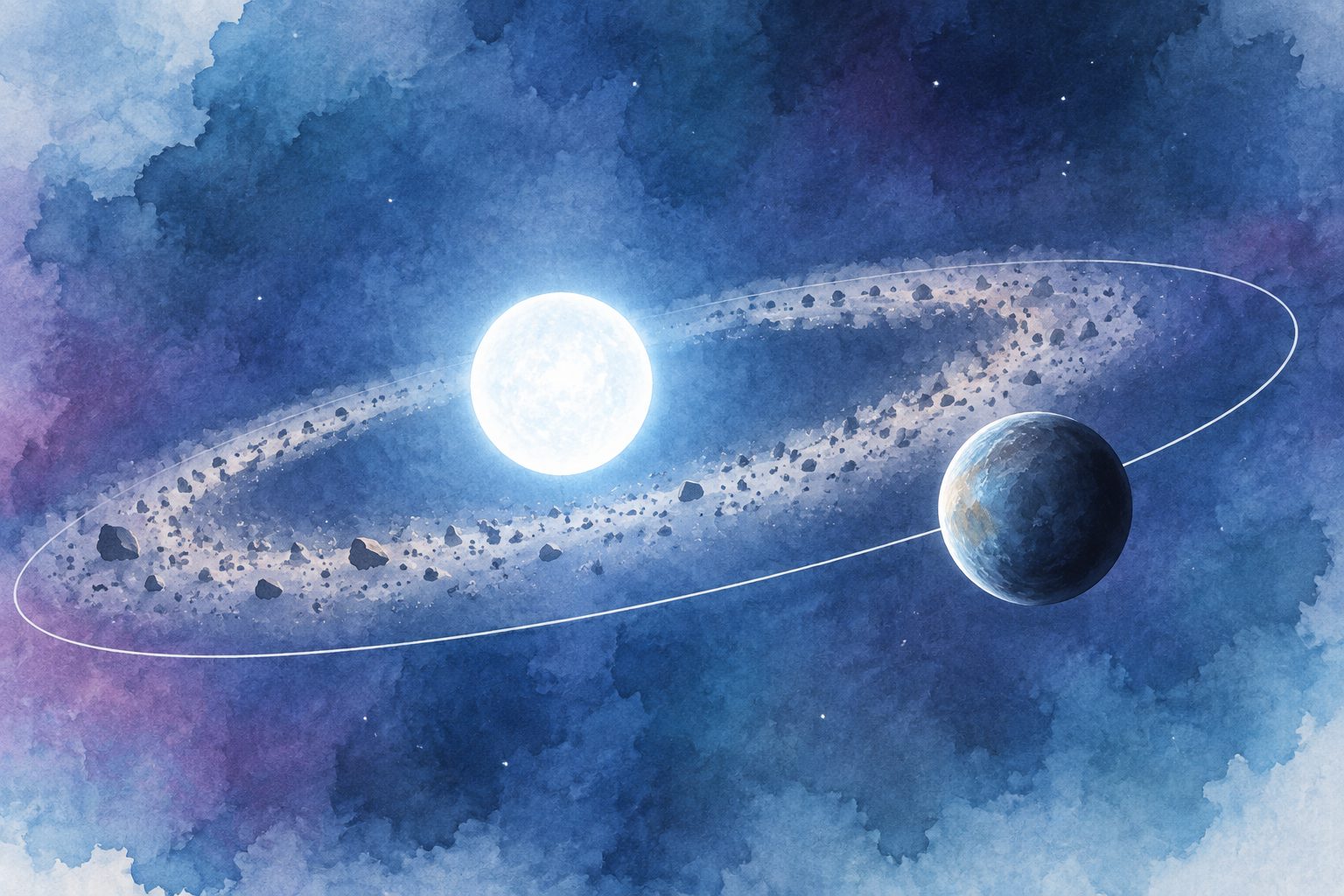
The planet candidate is feeding gas to the stellar remnant, and its unusual chemistry points to a later generation of planet formation.
White dwarfs can accrete debris from planetary bodies, leaving metals in their atmospheres. In HS 0209+0832, researchers found an unusual mixture: strong enrichment in elements including zinc, copper and niobium, alongside low levels of silicon and iron, unlike the composition of known Solar System bodies.
The researchers say this pattern is consistent with a second-generation planet, formed from material the star expelled during its giant phase. A 4.399 ± 0.026-day brightness variation, with an amplitude of 0.120% ± 0.018%, may come from heat changing across the planet's day and night sides or from a transiting tail of escaping gas.
An unusual planet signature
The white dwarf HS 0209+0832 is accreting material that is strongly enriched in trans-iron elements such as zinc, copper and niobium, but depleted in the rock-forming elements silicon and iron. The accreted material also shows a high enrichment of s-process elements, a chemical signature the researchers identify as distinguishing the candidate from first-generation planetary material.
The presence of helium in the white dwarf's atmosphere and the lack of terrestrial rock-forming elements suggest that the star is accreting the escaped atmosphere of a photo-evaporating giant planet candidate. Researchers also detected a sinusoidal photometric period of 4.399 ± 0.026 days at an amplitude of 0.120% ± 0.018%. They attribute this signal either to thermal emission changing over a planetary day-night cycle or to a transiting cometary tail from an evaporating gas giant.
Planets after a star's main life
Most planets are thought to form from material present while their star is being born. This candidate points to another possibility: a planet could form later from matter expelled when its parent star passed through its giant phase.
If the interpretation is correct, the system would show that close-in planets around white dwarfs can be chemically distinct from first-generation planets and can form after the star's main-sequence lifetime. It also provides a setting in which astronomers can study a planet losing its atmosphere to a white dwarf.
Evidence and open questions
The evidence combines the white dwarf's atmospheric abundances with photometric monitoring. The unusual elemental pattern is consistent with material from a second-generation planet, while the repeating brightness signal is consistent with either changing thermal emission from an orbiting planet or a transiting tail of escaping gas.
The object is described as a planet candidate, not a confirmed planet. The abstract does not establish which explanation for the photometric variation is correct, and the second-generation interpretation is based on the inferred chemical composition of material being accreted rather than a direct image of the planet. The result concerns one white dwarf system, so it does not show how common such planets are.
// Source
Nature Astronomy · 2026 · DOI: 10.1038/s41550-026-02983-7
Authors: Jack T. Williams, Boris T. Gänsicke, Nicholas Chamberlain Stone, D. Koester, Benjamin D. R. Davies, Christopher Tong, David J. Wilson, Snehalata Sahu, Andrew Swan, Thomas G. Beatty, S H Ramírez, Tim Cunningham, Knox S. Long
Institutions: University of Colorado Boulder, Laboratory for Atmospheric and Space Physics, Massachusetts Institute of Technology, University of Wisconsin–Madison, Hebrew University of Jerusalem, University of Warwick, Christian-Albrechts-Universität zu Kiel, Instituto de Astrofísica de Canarias, Space Telescope Science Institute, Center for Astrophysics Harvard & Smithsonian