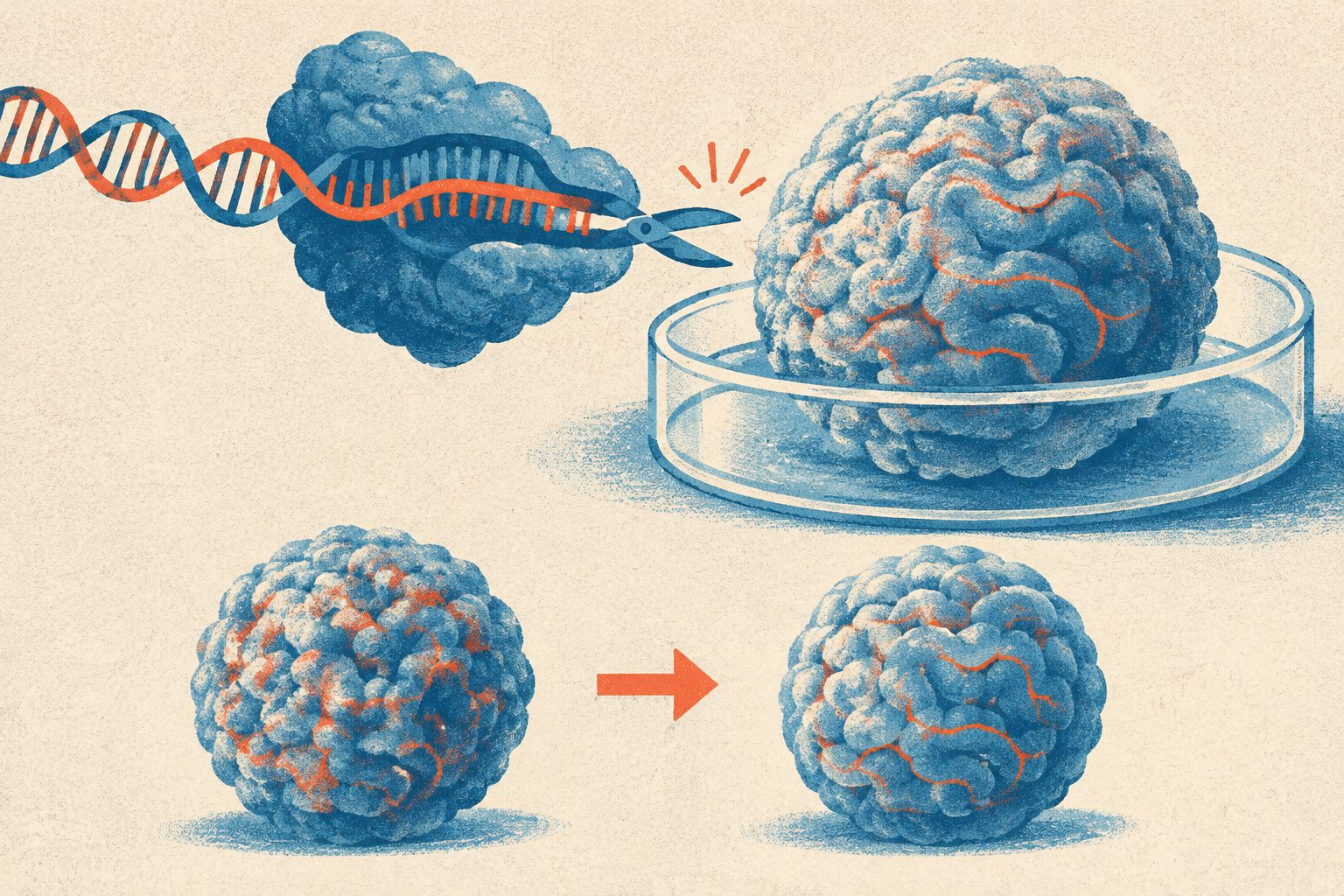
Activating regulatory DNA raised levels of two autism-linked genes in lab-grown human neurons and organoids.
The team mapped regulatory DNA regions called enhancers near CHD8 and SCN2A, then used them as targets for CRISPR-based gene activation. The approach was tested in excitatory neurons and cerebral forebrain organoids made from human pluripotent stem cells, which can develop features of the human brain in the laboratory.
In mutant neurons and organoids, enhancer targeting produced a sustained increase in the affected gene’s activity. The researchers report that this restored gene-expression levels and corrected mutation-associated changes in gene expression and physiology.
What the gene boost changed
The researchers studied haploinsufficiency, a condition in which one working copy of a gene is not enough for normal function, involving the autism-linked genes CHD8 and SCN2A. They targeted enhancers—stretches of regulatory DNA that help control gene activity—with CRISPR-based gene activation.
In human pluripotent stem cell-derived excitatory neurons and cerebral forebrain organoids, the approach produced a sustained increase in CHD8 or SCN2A expression specifically in the mutant cells and organoids. It restored gene-expression levels and rescued mutation-associated features, including changes in gene expression and physiology. The strategy used the remaining working copy of each gene and its normal regulatory system.
Why the approach matters
The findings support enhancer-targeted gene activation as a possible way to address some effects of haploinsufficient mutations in autism and other neurodevelopmental disorders. Rather than replacing a gene, the approach aims to increase activity from the working copy that is already present.
The results are limited to laboratory-grown human neurons and brain organoids, so they do not show whether the approach would work in people or whether it would be safe. They also concern two autism-linked genes and do not establish effects on the full range of autism-related traits.
Evidence and caveats
This was an experimental study in human stem cell-derived excitatory neurons and cerebral forebrain organoids carrying mutations in CHD8 or SCN2A. The researchers measured gene expression and physiological features after activating the genes through their enhancers, and reported rescue of mutation-associated changes.
The abstract does not report testing in animals or people, clinical outcomes, long-term safety, delivery to the brain, or effects beyond the modeled cellular and organoid features. Organoids and cultured neurons reproduce only some aspects of human neurodevelopment.
// Source
Nature Neuroscience · 2026 · DOI: 10.1038/s41593-026-02504-9
Authors: George T Chen, Aubrey J. Osorio, Sandra M. Holley, Kimiya Ghassemzadeh, Congyi Lu, Neville E. Sanjana, Carlos Cepeda, Daniel H. Geschwind
Institutions: University of California, Los Angeles, New York University, New York Genome Center