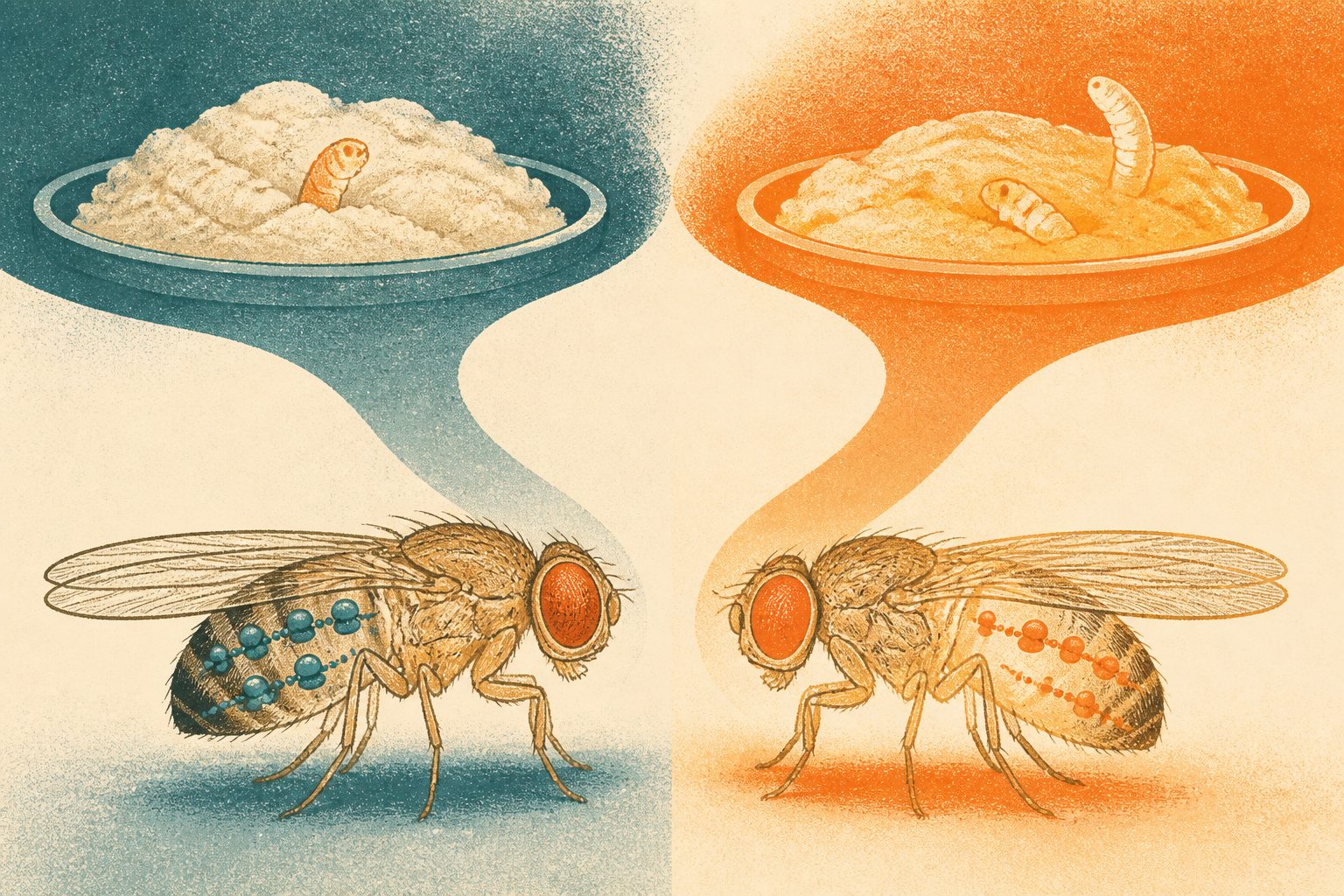
In fruit flies, restricting protein during the larval stage lowers a storage protein and later changes protein production and lifespan.
Researchers restricted protein intake during the larval stage and found that the flies lived longer as adults. The restriction reduced storage proteins, including larval serum protein 2, or Lsp2, and was associated with lower levels of ribosomal proteins and reduced protein-making activity early in adulthood.
Using dietary tracing, the researchers found that amino acids consumed as larvae remained in the flies into early adulthood and were incorporated particularly into ribosomal proteins. Silencing Lsp2 produced similar effects to early protein restriction, while restricting the amino acids phenylalanine or tyrosine was sufficient to reduce early-adult Lsp2 levels and promote longer life.
How early diet acts
Early-life protein restriction in Drosophila reduced storage-protein levels and extended adult lifespan. Amino acids obtained during the larval stage remained present into early adulthood and were incorporated into proteins, especially ribosomal proteins, which help make other proteins.
The researchers identified larval serum protein 2 (Lsp2) as a key link between early diet and adult physiology. Protein restriction durably reduced Lsp2 expression in early adulthood. Genetically silencing Lsp2 lowered ribosomal-protein abundance and protein-making activity, and extended lifespan in a way that resembled early-life protein restriction. Restricting phenylalanine or tyrosine, amino acids particularly enriched in the storage proteins, was also sufficient to reduce early-life Lsp2 and promote longevity.
Why the link matters
The findings identify a molecular mechanism by which nutritional conditions during development can influence adult biology. They suggest that Lsp2 carries part of the nutritional history from the larval stage into adulthood, linking early diet to adult protein production and lifespan in fruit flies.
The work helps explain how an early-life diet can have effects that persist across a developmental transition. Because the study was conducted in Drosophila, it does not establish whether the same mechanism affects aging or lifespan in humans.
Evidence and caveats
The study combines stable-isotope tracing, measurements of proteins and protein-making activity, genetic silencing of Lsp2, targeted amino-acid restriction and lifespan experiments in fruit flies. These approaches support a direct link between Lsp2, early-life nutrition and the measured adult traits.
The abstract does not report the sample sizes or detailed effect sizes. The evidence comes from Drosophila, so its relevance to other animals, including humans, remains unresolved.
// Source
Nature · 2026 · DOI: 10.1038/s41586-026-11031-3
Authors: Hina Kosakamoto, Rina Okada, Clive S. Barker, Ayako Isomura-Matoba, Jun Seita, Naoshi Dohmae, Koshi Imami, Fumiaki Obata
Institutions: Kyoto University, RIKEN Center for Sustainable Resource Science, RIKEN Center for Integrative Medical Sciences, RIKEN Center for Biosystems Dynamics Research