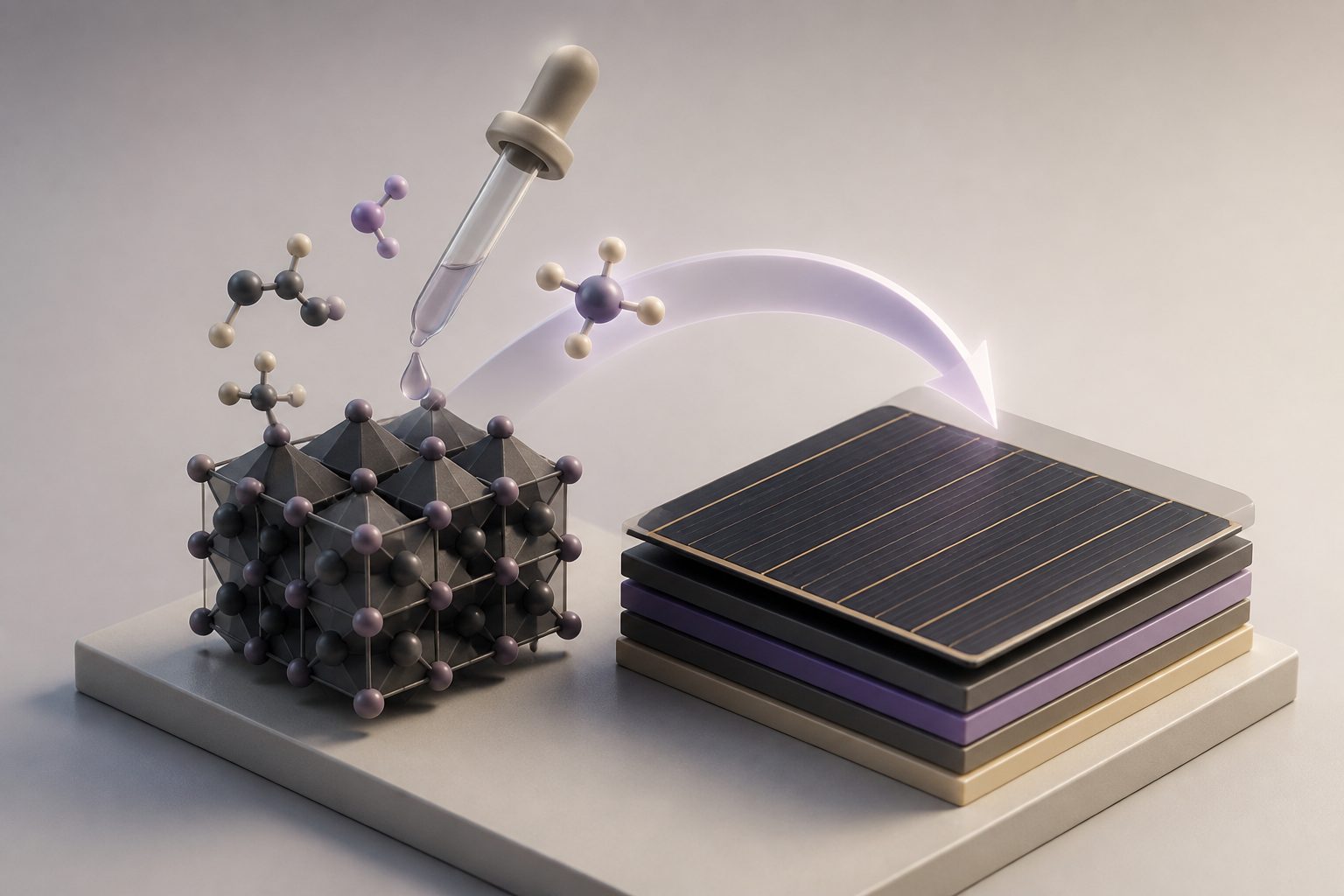
A precursor additive improved a wide-bandgap cell and helped an all-perovskite tandem retain performance in testing.
Wide-bandgap perovskites are used as the top cell in all-perovskite tandem solar cells, but their manufacture can produce defects and uneven crystallization. The researchers added 4-(3-carbamimidoylguanidino)benzoic acid hydrochloride, or CGBA, to the starting chemical mixture for cesium-formamidinium, bromine-rich perovskites.
The additive changed interactions among the starting materials during coating and heating. In the optimized 1.78-electron-volt cell, this helped control crystal growth, improve crystal orientation, reduce energy losses linked to defects and limit light-induced halide separation. The resulting tandem cell had a laboratory-measured efficiency of 29.63%.
What the chemistry changed
The optimized 1.78-electron-volt wide-bandgap single-junction cell reached a power conversion efficiency of 21.43% and a fill factor of 85.89%. The approach also produced reported efficiencies of 27.32% for a 1.53-electron-volt cell, 23.91% for a 1.68-electron-volt cell, 18.75% for a 1.85-electron-volt cell and 26.08% for a 1.58-electron-volt cell made without an antisolvent.
When used in the wide-bandgap subcell of a monolithic all-perovskite tandem, the strategy produced a laboratory-measured power conversion efficiency of 29.63%. Unencapsulated target devices retained 93% of their initial efficiency after 4,500 hours in nitrogen.
Evidence and caveats
This is a journal article reporting laboratory measurements of perovskite single-junction and tandem solar cells, along with a stability test on unencapsulated target devices. The abstract does not give the number of devices tested, statistical variation or comparisons with untreated controls. The reported stability result was obtained in nitrogen, and the abstract does not establish how the devices would perform under outdoor conditions, in air or over longer periods. The tandem result is described as laboratory-measured, not as a field demonstration.
// Source
Advanced Materials · 2026 · DOI: 10.1002/adma.75165
Authors: Kaixin Huang, Xianyong Zhou, Yintai Xu, Chao Xu, Hu Shen, Yajie Lei, Kai Yuan, Minhang Liu, Qing Zhong, Yuan Sheng, Jinbo Chen, Binbin Yu, Jing Li, Hanjian Lai, Zhixin Liu, Qifa Zheng, Lei Yan, Baomin Xu, Xingzhu Wang, Chang Liu
Institutions: University of South China, Southern University of Science and Technology, Xiangtan University, Energy Storage Systems (United States)