Physics and Astronomy · Astronomy and Astrophysics

Origins and Evolution of Life

Log in to follow
Abstract editorial illustration accompanying the article: Thick, cold oceans may have favored multicellular green algae

Thick, cold oceans may have favored multicellular green algae

Laboratory populations of unicellular green algae evolved motile multicellular forms in water with Snowball Earth-like viscosity. The results suggest that thick, cold oceans may have favored larger, collectively moving organisms during an important period in the evolution of multicellular life.

·23 views
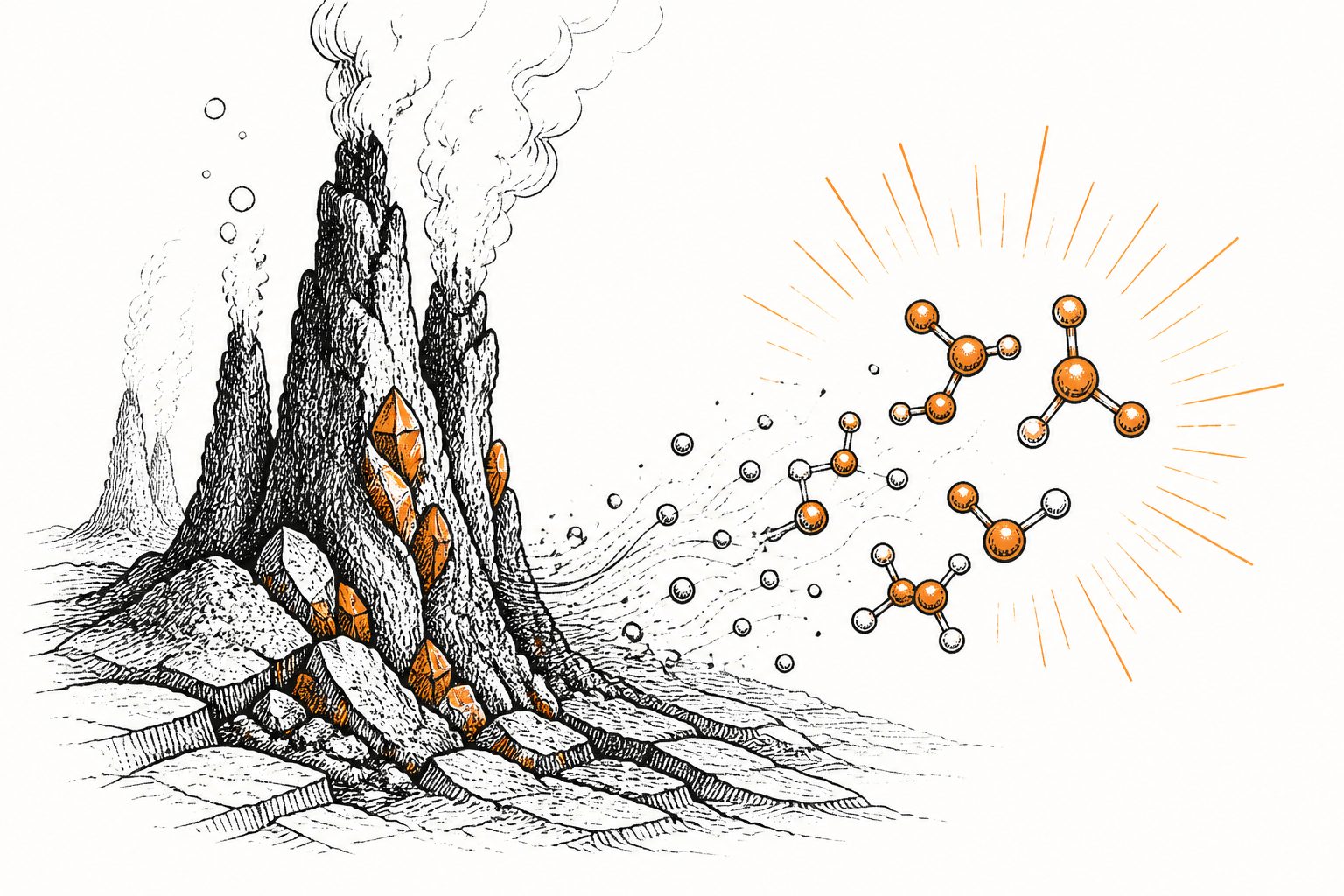
Abstract editorial illustration accompanying the article: A shared chemical reaction helped form both peptides and RNA-like chains

A shared chemical reaction helped form both peptides and RNA-like chains

A study found that amino acids and nucleotide building blocks could jointly produce short peptides and oligonucleotides in one-pot reactions under prebiotic conditions. The linked chemistry formed a reactive intermediate that was associated with greater amounts of some oligomers than reactions using either type of building block alone.

·61 views
Abstract editorial illustration accompanying the article: DNA May Carry Three Overlapping Layers of Information, Study Proposes

DNA May Carry Three Overlapping Layers of Information, Study Proposes

A Zenodo article proposes that DNA carries three overlapping information layers: one that specifies amino acids, another that affects how quickly proteins are made and folded, and a third linked to molecular stability and helix shape. An analysis of five human genes found broad compositional patterns at sites where the code allows multiple DNA sequences, with BRCA1 as a reported exception.

·48 views
Abstract editorial illustration accompanying the article: Earth’s earliest clues and lab chemistry suggest no single place made life

Earth’s earliest clues and lab chemistry suggest no single place made life

A review of evidence from Earth’s Hadean era and experiments on prebiotic chemistry finds that no single environment on early Earth appears to meet all the conditions needed for life to begin. Instead, the paper argues that multiple, connected processes across different settings likely helped build and stabilize the molecules that later became biology.

·59 views