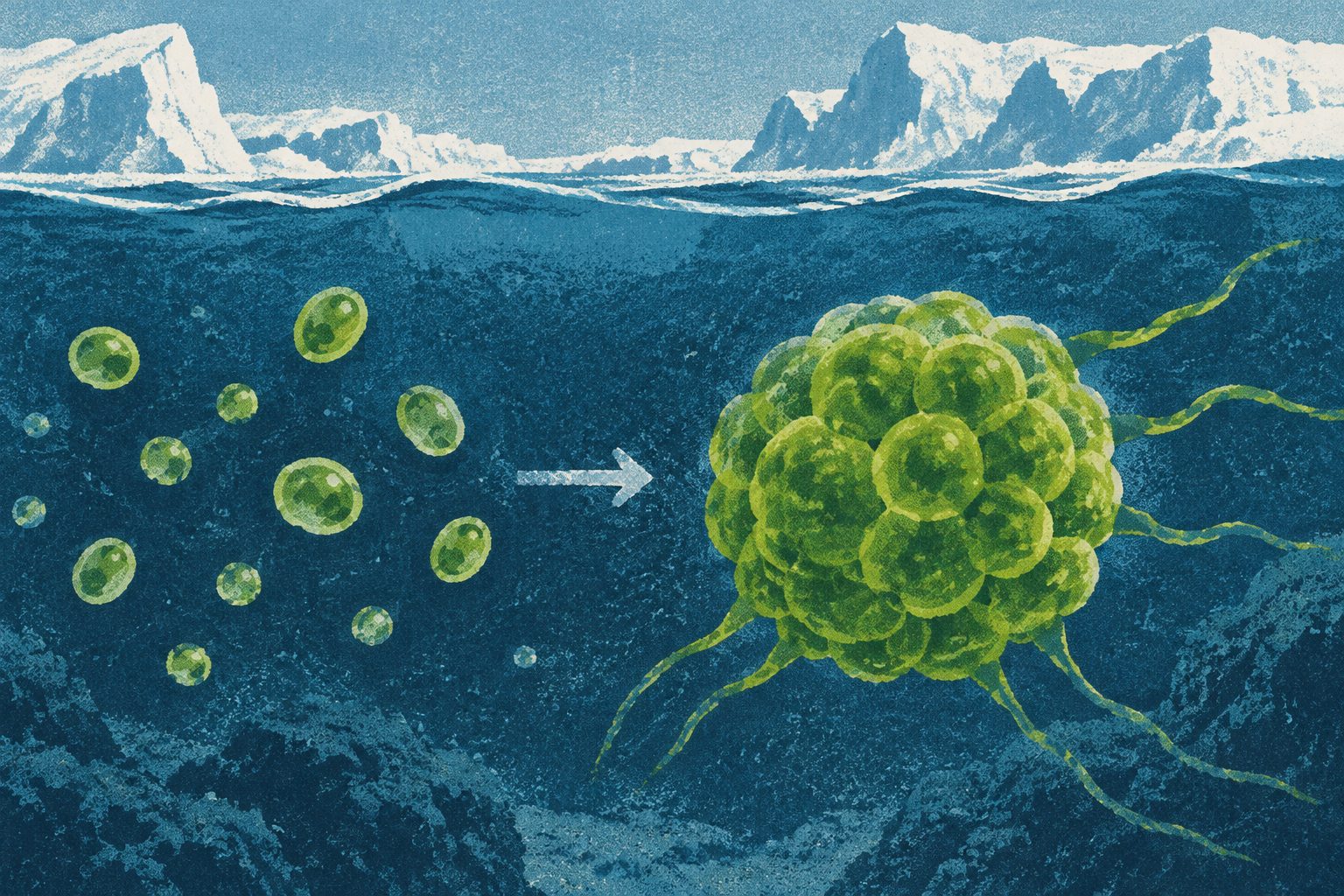
Experiments suggest that Snowball Earth-like water viscosity helped motile groups of algae move and acquire nutrients.
During the Cryogenian Snowball Earth glaciations, oceans beneath global sea ice may have become more than three times as viscous as modern water. Researchers tested whether this physical change could have made multicellularity advantageous by evolving unicellular green algae under high-viscosity conditions.
The populations evolved motile multicellular forms, along with other changes linked to size and speed. In the experiments, individual cells slowed as viscosity increased, while multicellular groups maintained their speed. The researchers propose that collective movement could have helped early multicellular organisms balance the energy costs of movement with the need to acquire nutrients.
What the algae evolved
Under Snowball Earth-like viscosities, populations of unicellular green algae evolved motile multicellular forms. The evolved populations also showed other phenotypes that optimized size and speed. Experiments found that increasing viscosity reduced the speed of single cells but had a much smaller effect on multicellular groups. Multicellular groups in thick water moved at speeds similar to those of single cells in less-viscous water, matching a theoretical expectation about the balance between movement and nutrient acquisition.
When the algae were returned to lower-viscosity conditions, multicellular forms remained present over the generations examined, providing evidence that the physical trait was heritable at the level of morphology. The researchers did not directly test the genetic basis of that inheritance.
Why thick water matters
The findings identify water viscosity as a possible ecological pressure that could have favored motile multicellular life during the Cryogenian Snowball Earth interval. Larger groups made up of cooperating flagellated cells could move through thick water more effectively than single cells, potentially easing constraints on movement and nutrient uptake.
This offers one possible explanation for why some multicellular algal groups increased in size, diversity and morphological variety around this period. It does not establish that viscosity caused the origin or later dominance of multicellular lineages, but it provides an experimentally supported mechanism that could have contributed to those changes.
Evidence and caveats
The study used experimental evolution with populations of a modern photosynthetic green alga exposed to different water viscosities, together with measurements of cell size and movement. The results matched theoretical expectations that viscosity would affect single-cell movement more strongly than collective movement. The researchers note that direct measurements of nutrient balance would still be needed.
The experiment used one modern organism from a lineage that has multicellular relatives, so its relevance to animals and early multicellular lineages is uncertain. The study assessed morphological rather than genetic heritability, and its sampling captured only part of the wider population-level variation. The results therefore show a possible mechanism, rather than a direct reconstruction of Snowball Earth evolution.