A zinc-based material retained 79% of its capacity after 500 charge-discharge cycles while operating at 4.5 volts.
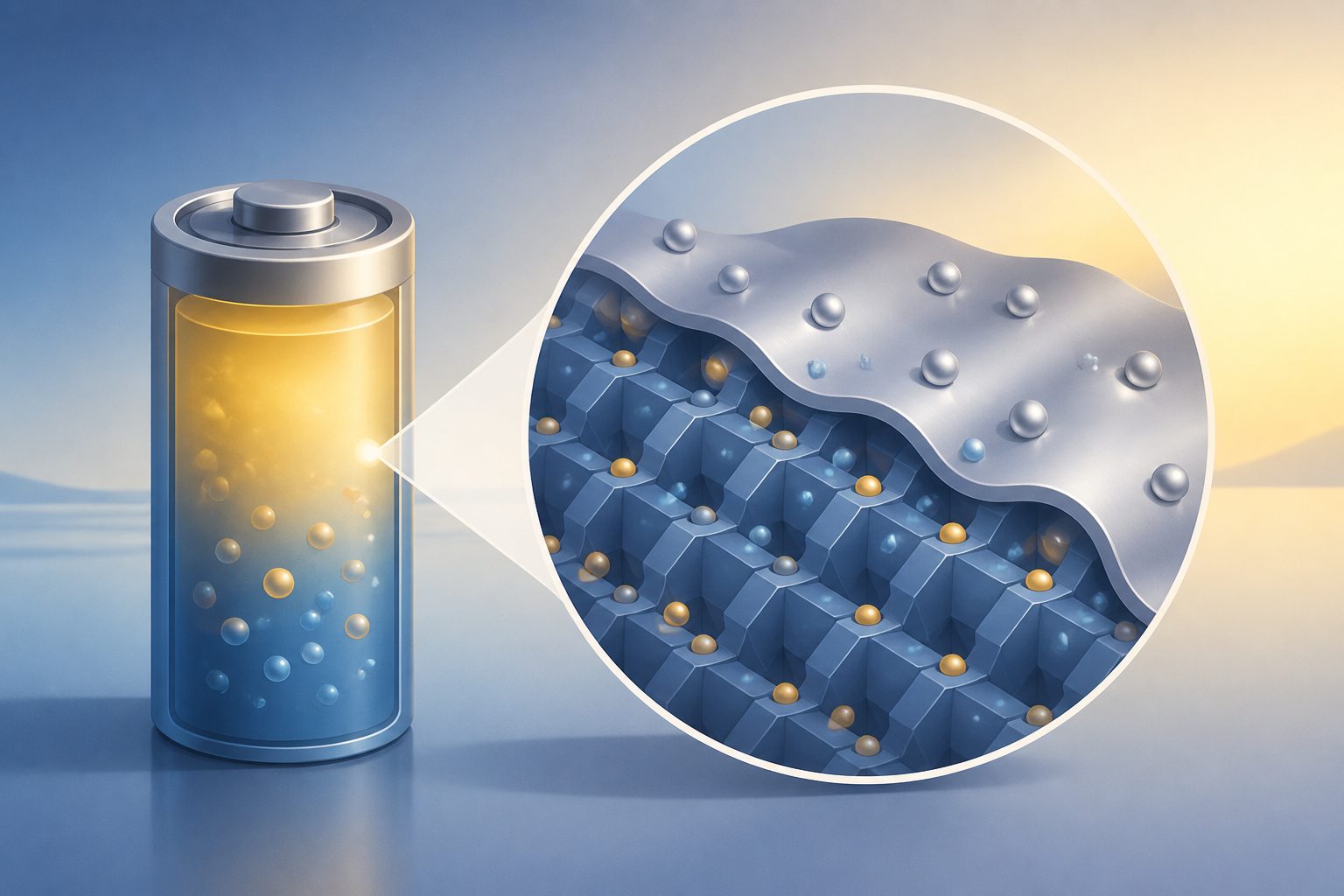
The study examines zinc nitroprusside, a material with an open framework that can host sodium ions. The researchers say incorporating zinc improved the framework’s structural stability during high-voltage operation, addressing capacity loss and limited cycle life seen in conventional Prussian blue analogs.
The material retained 79% of its capacity after 500 cycles at a charge-discharge rate of 1C, or 91 milliamps per gram. At a lower rate of 0.1C, it delivered a maximum discharge capacity of 69.4 milliamp-hours per gram.
What the zinc material does
The researchers synthesized zinc nitroprusside, Zn[Fe(CN)5NO], through coprecipitation, a process in which dissolved chemical compounds are combined to form a solid. They report that zinc incorporation stabilized the material’s large-channel structure during operation at 4.5 volts. The cathode retained 79% of its capacity after 500 cycles at 91 milliamps per gram, equivalent to 1C, and reached a maximum discharge capacity of 69.4 milliamp-hours per gram at 9.1 milliamps per gram, or 0.1C.
Evidence and caveats
This is a journal article reporting laboratory tests of a synthesized cathode material. The abstract provides cycling, voltage, rate-performance and capacity results, but it does not describe a complete commercial battery, long-term performance beyond 500 cycles, production at large scale, safety testing or a direct comparison with specific competing cathodes. The reported results therefore show the material’s performance under the stated test conditions rather than demonstrating readiness for commercial batteries.
// Source
ACS Omega · 2026 · DOI: 10.1021/acsomega.6c02046
Authors: João Frederico Alves, Hugo Cruz, Miguel Duarte, Yonny Romaguera Barcelay, Walter Ricardo Brito, Teófilo Rojo, Jorge F. J. Coelho, Adélio Mendes, M. Goreti F. Sales
Institutions: Universidade do Porto, University of the Basque Country, University of Coimbra, Hospital San Pedro