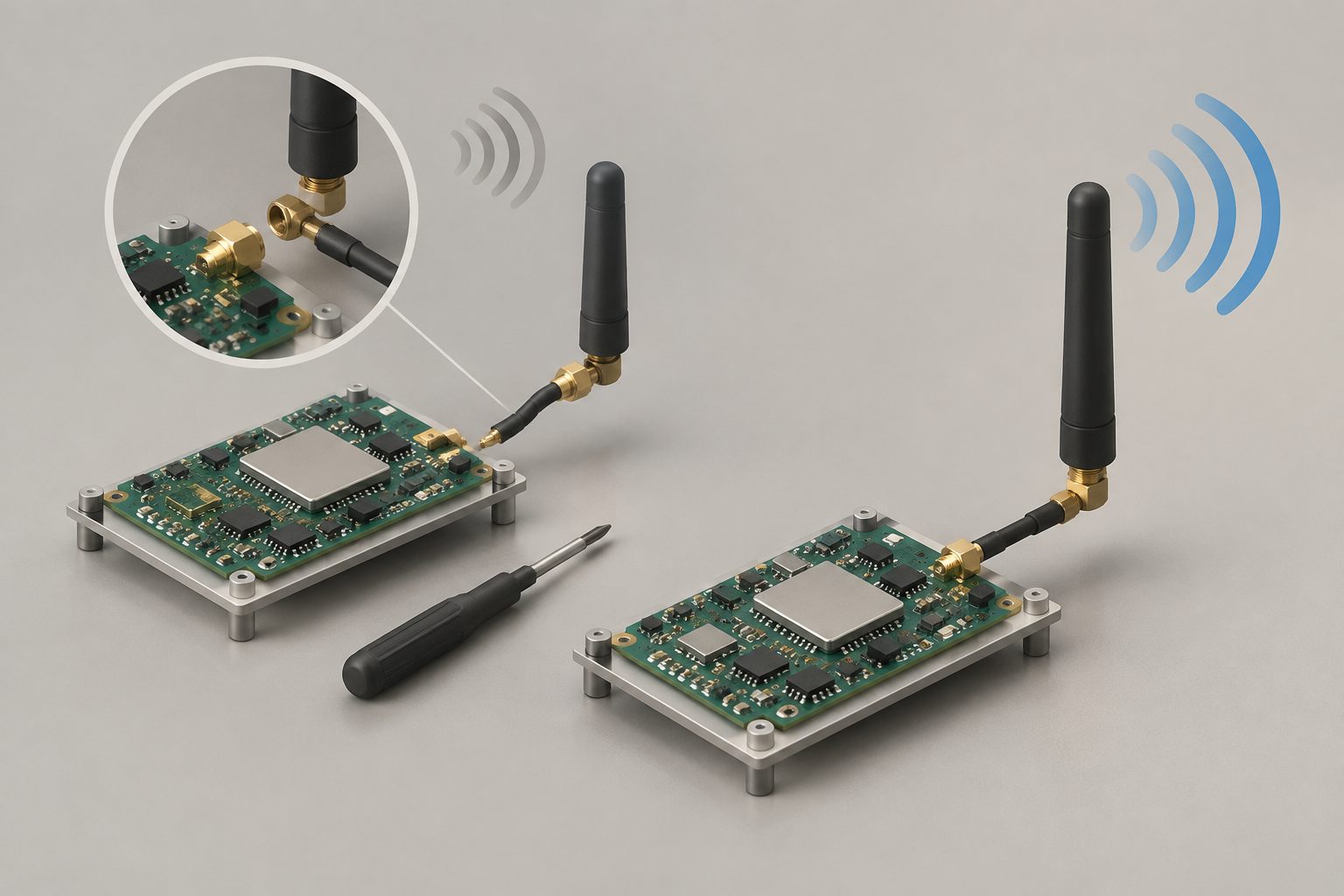
A two-step adjustment brought the prototype’s ability to detect weak signals to within 0.1 decibels of its design target.
The paper presents a workflow for measuring and modeling signal reflections at multiple points in a wireless radio, including the power amplifier, low-noise amplifier, antenna, switches and connecting lines. It combines component measurements and simulations to estimate how these losses affect the full wireless link.
Applied to a short-range Bluetooth 5.0 prototype, the framework predicted a receiver sensitivity shortfall of 3.2 decibels from the antenna-to-amplifier connection. Two rounds of matching-network correction restored sensitivity to within 0.1 decibels of the design target.
Evidence and limits
The study presents a modeling framework using network-analyzer measurements, simulations, load-pull testing and noise-figure measurements, then validates it on one Bluetooth 5.0 short-range wireless prototype. The reported correction closely matched the design target in that application, but the abstract does not report validation across multiple prototypes, wireless standards or operating conditions. The results therefore support the framework’s use in this demonstrated case, without establishing how well it will perform in every wireless system.
// Source
INTERNATIONAL JOURNAL OF COMPUTER SCIENCE AND MATHEMATICAL THEORY E-ISSN · 2026 · DOI: 10.56201/ijcsmt.v10.no2.2024.pg62.116
View paper (DOI)Published 2026-11-13 Authors: Robert Quainoo
Institutions: Northeastern University