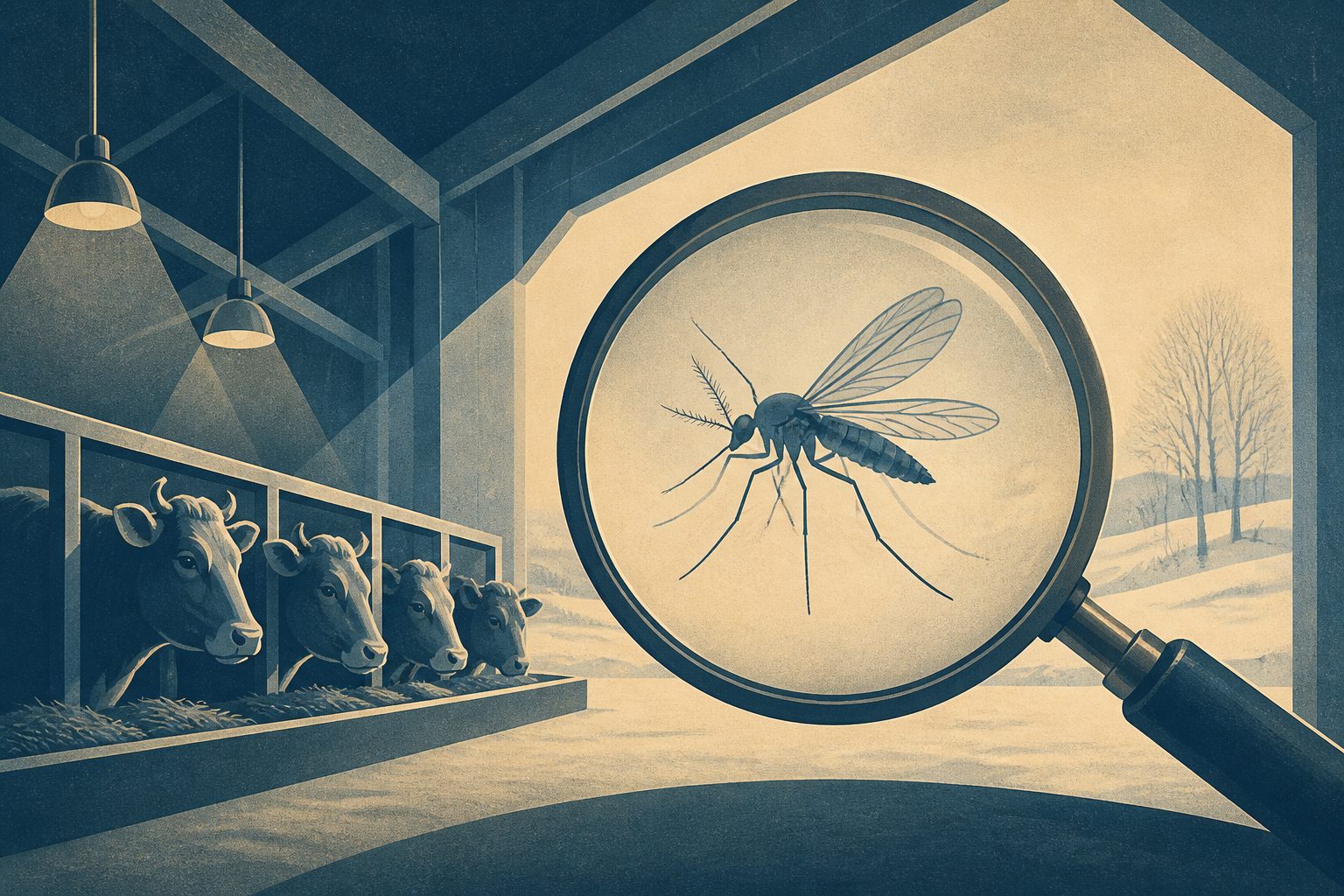
Across four winters, researchers found active, blood-feeding midges but detected bluetongue virus in only one sample.
Researchers monitored biting midges once a week at livestock facilities across Germany during four winters from 2021 to 2025. They found that 95% of captures occurred in November and March, while December through February produced only 5% of captures.
Blood-fed females were present, sometimes above the European threshold used to define a midge-free period. However, only one sample, collected in November 2024, tested positive for bluetongue virus type 3. The findings suggest that transmission to ruminants by midges during the central European winter is negligible, but they do not explain how the virus survives until spring.
What the midges carried
The study collected 46,358 female midges in 1,581 samples from cattle, sheep, goat and horse housing at 12 to 55 locations during four consecutive winters. November and March accounted for 95% of all captures; January and February each accounted for 1%. Blood-fed females were very rare in the middle of winter, but their numbers often exceeded the European threshold of fewer than five parous midges per trap and night for a vector-free period. Only one sample, from November 2024, contained bluetongue virus type 3 RNA. All other samples were negative for bluetongue virus, Schmallenberg virus and epizootic hemorrhagic disease virus.
Evidence and open questions
This was a four-year surveillance study using weekly light traps at livestock facilities across Germany, combined with temperature records and real-time PCR testing of pooled midges. The study covered conditions before and during a bluetongue virus type 3 outbreak, but only one of 1,581 pools tested positive, so the findings provide limited evidence about rare winter transmission events. Midges were assigned to broad species groups rather than identified individually, and the study measured insect activity and viral RNA rather than directly demonstrating transmission to animals. Variation in locations and the addition of monitoring sites may also have contributed to differences in activity, particularly in March 2024 and 2025.