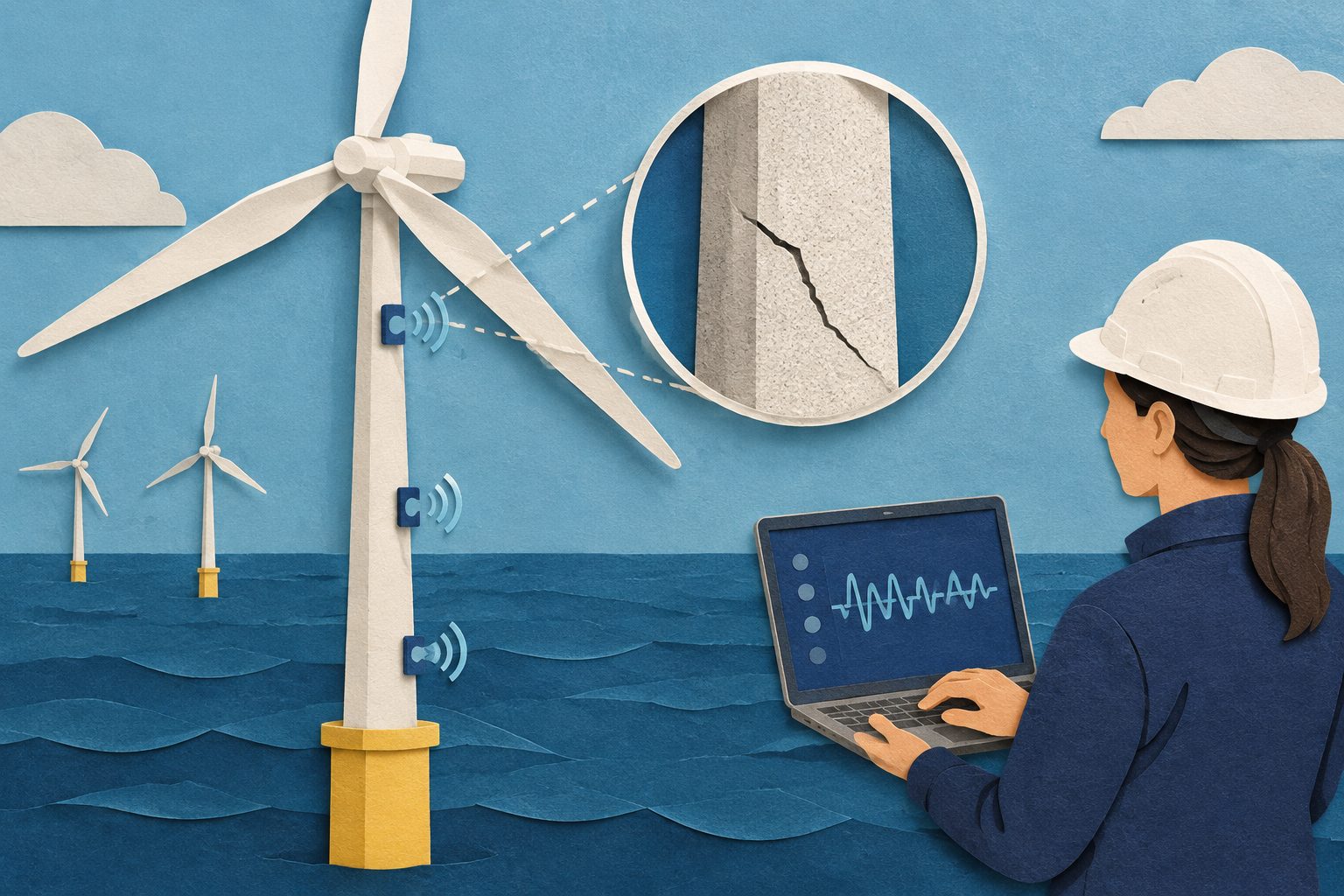
A six-month study found that compressed stress records can closely match full, high-speed measurements when cycles are preserved across data windows.
Researchers compared several ways to estimate fatigue damage from wind-turbine measurements, using six months of data from two tower sections on an instrumented onshore turbine. They compared full high-speed measurements with data summarized in windows as short as 15 seconds, while testing different ways to account for stress cycles that cross window boundaries.
Simply shortening the usual 10-minute data window did not improve the estimate. A method that preserved the continuity of those cycles recovered 99.5% of the full-measurement baseline, while two more heavily compressed methods recovered 98.8% and 96.2%.
How the data performed
The researchers used continuous rainflow cycle counting on the full stress record as their comparison baseline. Conventional counting on 10-minute windows recovered 76.3% of that baseline damage, while using 15-second windows alone recovered only 25.8%, because shorter windows cut up the slow stress cycles that contribute substantially to accumulated fatigue.
A modified low-frequency fatigue dynamics method preserved cycle continuity between windows and recovered 99.5% of the baseline damage. Two reduced-data approaches also performed closely: the start-peaks-valleys-end method retained 98.8% of the baseline damage, and a method using only each window’s maximum and minimum retained 96.2%. The comparisons covered different window lengths, sampling rates and two fatigue-curve standards, Eurocode 3 and DNV.
Why simpler monitoring matters
Full, high-speed strain records provide detailed fatigue estimates but are costly and demanding to store and process continuously across large fleets. The results indicate that shorter, second-resolution operational records—especially when processed to preserve cycles spanning data windows—could support more data-efficient fatigue monitoring.
That may make it easier to assess the remaining life of ageing turbines using measurements that are more practical to collect across a fleet. The study does not show that any particular turbine can safely remain in service beyond its design life; it evaluates methods for estimating the fatigue damage used in such assessments.
Evidence and caveats
The study benchmarked alternative methods against continuous rainflow counting, using six months of 50-hertz strain and operational measurements from two tower sections of one onshore wind turbine in central Portugal. It tested several data summaries and fatigue-curve formulations, rather than conducting a long-term fleet-wide deployment.
Because the evaluation involved one turbine, two instrumented tower sections and a six-month period, the reported accuracy may not represent all turbines, components, operating conditions or environments. The full-strain baseline was also used as the reference, so the findings concern agreement with that baseline rather than a direct prediction of when a turbine will fail or how much life it has left.