Wind farms changed local winds in forecasts, while nighttime temperatures shifted both ways
A Europe-wide modelling study found that including onshore and offshore turbines altered predicted winds and sometimes warmed or cooled nighttime air.
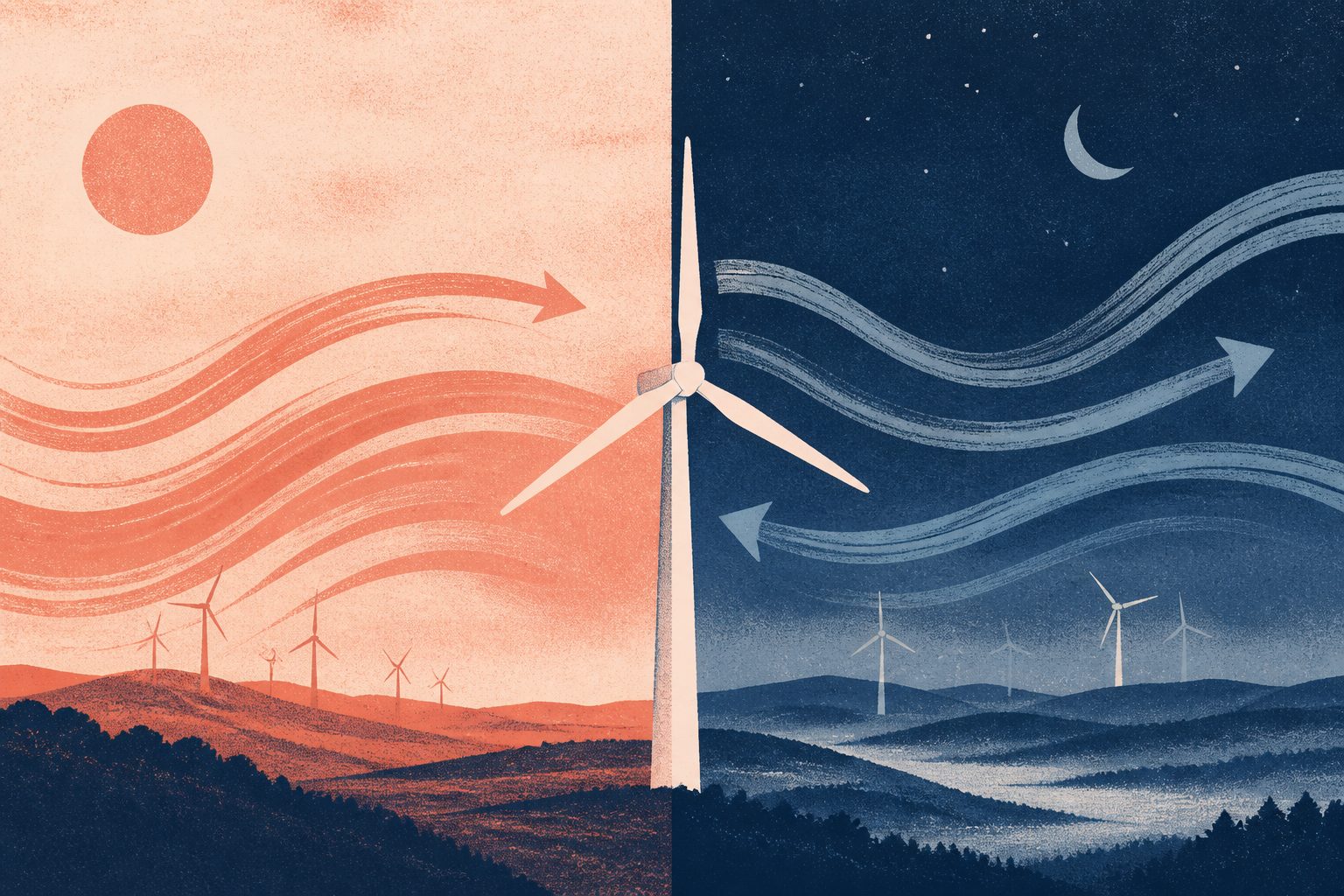
Editorial illustration — not from the study.
Researchers used the HARMONIE-AROME weather model to run 48-hour forecasts for Northern Europe every 12 hours across separate summer and winter months. They built a European wind turbine database from eight sources and tested forecasts with both onshore and offshore turbines, as well as offshore turbines alone.
Including wind farms reduced simulated wind speeds at turbine hub height near wind farms. Onshore turbines produced a wake effect that was large enough in strength and area to matter for wind forecasts. The modelled temperature effect near the surface was small across the two months overall, but at times the two wind-farm methods produced opposite nighttime effects: warming with one method and cooling with the other.
How turbines changed forecasts
The forecasts that included wind-farm effects showed strong reductions in wind speed near wind farms at turbine hub height. Differences between forecasts that ignored wind farms and those using a wind-farm parameterization were statistically significant for many onshore and offshore farms.
Onshore turbines had a non-negligible wake effect, meaning their influence on wind extended beyond the immediate turbine location and was large enough to affect accurate wind forecasting. Of the two methods tested, the method developed by Fitch and colleagues in 2012 compared best with observations across all sites, particularly at measurement masts and lidar sites close to wind farms.
The average effect on near-surface temperature over the two study months was small, but it was considerable during some periods. The two methods produced opposing nighttime temperature effects, with one indicating warming and the other cooling.
Why local wind forecasts matter
Wind farms can affect the weather conditions that forecasting systems are designed to predict, not only at offshore sites but also on land. The results indicate that leaving onshore turbines out of a forecast can miss a meaningful wake effect, while including wind-farm information may change local wind predictions near turbines.
More accurate wind forecasts are relevant to understanding local weather and to forecasting wind power, although this study did not assess changes in electricity production or grid performance. The opposing nighttime temperature responses also show that the choice of wind-farm method matters when interpreting temperature effects.
Evidence and study limits
This was a numerical weather-modelling study supported by comparisons with observations at several types of sites, including masts and lidar locations. The researchers ran sequential 48-hour forecasts every 12 hours for Northern Europe during separate summer and winter months chosen to represent the region's 30-year wind climate reasonably well. They tested two wind-farm parameterizations and scenarios with both onshore and offshore turbines or offshore turbines alone.
The findings are therefore specific to the HARMONIE-AROME model, the tested wind-farm methods, the European turbine database and the selected Northern European periods. The abstract does not provide the number of turbines, farms or observation sites, nor does it establish how the results would vary in other regions, seasons or weather conditions. The opposing temperature effects also indicate uncertainty linked to the parameterization used.
// Source
Geoscientific model development · 2026 · DOI: 10.5194/gmd-19-8115-2026
Two years after the Kakhovka dam breach, the former reservoir bed had changed from a largely exposed, degraded surface into a landscape mosaic with much more vegetation and less residual water. Satellite data also showed that substantial areas still faced thermal and moisture stress.
Researchers designed a control system for coordinating extra robotic limbs with a person’s natural limbs. In simulations, the system stayed stable, shared effort between the person and the robotic limbs, and kept tracking errors low across varied conditions.
Researchers created hydrogel composites that can be reshaped in water by changing the direction of polarized light. The cubes stretched to as much as twice their original side length, and the team made microscopic wells that could fully close.