When disaster news helps or harms older adults’ preparedness
The review finds crisis coverage can boost risk understanding and emergency planning—or fuel anxiety and delay action, depending on the message and how people consume it.
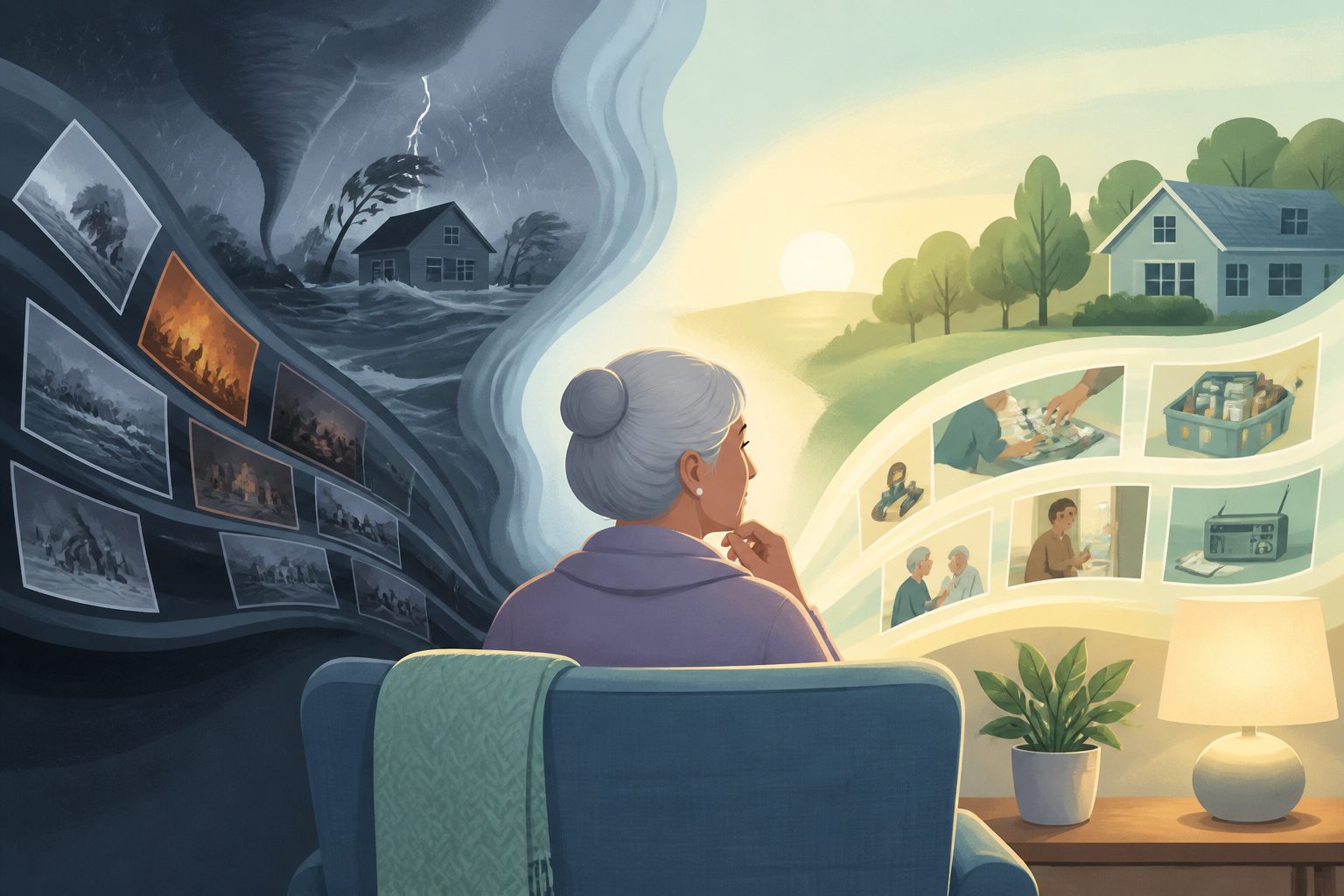
Editorial illustration — not from the study.
Older adults are more likely to be affected by disasters, and media can play a dual role: it can spread timely guidance, but it can also intensify anxiety and undermine preparedness when coverage is distressing or inaccurate.
Synthesizing 36 sources (28 peer-reviewed studies and 8 guidelines or reports), the review describes three related pathways. It emphasizes the need for age-tailored risk communication that limits “always-on” distressing coverage, offers plain-language steps, uses trusted local messengers, and corrects misinformation while providing practical support.
How media exposure shifts outcomes
Across diverse studies, the review reports three pathways linking crisis media exposure to preparedness and resilience in older adults.
First, when information comes from trusted sources and includes concrete, feasible steps, media exposure is associated with better risk appraisal and preparedness actions, such as making emergency kits, building medication buffers, and planning evacuations.
Second, repeated or prolonged exposure to graphic or sensational coverage is associated with higher stress and anxiety, including among people who are indirectly exposed. The review describes evidence of a feedback loop in which distress increases further media consumption.
Third, preparedness and resilience through digital channels depend on digital health literacy and misinformation management—digital formats can enable or obstruct action depending on whether people can judge and handle misinformation.
The review also outlines communication approaches aimed at supporting coping: using multiple accessible channels (including television/radio plus simple digital formats), limiting “always-on” distressing coverage, providing plain-language stepwise guidance, emphasizing response efficacy and self-efficacy, and integrating rapid misinformation correction with practical services.
Guidance for age-tailored risk messages
Because older adults may rely heavily on media during disasters, how coverage is delivered can influence both what people do and how they feel. The review’s synthesis points to communication choices—trust, clarity, practicality, and managing distress and misinformation—that can help support preparedness without unnecessary distress.
Narrative review evidence and caveats
This is a narrative review that synthesized evidence from 36 sources, including 28 peer-reviewed studies and 8 guidelines or reports, searched across major databases from January 2000 through July 2025. The included research varied in design, so the conclusions are presented as converging pathways rather than as single pooled effect estimates.
As a narrative review, it does not provide the same level of certainty as a systematic review with formal meta-analysis, and the abstract does not specify which specific studies drove each pathway most strongly. The review’s findings apply to the relationships described in the included literature, but the abstract does not quantify how consistently each pathway appears across all disaster types and media platforms.
// Source
Discover Public Health · 2026 · DOI: 10.1186/s12982-026-02620-8
People have fished for tuna for about 44,000 years and billfish for about 10,000 years, according to a global review of archaeological evidence. But sustained, intensive fishing in offshore and oceanic waters appears to have developed mainly during the past 200 years.
People considering whether to leave flood-prone coastal communities weigh disastrous flooding and rising costs alongside crime, healthcare and proximity to family and friends. In a survey of 182 respondents, most said they would not relocate, while others said they would move immediately or in the future.
A study of eight managers found that they preferred human coaches for reflective questioning, even though they welcomed that approach from a person. When the same coaching protocol came from an AI system, they wanted it to provide answers instead.