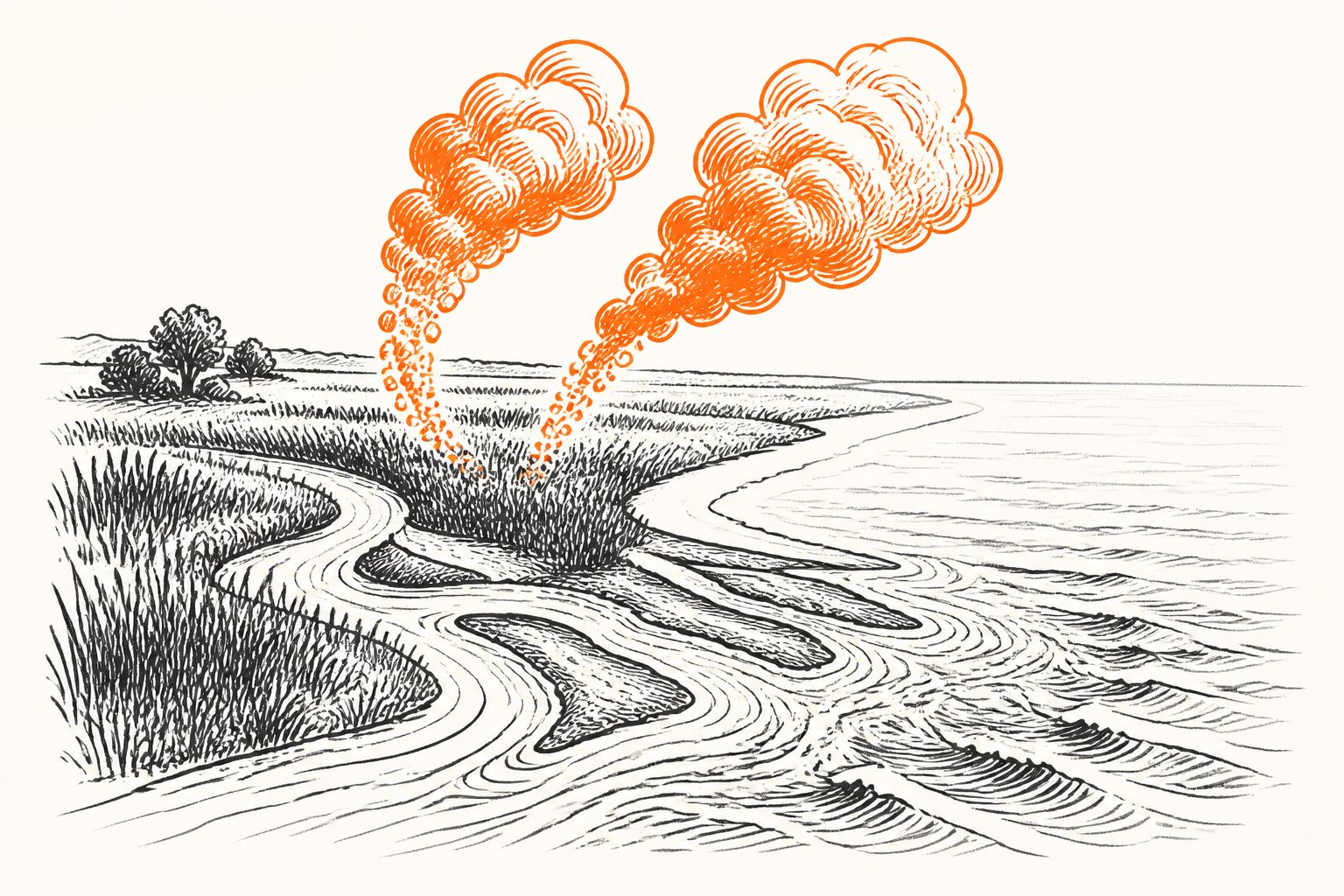
Slow-moving channels and carbon-rich wetland water intensified carbon dioxide changes in the river’s final stretch to the sea.
Researchers measured oxygen and carbon dioxide dynamics every 15 minutes in the Danube Delta over two years, using stations in the three main river reaches and, for an additional year, in three channels within the delta. They found much stronger daily metabolic cycles in the delta’s slower-flowing channels than at the upstream river station.
During spring floods, oxygen-poor and carbon dioxide-rich wetland water made up as much as 13%–25% of downstream water at some stations. The combined effects of metabolism within the delta and wetland discharge doubled carbon dioxide emissions near the river mouth compared with the upstream Danube station.
What the delta changed
Daily oxygen and carbon dioxide fluctuations differed by a factor of 100 across stations and seasons. The delta’s slow-flowing channels had median daily metabolic-cycle amplitudes 4–8 times larger than those at the upstream river station, and metabolism there was, on average, 3–4 times more sensitive to water temperature and cloud cover.
Wetland discharge was most pronounced during spring floods, with apparent mixing ratios of up to 13%–25%, depending on the station. In a channel draining wetland waters, average carbon dioxide supersaturation was almost an order of magnitude higher than in the Danube inflow. Together, intense metabolism and wetland discharge doubled aquatic carbon dioxide emissions near the river mouth. At the landscape level, however, carbon drawdown is likely five times larger than aquatic carbon dioxide emissions.
Evidence and caveats
The study used high-resolution sensor measurements of oxygen and carbon dynamics collected every 15 minutes over three years: two years in the Danube Delta’s three main river reaches and one additional year in three delta channels. The researchers analyzed daily cycles and relationships between the measurements to assess metabolism and water exchange.
The abstract does not give the absolute carbon dioxide emission rates, measurement uncertainties or details of how the landscape-level carbon drawdown was estimated. The results come from the Danube Delta and may not apply in the same way to other deltas. The study also relies on field time-series measurements rather than a controlled experiment.