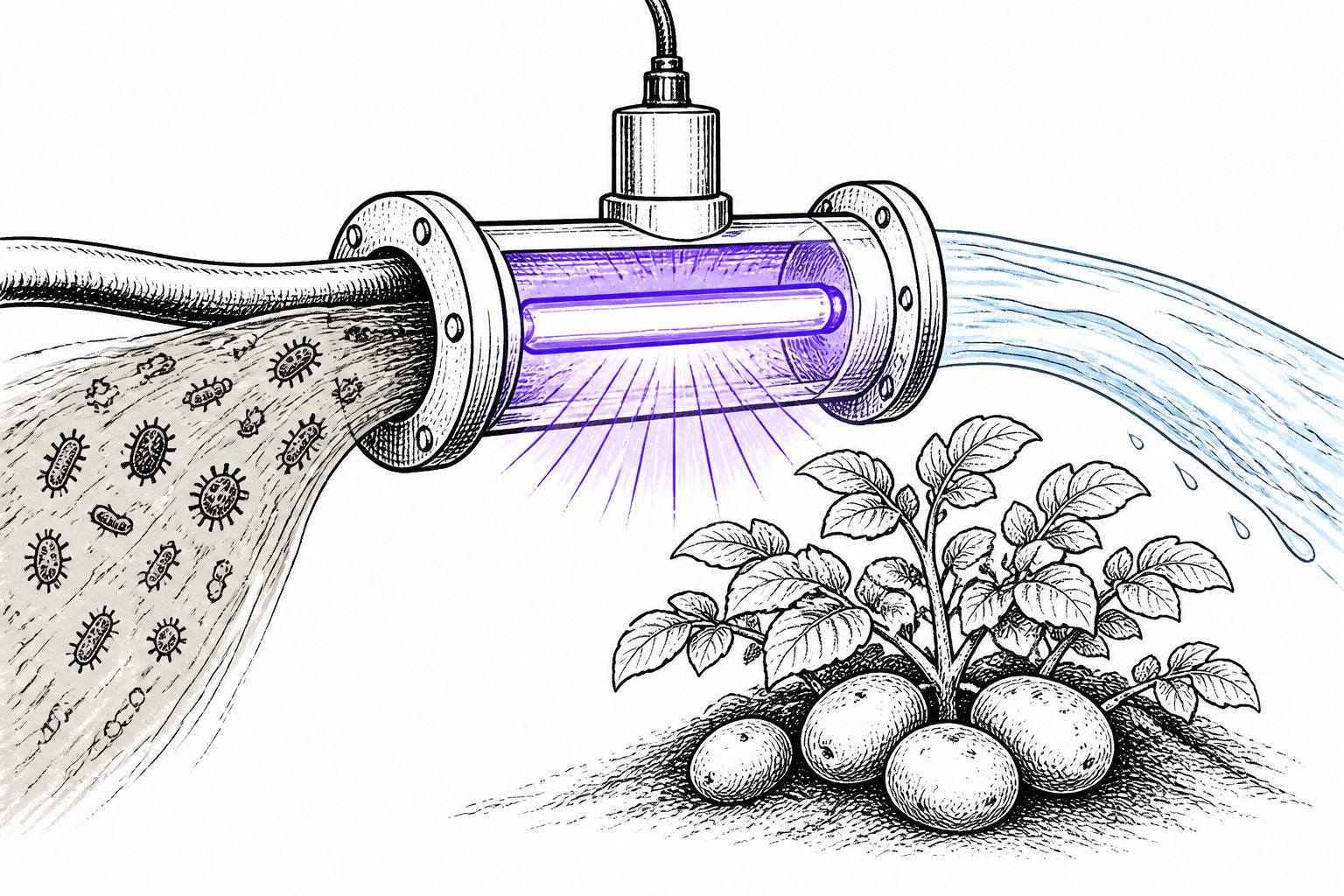
Researchers tested and optimized a multi-processor ultraviolet-C reactor for treating surface irrigation water that can carry bacteria linked to potato disease. The water required pre-filtration because its turbidity and suspended material reduced the passage of ultraviolet light; a 5-micron sediment filter improved ultraviolet transmission from 75% to 85%.
Biology1 week ago
Ultraviolet treatment cut potato pathogens in irrigation water by 99.99%
A reactor using ultraviolet light reduced the bacteria that cause potato brown rot and soft rot, while treated water suppressed disease in plant tests.
What the light treatment did
The optimized reactor setting used 270 watts of lamp power and a flow rate of 35 cubic meters per hour. It delivered an ultraviolet dose of 52.54 millijoules per square centimeter and achieved a 4-log reduction in both Ralstonia solanacearum, which causes bacterial wilt, and Pectobacterium carotovorum, which causes soft rot. This corresponds to a 99.99% reduction under the tested conditions. Ralstonia was more sensitive to ultraviolet light, requiring 6.23 millijoules per square centimeter for each log of inactivation, compared with 10.30 for Pectobacterium. A microscope examination showed severe cell-wall damage in Ralstonia at higher doses. Plant tests found that treated irrigation water significantly suppressed bacterial wilt in tomato seedlings and soft rot in potato tubers.
Why irrigation water matters
Surface irrigation water can transmit bacteria that damage potato crops and affect production and export. The results indicate that ultraviolet treatment, combined with pre-filtration, can substantially reduce these pathogens in water and suppress disease in the plant tests. The approach could therefore be relevant where irrigation water needs treatment, although its costs and effects on soil microbes still need assessment.
Evidence and remaining questions
The study combined water-quality measurements, laboratory ultraviolet dose-response tests, reactor trials, microscope observations and bioassays with tomato seedlings and potato tubers. The reported 4-log reduction applies to the optimized reactor conditions and the tested water after pre-filtration; the abstract does not establish performance across all irrigation-water conditions or at full agricultural scale. The researchers identify large-scale economic feasibility and long-term effects on soil microbial biodiversity as areas for future work.
// Source
Scientific Reports · 2026 · DOI: 10.1038/s41598-026-67661-0
Authors: Fathi A. A. Hassan, Ashraf Fathy Abd El-Rahman, Kamel M. Elhalag, Ahmed E. Azab, Nevein A. S. Messiha
Institutions: Agricultural Research Center, Agricultural Genetic Engineering Research Institute