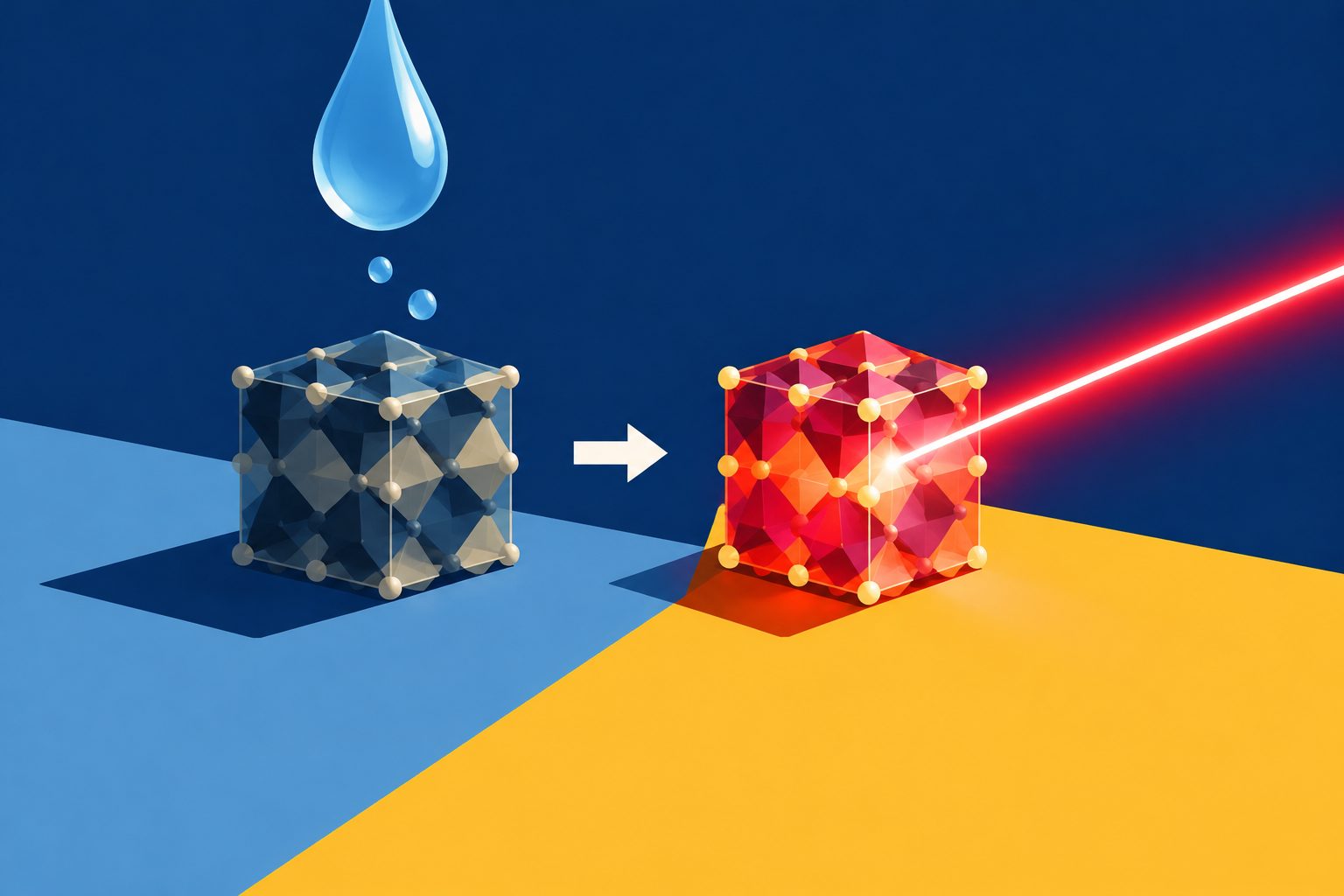
A controlled reaction with moisture turned larger, non-emitting crystals into submicron crystals that showed lasing one particle at a time.
The study began with non-emitting Cs4PbBr6 microcrystals and used restricted exposure to moisture to drive a solid-state chemical change. This produced 300–700 nanometre CsPbBr3 crystals before larger, more regular crystals formed.
Under strong optical excitation, isolated submicron crystals showed a clear threshold for stimulated emission, a sudden narrowing of their emission linewidth, linear polarization and faster emission dynamics. Their quality factors were about 103, and measurements on multiple crystals found the behavior was reproducible even though the excitation threshold varied substantially.
Evidence and open questions
This is a journal article based on optical measurements of isolated crystals produced through a moisture-driven phase transformation. The combination of an excitation threshold, sudden linewidth narrowing, polarization behavior, quality factors and faster emission dynamics supports the authors’ interpretation of lasing. The abstract does not report the number of crystallites measured, long-term stability, device integration, efficiency or how precisely the transformation and lasing thresholds can be controlled. It also notes substantial variation in threshold between crystallites.
// Source
Communications Chemistry · 2026 · DOI: 10.1038/s42004-026-02264-4
Authors: Haoyu Tang, Qian Wang, Hongyu Yang, 永玉 白, Xing Wang, Sa Zhang, Jian Huang, Jingzhou Li, Yichi Zhong
Institutions: Chinese Academy of Sciences, University of Chinese Academy of Sciences, Ningbo University of Technology, Chengdu University of Technology