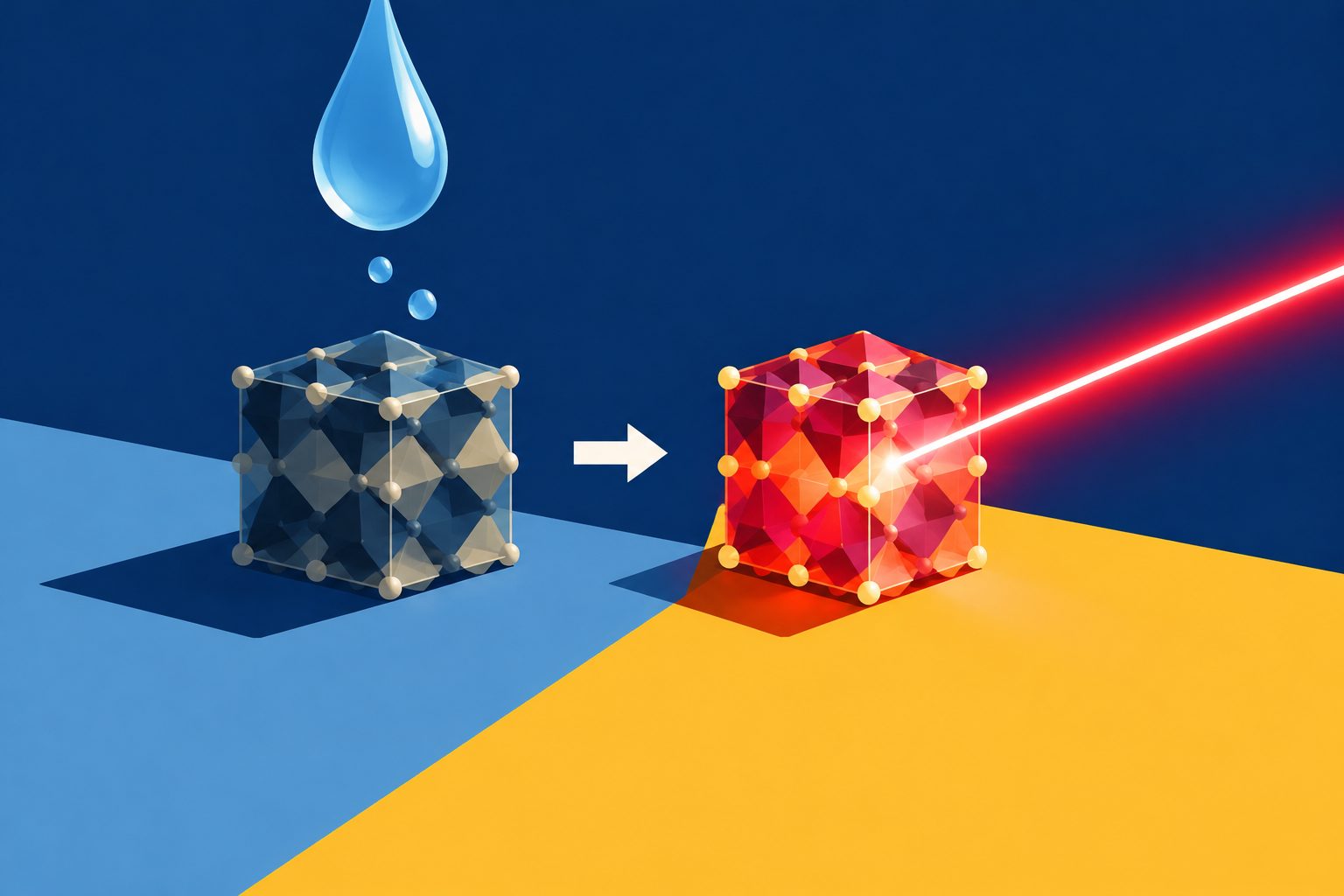
A leather-based device produced tunable blue and orange light, resisted bending and washing, and allowed water vapor to pass through.
The researchers first grew the conductive polymer polypyrrole throughout natural leather, using a treatment modeled on leather retanning. They then coated it with a light-emitting layer and a top electrode, turning the leather into the flexible bottom electrode of the display.
The resulting device combined light emission with electromagnetic interference shielding. It produced color-tunable patterned displays, remained durable through repeated bending and water washing, and preserved high water-vapor transmission associated with collagen-based leather.
What the leather display does
The leather-based display produced blue light at 452 nanometers when its light-emitting layer contained copper-doped zinc sulfide, and orange light at 586 nanometers with manganese-doped zinc sulfide. Under an alternating current of 110 volts and 1.0 kilohertz, a 3.0-by-3.0-centimeter display reached luminance of up to 56.45 candela per square meter across its tested regions. The brightness variation between nine measured regions was less than 5%.
The display retained high luminance after 1,000 bending cycles and after water washing. The researchers also report resistance to abrasion and stable operation during extended continuous use, although the supplied excerpts do not give the duration or numerical results for those tests. The conductive leather contributed to electromagnetic interference shielding through its conductive, layered and fibrous structure. The leather’s collagenous structure also provided a high water-vapor transmission rate, a property associated with wearing comfort.
Evidence and caveats
This is a materials and device study based on laboratory fabrication and performance tests of a leather-based display. The reported evidence includes measured light output and color, brightness uniformity across a small display area, durability tests involving bending and water washing, electromagnetic interference shielding performance, and water-vapor transmission.
The supplied excerpts do not report tests on people or prolonged wear on skin, so “skin-friendly” here refers to the leather’s material properties rather than demonstrated human comfort or safety. They also do not provide numerical shielding values, the duration of continuous operation, comparisons with other flexible displays, or evidence about large-scale manufacturing and use outside the laboratory.