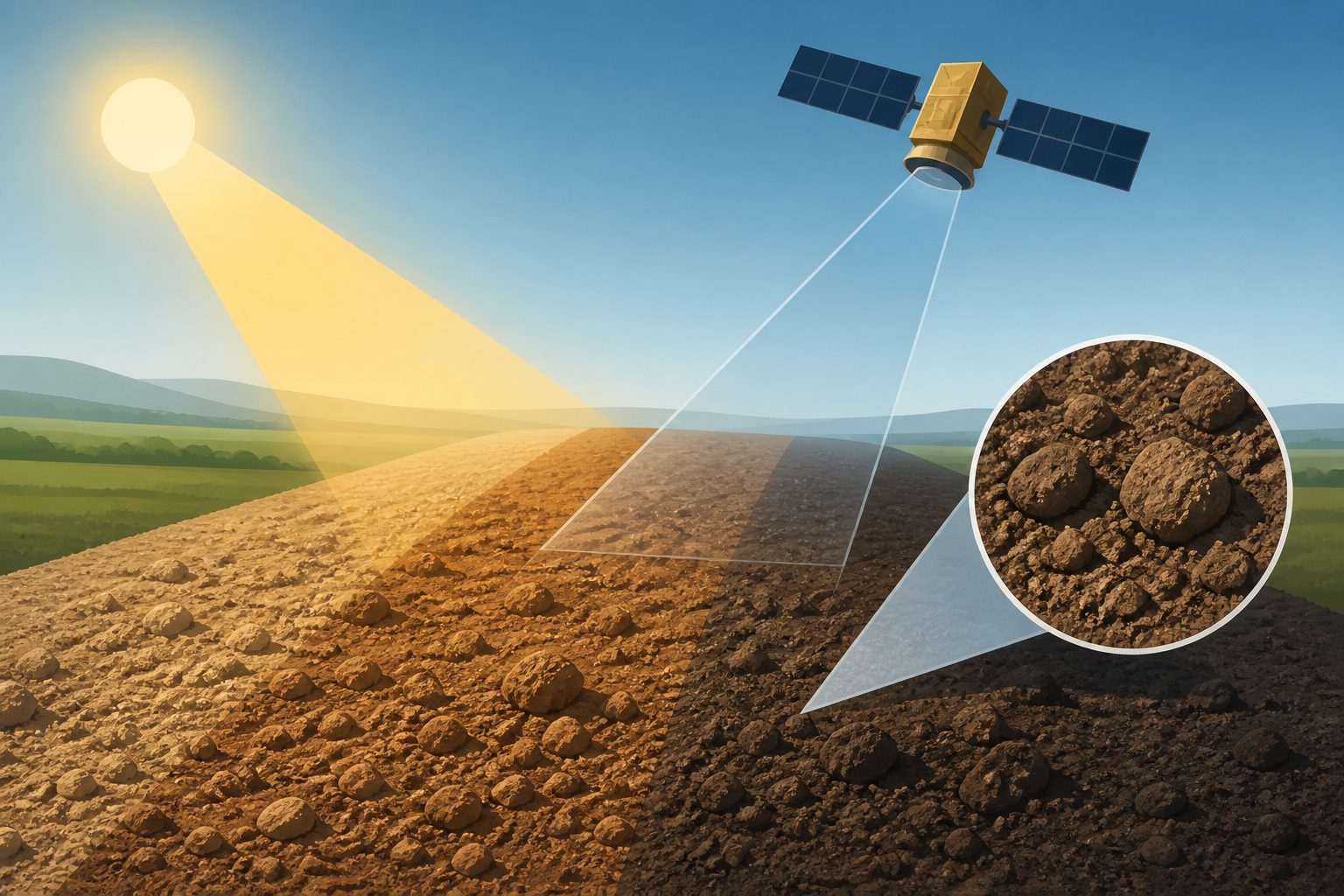
A continent-wide analysis of Landsat and Sentinel-2 measurements finds solar angle effects dominate how bare-soil reflectance varies over time.
Bare soil is only visible to satellites during limited windows in Europe, so studies frequently rely on time-averaged spectra built from many days or weeks. But the study reports that the amount and causes of spectral variability depend on physical factors that affect how light interacts with the ground.
Analyzing seven-year Level-2A corrected reflectance time series at 27,819 LUCAS sites across Europe, the researchers decomposed variability into contributions linked to surface soil moisture and illumination geometry (including solar incidence angle). They also separated effects related to atmospheric conditions from those caused by ground-level interactions between light and the soil surface.
Data and uncertainty
The evidence comes from a statistical analysis of seven-year, Level-2A corrected satellite reflectance time series from Landsat 8 and Sentinel-2, covering 27,819 LUCAS sites across Europe, and using independent environmental datasets from Copernicus and ECMWF. Key limitations are that the results are framed around variability in satellite-measured reflectance at these observation sites and time series, and that the abstract does not specify how much of the variability may come from other unmeasured factors or how well the findings transfer beyond Europe or beyond the specific satellite products and processing used.