Small mechanical stress raises superconductivity in a stripe-ordered crystal
In a lanthanum-barium copper oxide crystal, stress lifted the superconducting transition from about 5 kelvin to as high as 46 kelvin.
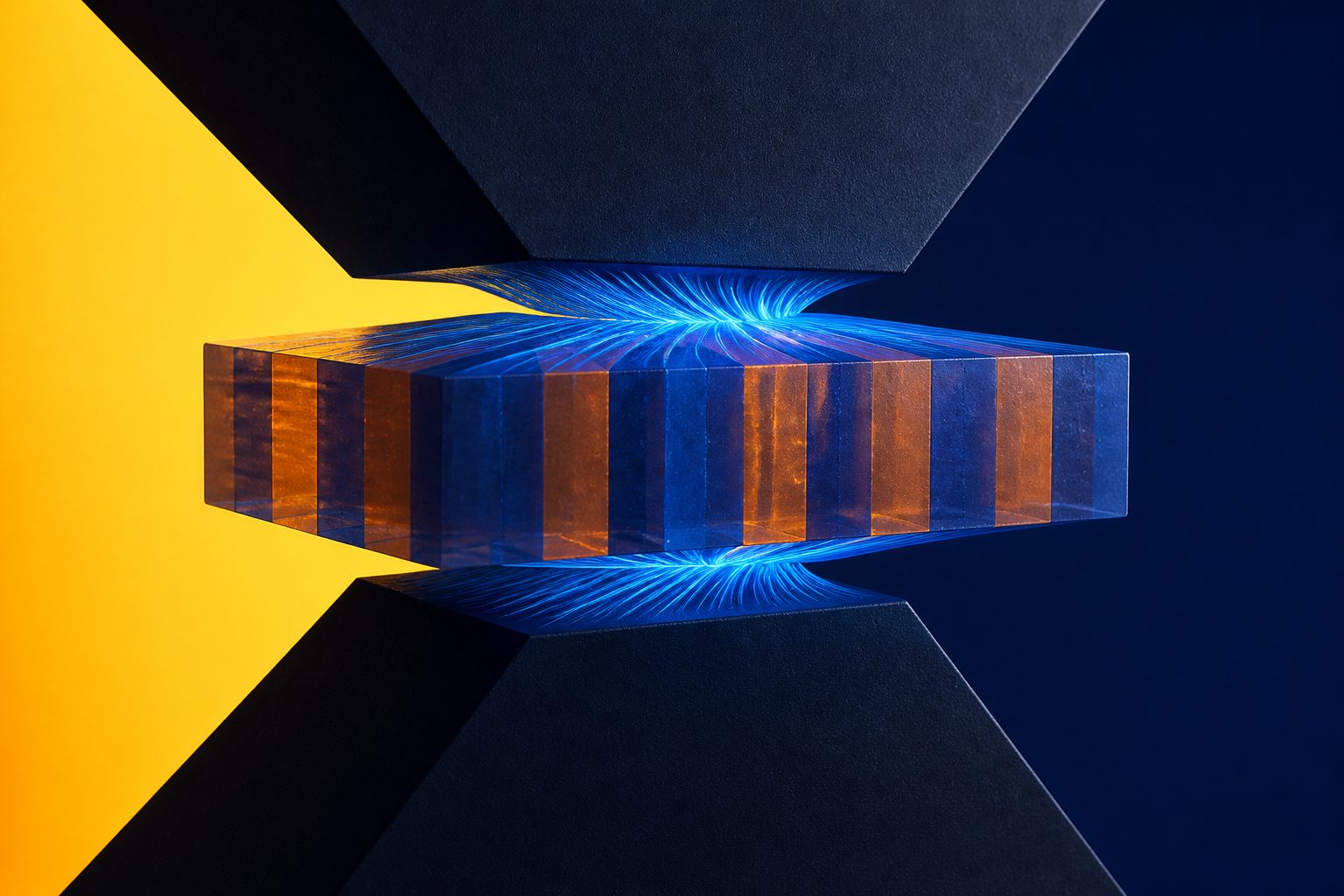
Editorial illustration — not from the study.
The study examined La2−xBaxCuO4, a copper-oxide material whose magnetic stripes are especially stable when x is 0.125. In an x=0.125 crystal, compressive stress applied within the copper-oxide planes raised the bulk superconducting transition from about 5 kelvin to 37 kelvin at 0.5 gigapascals, with the transition beginning as high as 46 kelvin in the reported measurements.
Muon-spin measurements, magnetic susceptibility and electrical resistance showed that stress reduced the fraction of the sample with static magnetic stripe order by about half, while leaving local magnetic order and its onset temperature comparatively intact. Stress also removed the resistance feature linked to the material’s low-temperature tetragonal structure across the tested compositions.
Stress changes the balance
For the x=0.125 composition, in-plane stress applied 45 degrees to the copper-oxygen bonds produced a large increase in three-dimensional superconductivity. The abstract reports a rise from 5 kelvin to a zero-resistance state at 37 kelvin under 0.5 gigapascals, with the superconducting transition beginning as high as 46 kelvin. Measurements on the same crystal found that the onset temperature of spin-stripe order changed only modestly, but the fraction of the sample containing static magnetic order fell by about a factor of two. Local magnetic order remained. The resistance peak associated with the low-temperature tetragonal phase was fully suppressed across the x=0.115, 0.125 and 0.135 compositions tested.
The researchers interpret these results as showing that static stripe order mainly restricts the ability of superconductivity to form a coherent three-dimensional state, rather than eliminating the interactions that support pairing. They propose that stress weakens the lattice anisotropy that pins the stripes, allowing a more spatially uniform superconducting state while stripe-related correlations remain relevant.
Why the result matters
The x=0.125 composition has the strongest stripe order and the lowest superconducting transition under no applied stress, yet it developed the highest transition under stress among the compositions discussed. This shows that the relationship between stripe order and superconductivity is not simply one of competition: static stripe order can hinder global superconducting coherence, while the interactions associated with stripes may still be connected to superconducting pairing.
The results also show how selectively changing the crystal structure with in-plane stress can separate linked magnetic, structural and superconducting effects. That gives researchers experimental constraints for explaining how superconductivity emerges in copper-oxide materials.
Evidence and limits
The study combined muon-spin rotation, AC magnetic susceptibility and electrical-resistance measurements. The main measurements used a single La1.875Ba0.125CuO4 crystal under compressive stress applied within the planes and at 45 degrees to the copper-oxygen bonds; resistance measurements also examined x=0.115 and x=0.135. The different measurements consistently linked stronger superconductivity with suppression of the low-temperature tetragonal response and a smaller static magnetic volume fraction.
The evidence describes how this particular material responds under the tested stress direction and pressures. The excerpts do not establish that the same response will occur in other cuprates, under other stress orientations or in larger sets of samples. The proposed role of dynamic stripe correlations and pairing is an interpretation of the measurements, not a direct measurement of the pairing mechanism.
A theoretical study proposes an experiment in which a mass placed in a quantum superposition could produce an effectively repulsive gravitational effect on another particle. The effect would arise from quantum interference and, if observed, would conflict with general relativity’s description of gravity as always attractive.
Researchers report that silicon spin qubits can perform precise operations in parallel, overcoming a major source of error during simultaneous control. In a five-qubit array, gate fidelities stayed above 99.99% for up to three qubits and above 99.9% when all five operated together.
A survey of MESSENGER measurements identified 116 candidate magnetic reconnection layers near Mercury’s magnetopause. The structures appear to recur under the planet’s typically low-Alfvén-Mach-number solar wind, but they cannot yet be confirmed as reconnection outflows.