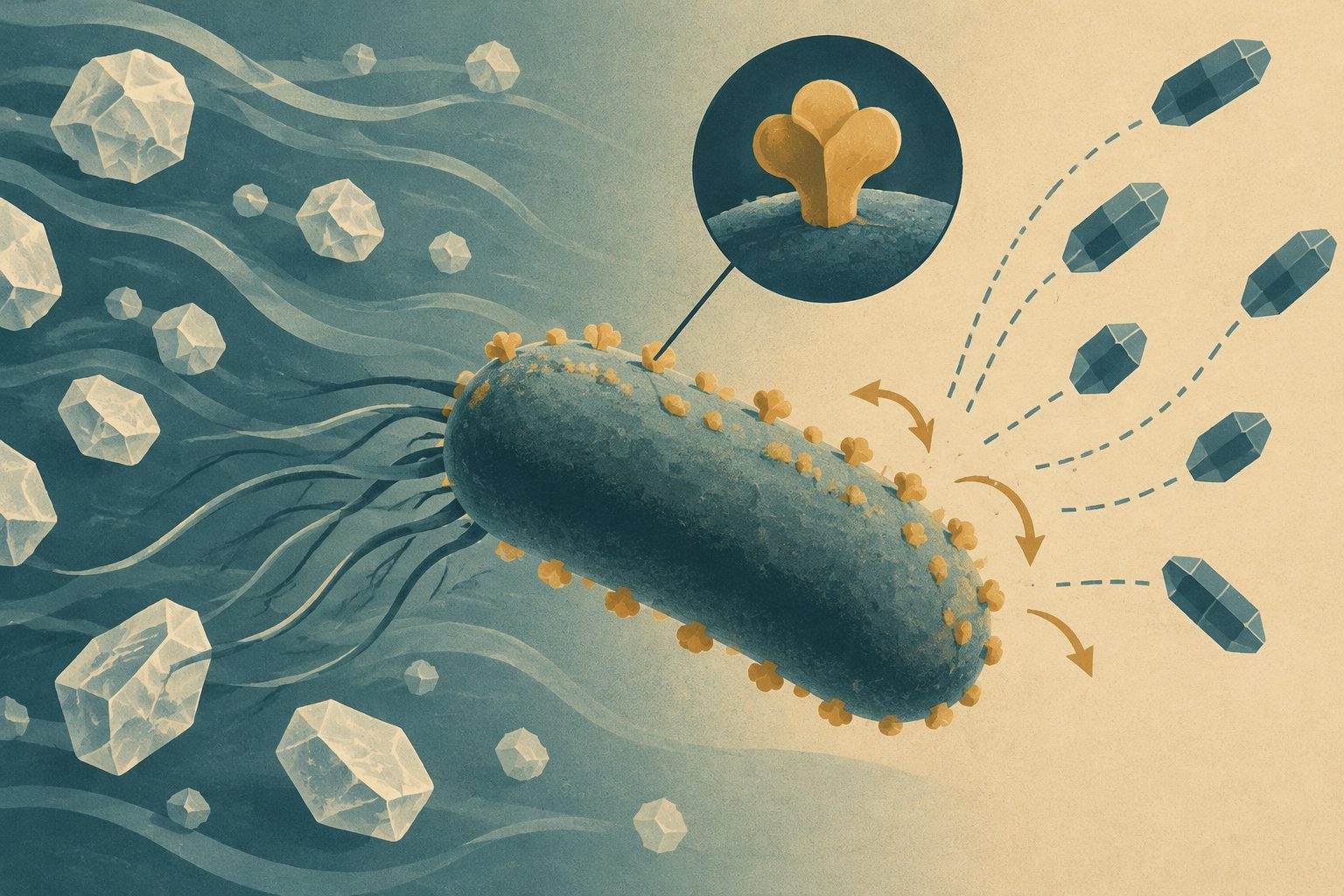
Higher salt levels increased kanamycin resistance, while changes in the outer-membrane protein OmpC appeared to contribute but did not explain the effect by themselves.
Researchers tested kanamycin resistance in wild-type E. coli and strains altered in the genes for the outer-membrane proteins OmpC and OmpF. They grew the bacteria in media containing different concentrations of sodium chloride and measured antibiotic resistance using minimum inhibitory concentration tests, along with protein analysis by SDS-PAGE.
Resistance increased as salt stress rose. OmpC levels also increased in the wild-type and ompF strains, but OmpF levels did not show the expected corresponding decrease. A strain initially thought to lack OmpF was found by PCR and protein analysis to still carry and express ompF. The findings indicate that the balance between OmpC and OmpF may contribute to kanamycin resistance, but is not the only mechanism involved.
How salt changed resistance
Increasing osmotic stress, created with higher sodium chloride concentrations, increased E. coli resistance to kanamycin. In wild-type bacteria and the strain described as ompF, OmpC protein levels rose as salt concentrations increased, but the researchers did not observe a matching decrease in OmpF.
The strain initially thought to be missing ompF was found by PCR to contain the gene, and SDS-PAGE showed that it produced OmpF protein. Bacteria lacking ompC also showed resistance comparable to wild-type cells at higher salt concentrations. Together, the results suggest that increased OmpC expression and the OmpC-to-OmpF balance play a role in resistance, but cannot fully account for it.
Evidence and caveats
This was a laboratory study using E. coli strains grown in media with varying sodium chloride concentrations. The researchers measured kanamycin minimum inhibitory concentrations and analyzed outer-membrane proteins with SDS-PAGE, while PCR was used to check the identity of the strain thought to lack ompF.
The abstract does not report the numerical resistance values, the sodium chloride concentrations, or the number of biological replicates. The strain expected to be ompF-deficient was not actually confirmed to lack the gene or its protein, limiting what can be concluded from that comparison. The results also show that OmpC and OmpF changes may not be the only mechanisms behind the increased resistance.
// Source
Open Collections · 2026 · DOI: 10.14288/ujemi.v17.203954
Authors: Arkhjamil Angeles, Lauren Coombe
Institutions: University of British Columbia