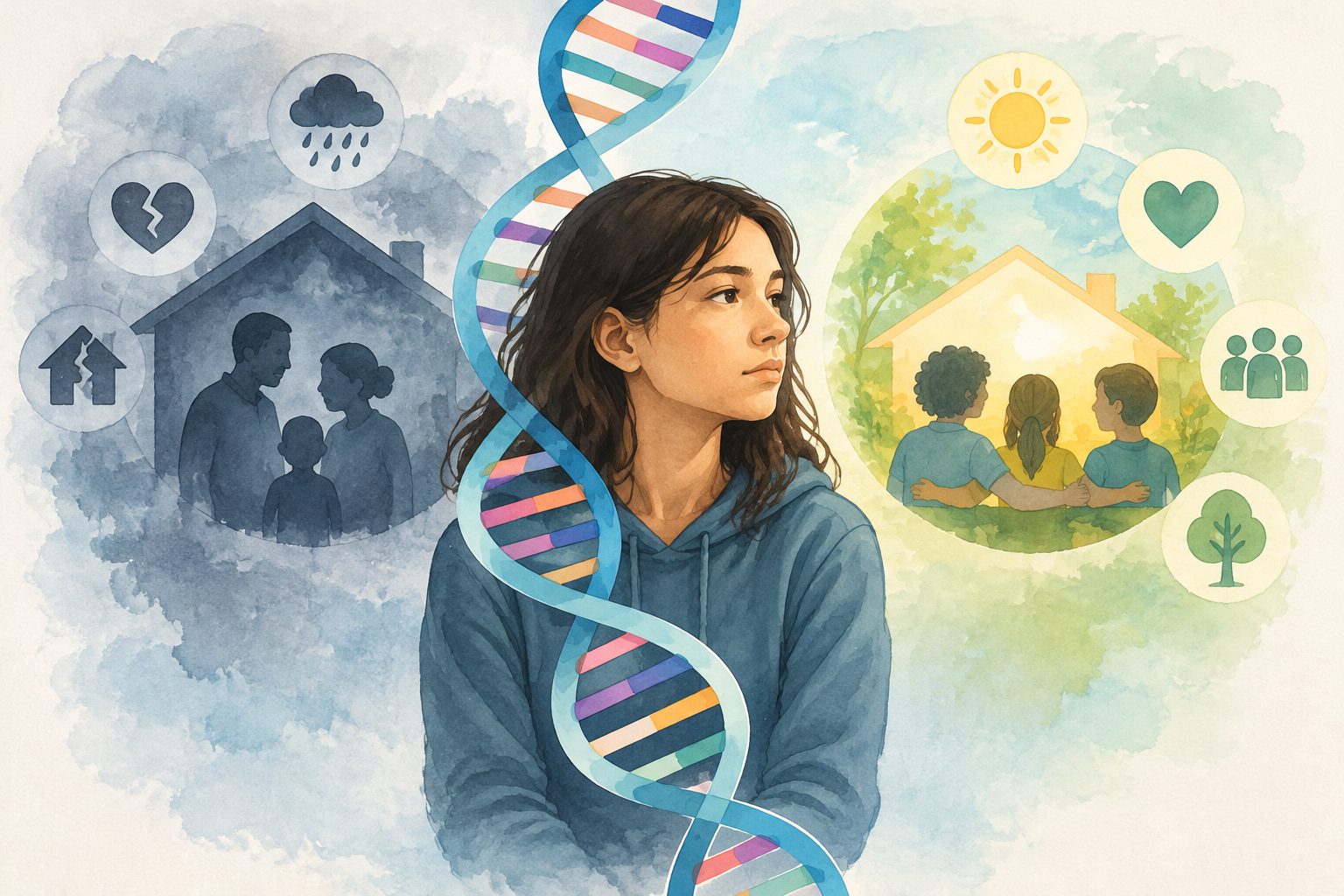
In a large U.S. youth study, higher genetic scores for psychiatric and substance-use disorders were associated with more household adversity and less positive day-to-day experience.
Researchers analyzed data from the Adolescent Brain and Cognitive Development Study, which collected reports from young people and parents alongside measures of the built environment. The sample included 4,797 participants genetically similar to European reference populations, 1,585 similar to African reference populations and 2,012 similar to Admixed American reference populations.
The team compared genetic scores for conditions including attention-deficit/hyperactivity disorder, major depressive disorder, alcohol-use disorder and cannabis-use disorder with six broad environmental factors. Higher scores for several psychiatric and substance-use conditions were associated with more household adversity and fewer positive day-to-day experiences, after adjustments for age, sex, income relative to household needs and genetic ancestry.
What the study found
The strongest and most consistent associations involved two environmental factors: household adversity and positive day-to-day experiences. Higher scores for broad externalizing liability, attention-deficit/hyperactivity disorder and several substance-use conditions were associated with greater household adversity. Higher scores were also associated with fewer positive daily experiences, such as school enjoyment and acceptance by caregivers.
Household adversity was associated with scores for externalizing liability and attention-deficit/hyperactivity disorder across the three genetically informed ancestry groups. It was also associated with scores for general substance-use disorder and major depressive disorder in participants genetically similar to European and Admixed American reference populations. The pattern for positive experiences differed by group and disorder, but lower positive experiences were associated with higher externalizing-liability scores in all three groups.
Why these links matter
Environmental experiences and genetic liability are often studied as separate contributors to psychiatric and substance-use disorders. These findings show that they can be related to one another in adolescence, particularly for household adversity and positive daily experiences.
That matters because failing to account for these correlations could make it harder to estimate the separate contributions of genes and environments, or could inflate estimates of gene–environment interactions. The study does not show that genetic scores cause adversity or that adversity causes psychiatric or substance-use disorders.
Evidence and limitations
This was an observational analysis of data from 8,394 participants in the U.S. Adolescent Brain and Cognitive Development Study. Researchers used polygenic scores—summaries of many genetic variants associated with a trait—and environmental factors built from youth and parent reports plus objective measures of the built environment. The analyses adjusted for sex, age, income relative to household needs and genetic ancestry principal components.
Because the analysis used only the children's genetic scores in a sample of unrelated participants, it could not separate genetic transmission from shared family influences or direct effects of the environment. In particular, the researchers said the results show a correlation between household adversity and genetic liability, not that passive gene–environment correlation was demonstrated. Studies including parental genetic scores, siblings or other family-based comparisons will be needed to distinguish these explanations more clearly. Associations also differed across genetically informed ancestry groups, so the findings should not be treated as identical for all populations.
// Source
European Child & Adolescent Psychiatry · 2026 · DOI: 10.1007/s00787-026-03201-5
Authors: I‐Tzu Hung, Nathaniel Thomas, David W. Sosnowski, Julia W. Felton, Ran Barzilay, Tyler M. Moore, Elina Visoki, Nathan A. Gillespie, Danielle M. Dick, Brion S. Maher, Jill A. Rabinowitz
Institutions: University of Pennsylvania, Johns Hopkins University, Wayne State University, Children's Hospital of Philadelphia, Virginia Commonwealth University, Rutgers, The State University of New Jersey