Review reports longer survival with some targeted drugs in BRAF-mutant bowel cancer
An analysis of 18 randomized trials found more favorable survival measures with BRAF-directed therapy than with EGFR-directed therapy in metastatic colorectal cancer.
High evidenceReviewSome caution advised
Medical disclaimer: This article summarizes research findings and is for informational purposes only. It is not medical advice.
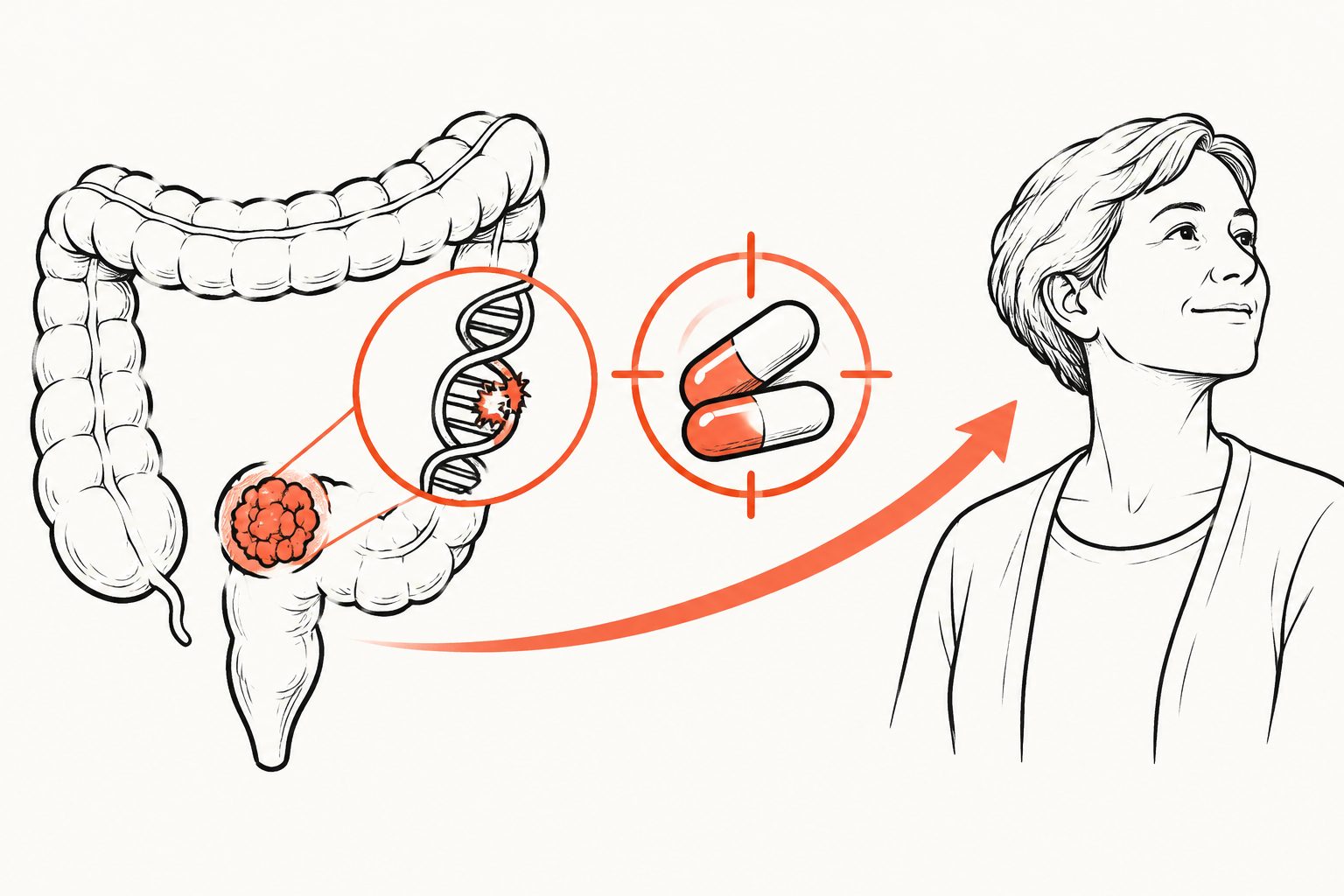
Editorial illustration — not from the study.
The analysis focused on a difficult-to-treat molecular subtype of metastatic colorectal cancer. Researchers reconstructed patient-level survival information from published Kaplan-Meier curves and pooled results across randomized controlled trials that evaluated targeted treatment approaches.
Across first-line studies, the pooled median overall survival was 22.3 months for BRAF-directed regimens, 17.1 months for VEGF-targeted therapy, and 10.1 months for EGFR-directed therapy. The analysis found better overall and progression-free survival measures for BRAF-directed treatment than for EGFR-directed treatment, and better overall survival for VEGF-targeted treatment than for EGFR-directed treatment.
What the review covered
The researchers examined whether survival differed among targeted treatment classes for people with metastatic colorectal cancer containing a BRAF V600E mutation. They systematically searched four medical databases through July 2025 and included 18 randomized controlled trials with 11,931 participants. Because individual patient data were not directly available in the included reports, the team digitized published Kaplan-Meier survival curves, reconstructed individual patient data, and used statistical models to pool overall survival and progression-free survival results. The analyses accounted for reported study-level factors, clustering, and multiple comparisons.
Key conclusions
Across studies evaluating first-line treatment, pooled median overall survival was 22.3 months with BRAF-directed regimens, 17.1 months with VEGF-targeted therapy, and 10.1 months with EGFR-directed therapy. Compared with EGFR inhibition, BRAF inhibitor-directed treatment was associated with better overall survival, with a hazard ratio of 0.43, and better progression-free survival, with a hazard ratio of 0.47. VEGF inhibition was also associated with better overall survival than EGFR inhibition, with a hazard ratio of 0.56. EGFR-directed regimens had the least favorable survival results across the analyses. These are pooled associations from comparisons across trials and do not establish that one treatment will produce the same result for every patient.
Who this may apply to
The findings may be relevant to people with metastatic colorectal cancer whose tumors have a BRAF V600E mutation and who resemble participants in the included randomized trials, particularly in first-line treatment settings represented in those studies. They do not necessarily apply to people with other tumor mutations, earlier-stage colorectal cancer, different health characteristics, or treatment situations not represented in the trials. The analysis is evidence about groups of patients and should not be read as a prediction for any one individual or as treatment advice.
What this could mean
The findings add comparative information about targeted treatment approaches for a specific, aggressive form of metastatic colorectal cancer. They suggest that treatment class may be linked with different survival outcomes in people whose tumors carry a BRAF V600E mutation. The results do not apply to colorectal cancers without this mutation, and they do not by themselves determine which option is appropriate for an individual person.
Limitations & evidence assessment
The analysis used reconstructed data taken from published survival curves rather than original individual patient records, so some details and precision may have been lost. The treatment comparisons came from different randomized trials, which may have differed in participants, other treatments, follow-up, and study methods; adjustment for study-level factors cannot remove all such differences. The abstract does not provide detailed information about these differences, the exact regimens within each treatment class, or how consistently the mutation and treatment subgroups were defined. As a result, the findings support comparisons at the pooled study level but may not represent a direct head-to-head comparison of every regimen.
Why this evidence level: Meta-analysis pooling multiple studies sits at the top of common evidence hierarchies.
Evidence levels are editorial estimates derived from study metadata — they are not clinical appraisals.
// Source
Journal of Gastrointestinal Cancer · 2026 · DOI: 10.1007/s12029-026-01597-6
Researchers combined genetic data from more than 1 million human participants to study factors associated with endometriosis. They identified 58 genomic regions, including 27 not previously reported, and used additional molecular analyses to implicate 314 genes. These findings point to possible biological pathways for further research, but they do not establish causes or demonstrate that any treatment will work.
Researchers systematically reviewed laboratory studies of how temperature affects the time it takes arboviruses to become transmissible inside mosquitoes. Across 53 studies covering 17 viruses, higher temperatures were generally linked with greater transmission efficiency and a shorter time to infectiousness for Zika and West Nile viruses, while results for several other viruses were unclear.
This systematic review and meta-analysis examined whether ultra-low-dose computed tomography (CT) can detect pulmonary, or lung, nodules while using less radiation than standard-dose CT. Across 42 studies involving 15,792 patients, pooled sensitivity for nodule detection was 91.9%, but results varied greatly between studies. The review also found that ultra-low-dose CT used an average effective dose of 0.22 millisieverts (mSv), while detection was less reliable for some small or hazy nodules and in patients with a high body mass index.