Review models how climate-related behavior could increase radon-linked lung cancer risk
A scoping review and model estimated higher lung cancer mortality under hypothetical changes in indoor cooling and basement use.
Moderate evidenceReviewInterpret with caution
Medical disclaimer: This article summarizes research findings and is for informational purposes only. It is not medical advice.
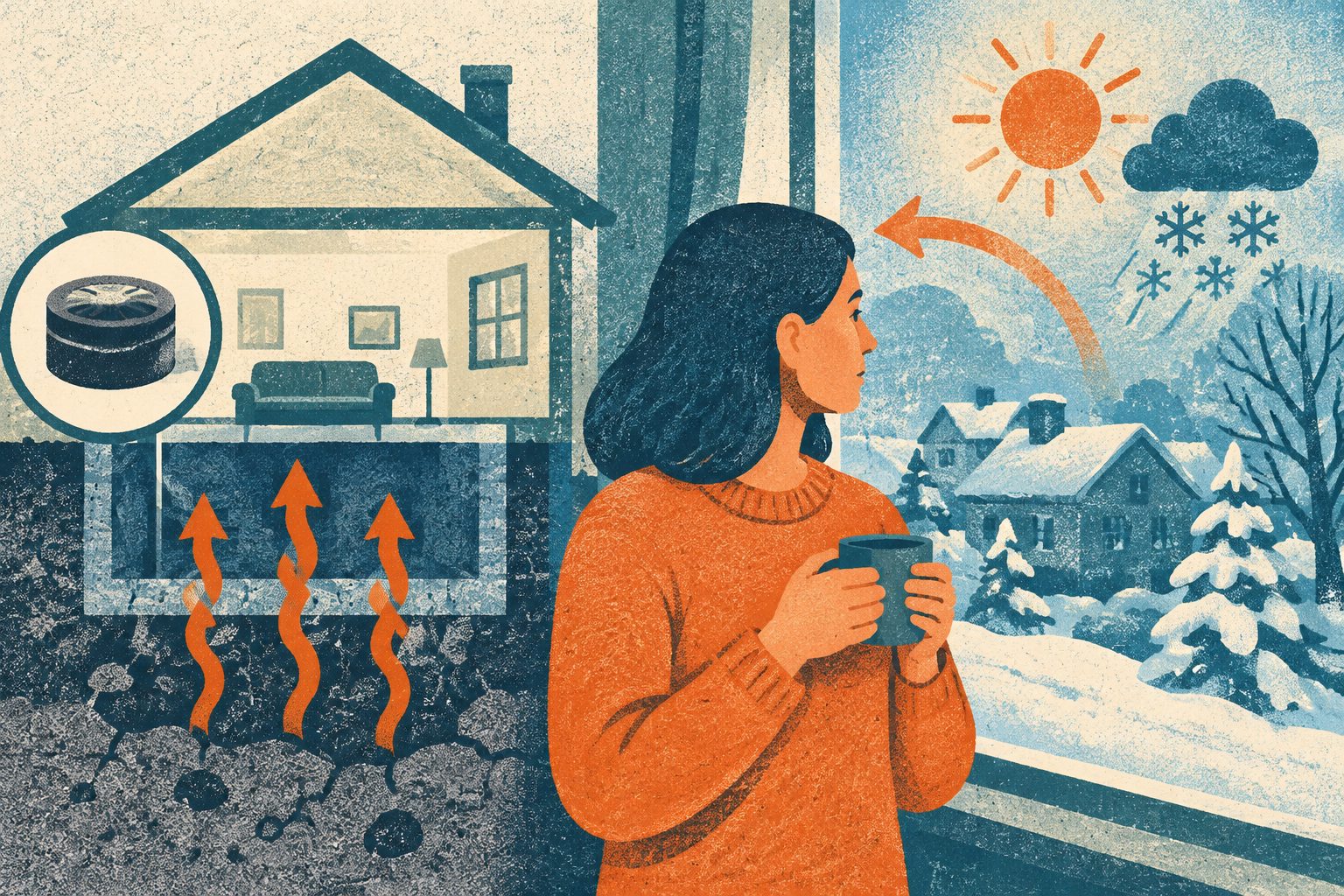
Editorial illustration — not from the study.
The researchers examined whether some ways people might adapt to hotter conditions could change their exposure to radon, a radioactive gas that can build up indoors and is associated with lung cancer. They reviewed published literature and created four scenarios: current conditions, increased air-conditioning use, increased time in basements, and a combination of the two.
Using an established exposure-and-age model, they estimated cumulative excess lung cancer mortality by age 85 for populations in the United States and pooled populations in France, Germany, and Italy. The results suggest that the combined hypothetical scenario could be associated with higher modeled mortality, but the estimates depend on the assumptions used in the scenarios and model.
What the review covered
This was a scoping review rather than a new clinical or population experiment. The researchers reviewed literature on climate change and indoor radon, then modeled four possible exposure scenarios reflecting changes in indoor cooling and time spent in basements. They used the BEIR VI exposure-age-concentration model to estimate cumulative excess lung cancer mortality by age 85 for US and pooled French-German-Italian populations. The abstract does not state the number of publications included, the number of people represented by the modeled populations, or whether the scenarios were based on measured behavior changes.
What the review concluded
Compared with current conditions, the combined hypothetical scenario was estimated to produce an additional 46 lung cancer deaths per 10,000 people in the United States and 42 per 10,000 people in the pooled European populations by age 85. These figures are model estimates under specified assumptions, not counts of deaths observed in people. The abstract does not provide separate numerical estimates for the air-conditioning-only or increased-basement-time scenarios.
Who this may apply to
The estimates are most relevant to population-level planning for people living in settings represented by the US and pooled French-German-Italian model populations, and only under conditions resembling the scenarios used. They should not be interpreted as a personalized estimate for any individual household or as a direct forecast of deaths. The abstract does not show how well the scenarios apply to other countries, housing types, climates, or patterns of indoor behavior.
The significance
Radon exposure is a potential indoor environmental contributor to lung cancer risk, and climate-related changes in where and how long people spend time indoors could alter exposure. This work identifies a possible pathway for further research and public-health planning. It does not show that climate change has caused the modeled number of deaths, and it does not establish the actual size of this effect in any particular household or population.
Limitations & evidence assessment
The central results come from hypothetical scenarios and a mathematical model, so they depend on assumptions about future behavior, indoor conditions, radon concentrations, exposure duration, and the relationship between exposure and lung cancer mortality. The study does not report direct measurements of changing radon exposure or observed lung cancer deaths resulting from climate-related behavior. Because this is a scoping review, the abstract does not establish that all relevant studies were identified or that the evidence was formally combined and assessed for quality. Important details about the included literature, model inputs, scenario probabilities, and uncertainty ranges are not provided in the abstract.
Why this evidence level: Narrative review: synthesizes existing work but without systematic methodology.
Evidence levels are editorial estimates derived from study metadata — they are not clinical appraisals.
Researchers combined genetic data from more than 1 million human participants to study factors associated with endometriosis. They identified 58 genomic regions, including 27 not previously reported, and used additional molecular analyses to implicate 314 genes. These findings point to possible biological pathways for further research, but they do not establish causes or demonstrate that any treatment will work.
Researchers systematically reviewed laboratory studies of how temperature affects the time it takes arboviruses to become transmissible inside mosquitoes. Across 53 studies covering 17 viruses, higher temperatures were generally linked with greater transmission efficiency and a shorter time to infectiousness for Zika and West Nile viruses, while results for several other viruses were unclear.
This systematic review and meta-analysis examined whether ultra-low-dose computed tomography (CT) can detect pulmonary, or lung, nodules while using less radiation than standard-dose CT. Across 42 studies involving 15,792 patients, pooled sensitivity for nodule detection was 91.9%, but results varied greatly between studies. The review also found that ultra-low-dose CT used an average effective dose of 0.22 millisieverts (mSv), while detection was less reliable for some small or hazy nodules and in patients with a high body mass index.