Review links isotretinoin with temporary dry mouth and other oral changes
Evidence about cavities, gum changes, and dental procedures remains limited and mixed.
Low evidenceReviewInterpret with caution
Medical disclaimer: This article summarizes research findings and is for informational purposes only. It is not medical advice.
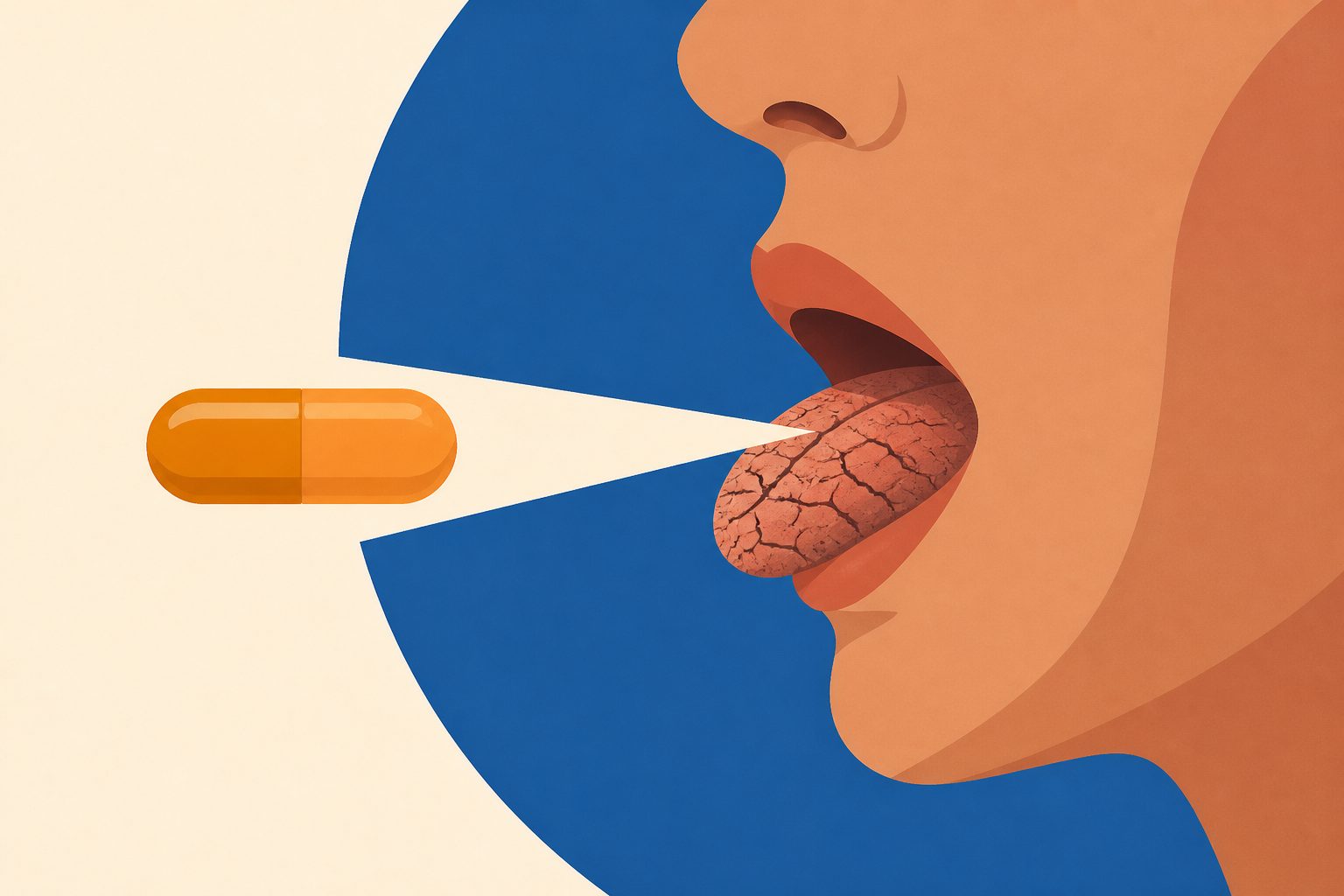
Editorial illustration — not from the study.
The review searched several research databases and considered clinical studies, other reviews, and selected laboratory or mechanistic studies. Across the human studies summarized, saliva production often fell during treatment, and some studies reported changes in saliva buffering, cavity-related measures, gum inflammation, bleeding, plaque, or probing depth. These changes were not consistent across all studies, and some appeared to be temporary.
The review did not establish that isotretinoin directly causes periodontitis, a severe form of gum disease. It also reported that available evidence does not support routinely delaying necessary dental procedures solely because someone is taking isotretinoin, while emphasizing that evidence specific to oral surgery is sparse. The review described this as an area requiring further study rather than a settled conclusion.
The question reviewed
Researchers conducted a structured literature search, mainly in PubMed/MEDLINE and also in Google Scholar, Scopus, and Web of Science. They reviewed original clinical studies, systematic reviews, and selected mechanistic studies concerning saliva, mouth tissues, cavities, and periodontal health during systemic isotretinoin therapy. The review included human studies with different designs and sample sizes, including studies of 8, 24, 25, 28, and 45 treated participants, as well as larger case-control studies; it also discussed laboratory research. The review itself was described as narrative rather than as a new clinical trial or meta-analysis.
What the evidence shows
The most consistent findings in people were lower salivary flow and symptoms of dry mouth. Chapped lips and oral dryness were common, while burning sensations and mouth ulcers were reported less often. In some studies, saliva had lower buffering capacity or participants had higher cavity-related measures, but a direct cause-and-effect relationship between isotretinoin and tooth decay was not established.
Gum-related results varied. Some longitudinal studies reported temporary increases in gum inflammation, bleeding, plaque, or probing depth, while others found little clinical worsening. One study found no significant deterioration in measured periodontal clinical parameters. Biomarker and microbiology studies reported changes in inflammatory, tissue-remodeling, or bacterial measures, but the review stated that their clinical importance remains uncertain. The review found no convincing evidence that isotretinoin directly causes periodontitis or that it routinely impairs oral wound healing, although oral-surgery evidence was limited.
Who this may apply to
These findings may be relevant to people receiving systemic isotretinoin for acne, particularly those experiencing oral dryness, chapped lips, or other mouth symptoms, and to dental professionals evaluating such patients. They do not show that every person taking isotretinoin will develop cavities or gum disease, and they do not establish effects for every type of dental or oral-surgery procedure. The laboratory findings apply to experimental models rather than directly to any patient population.
The significance
Dry mouth and related symptoms may be relevant to people taking isotretinoin and to dental professionals assessing oral complaints during treatment. The review suggests that measurable changes in saliva or gum-related tests should not automatically be treated as clinically important disease. Its discussion of dental procedures is also relevant because it found insufficient evidence for routine postponement based on isotretinoin use alone, but this conclusion is not based on strong, procedure-specific oral-surgery evidence.
Limitations & evidence assessment
This was a narrative review, not a meta-analysis or a new controlled study, so its conclusions depend on the quality and completeness of the available research. The included clinical studies were generally small, used different designs and outcomes, and often had relatively short follow-up; some had participants who did not complete the study. The periodontal findings were heterogeneous, and the review did not establish causation. Laboratory studies involving cultured oral cells or experimental retinoic acid models can suggest possible mechanisms, but they are not direct evidence of mouth injury in people. Evidence about oral and maxillofacial surgery was specifically described as sparse, and the review noted that findings from skin procedures cannot be directly applied to every dental procedure.
Why this evidence level: This is a narrative review that brings together several small clinical and observational studies, along with laboratory and mechanistic research. The included studies had mixed results, and the review does not provide a meta-analysis or a new, controlled clinical trial.
Evidence levels are editorial estimates derived from study metadata — they are not clinical appraisals.
// Source
International Journal of Innovative Technologies in Social Science · 2026 · DOI: 10.31435/ijitss.3(51).2026.6637
Researchers analysed double-blind randomised trials of adults with major depressive disorder to compare 10 antidepressants with placebo during the first eight weeks of treatment. Some medicines were associated with longer QTc intervals, a heart rhythm measurement, but the analysis did not find higher rates of early major cardiovascular events or non-suicidal death compared with placebo.
Researchers studied 4,695 very preterm infants in Sweden and compared outcomes among those who did and did not receive a three-strain probiotic supplement. Probiotic exposure was associated with lower rates of death and necrotizing enterocolitis, a serious intestinal disease, but was not clearly associated with culture-confirmed sepsis.
This systematic review examined whether educational activities in medical school influence students' emotional empathy. The eight included studies reported some effects, but results differed across types of empathy and across interventions, so the overall findings remain uncertain.