Review finds strong antiviral activity in lab tests, but limited human evidence
Photodynamic methods showed promise for ex vivo and localized applications, while their wider clinical usefulness remains uncertain.
High evidenceReviewInterpret with caution
Medical disclaimer: This article summarizes research findings and is for informational purposes only. It is not medical advice.
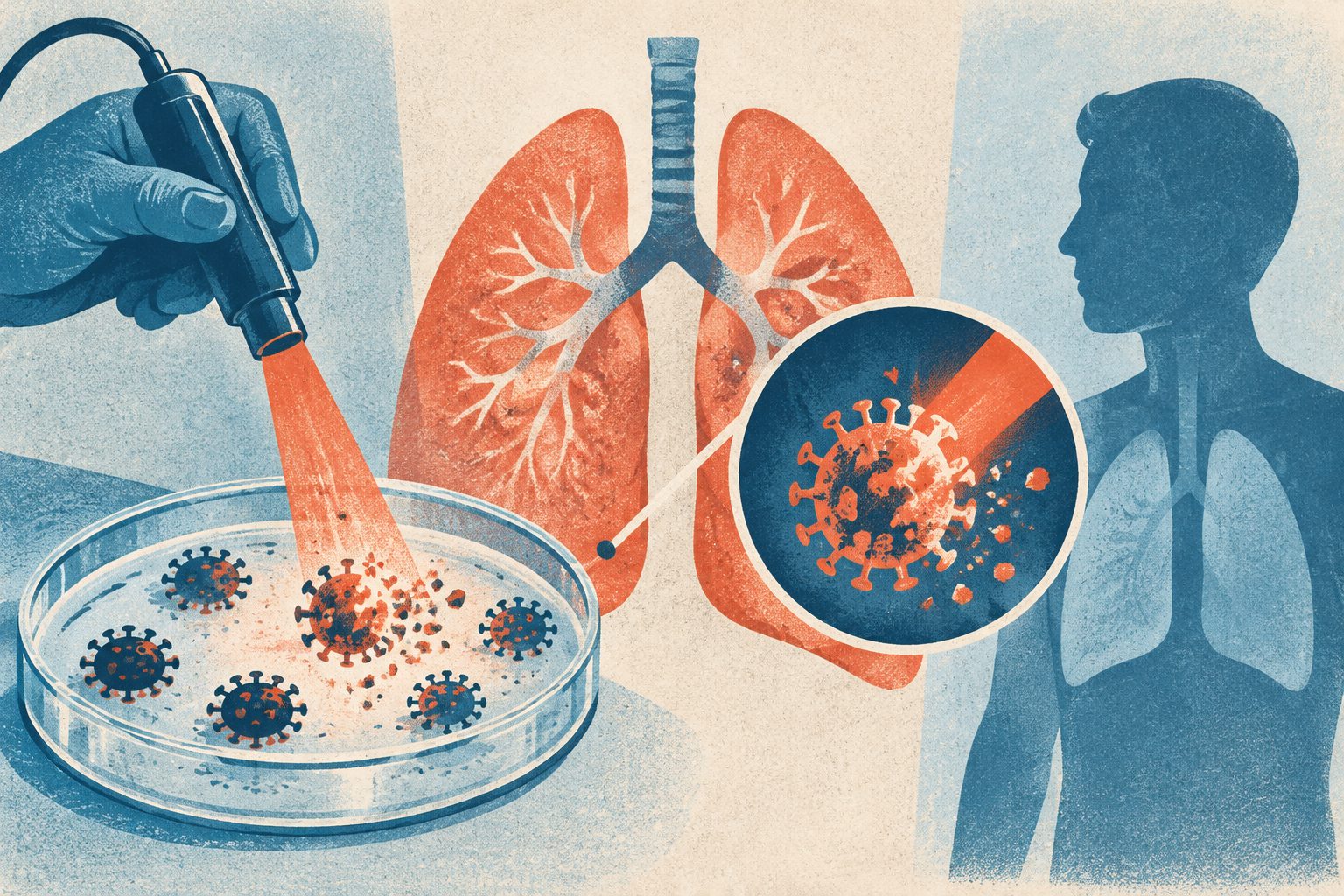
Editorial illustration — not from the study.
Researchers reviewed studies published from 1990 through April 2026 on methods that use a light-sensitive substance and light to generate reactive oxygen species. They distinguished photodynamic inactivation, mainly used outside the body or on materials such as blood products, from photodynamic therapy, which is intended to treat infections in the body.
Of 242 records identified, 30 studies met the inclusion criteria. Most were laboratory or ex vivo studies, while 4 were animal studies and 4 were clinical studies. The review reported strong activity against enveloped viruses in laboratory testing, but emphasized that higher concentrations of the light-sensitive substances and higher light doses were generally needed for non-enveloped viruses. The clinical evidence was too limited to establish effectiveness or safety conclusively.
What the review covered
The review asked how effective and clinically applicable photosensitizer-mediated photodynamic methods are against viruses. The researchers searched PubMed, Scopus, Web of Science, and Embase for peer-reviewed original studies published between January 1990 and April 2026. They included studies conducted in vitro, ex vivo, in animals, or in clinical settings, and excluded studies using direct ultraviolet light without a photosensitizer or light-independent antiviral mechanisms. Two reviewers independently screened studies and extracted information, and the authors assessed risk of bias with design-appropriate tools. Because the studies differed substantially in the viruses, photosensitizers, light settings, and outcome measures, the findings were summarized narratively rather than combined in a statistical meta-analysis.
What the review concluded
Thirty studies were included: 22 laboratory or ex vivo studies, 4 animal studies, and 4 clinical studies. Photodynamic inactivation produced multi-log reductions in enveloped viruses in the included laboratory and ex vivo research. Non-enveloped viruses generally required higher photosensitizer concentrations and light doses. The substances studied included methylene blue, porphyrins, phthalocyanines, Rose Bengal, riboflavin, and ruthenium complexes.
The review described the safety profile of photodynamic inactivation in transfusion-related applications and photodynamic therapy in mucocutaneous applications as potentially promising, but not conclusively established. The authors concluded that the evidence is almost entirely preclinical and does not currently support conventional photodynamic therapy as a clinically feasible treatment for systemic viremia. No extracorporeal or targeted light-delivery approach has yet been clinically validated according to the review.
Who this is relevant to
The results may be relevant to researchers studying ex vivo pathogen reduction and localized, accessible mucocutaneous infections, because those were the main settings represented. Laboratory findings apply directly only to the tested experimental conditions, and animal findings apply to animal models rather than to patients. The review does not establish that these methods are effective or safe for systemic viral infections, for people with other types of infections, or for routine clinical use.
What this could mean
The findings help separate two different uses that are sometimes grouped together: reducing viruses outside the body, such as in blood products, and treating an infection within the body. Laboratory and ex vivo results suggest that photosensitizer-and-light methods can damage viral components, particularly for enveloped viruses, but laboratory activity does not establish benefit in patients. The animal findings also may not translate to humans, and the small amount of clinical evidence does not establish effectiveness or safety for general viral infections. The review therefore identifies possible areas for further research rather than a validated broad antiviral treatment.
Limitations & evidence assessment
Only 30 studies were included, and most were laboratory or ex vivo studies rather than studies in people. There were 4 animal studies and 4 clinical studies, so clinical conclusions are based on a small evidence base. The studies differed widely in viral targets, photosensitizers, light parameters, and outcome measures, preventing a pooled statistical analysis. The abstract does not provide detailed results for each clinical study or describe the individual risk-of-bias judgments. The reported safety findings remain preliminary, and no included approach had clinically validated systemic treatment or targeted light delivery.
Why this evidence level: Systematic review aggregating primary studies with explicit methodology.
Evidence levels are editorial estimates derived from study metadata — they are not clinical appraisals.
// Source
International Microbiology · 2026 · DOI: 10.1007/s10123-026-00915-z
Researchers combined genetic data from more than 1 million human participants to study factors associated with endometriosis. They identified 58 genomic regions, including 27 not previously reported, and used additional molecular analyses to implicate 314 genes. These findings point to possible biological pathways for further research, but they do not establish causes or demonstrate that any treatment will work.
Researchers systematically reviewed laboratory studies of how temperature affects the time it takes arboviruses to become transmissible inside mosquitoes. Across 53 studies covering 17 viruses, higher temperatures were generally linked with greater transmission efficiency and a shorter time to infectiousness for Zika and West Nile viruses, while results for several other viruses were unclear.
This systematic review and meta-analysis examined whether ultra-low-dose computed tomography (CT) can detect pulmonary, or lung, nodules while using less radiation than standard-dose CT. Across 42 studies involving 15,792 patients, pooled sensitivity for nodule detection was 91.9%, but results varied greatly between studies. The review also found that ultra-low-dose CT used an average effective dose of 0.22 millisieverts (mSv), while detection was less reliable for some small or hazy nodules and in patients with a high body mass index.