Review finds more five-year weight loss after gastric bypass than sleeve surgery
The interpretation depends partly on whether researchers set out to test superiority or similarity between the procedures.
High evidenceReviewSome caution advised
Medical disclaimer: This article summarizes research findings and is for informational purposes only. It is not medical advice.
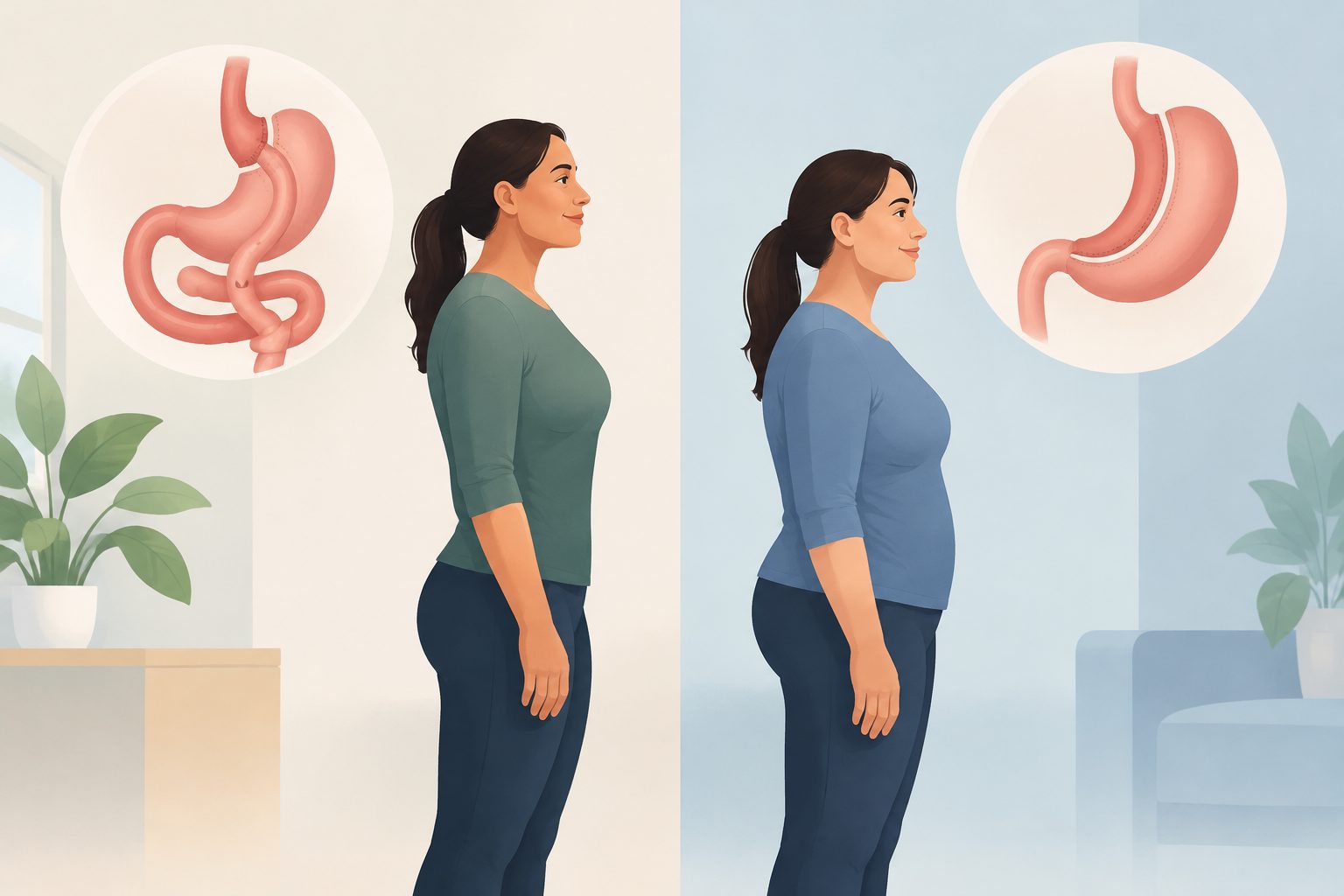
Editorial illustration — not from the study.
Researchers searched three medical databases for randomized trials reporting five-year weight-loss outcomes after sleeve gastrectomy or Roux-en-Y gastric bypass. They included four European studies with follow-up rates above 70% and judged each to have a low risk of bias.
In the pooled analysis, gastric bypass was associated with 8.5 percentage points more excess weight loss and 3.6 percentage points more total weight loss than sleeve surgery. The authors also showed that the same numerical results could lead to different conclusions when trials use superiority or equivalence designs and different definitions of an acceptable difference.
What the review covered
The researchers examined how the design and statistical hypothesis of a randomized trial can affect conclusions about five-year weight loss after two metabolic bariatric procedures: sleeve gastrectomy and Roux-en-Y gastric bypass. They searched PubMed, Embase, and the Cochrane databases through January 20, 2026, for randomized trials with more than 70% follow-up that reported percentage excess weight loss or percentage total weight loss. Four European trials, published between 2018 and 2025, met the criteria, including 975 participants in total. Two trials tested whether one procedure was superior, and two tested whether the procedures were equivalent within preset limits.
Key conclusions
The pooled estimates showed 8.5 percentage points more excess weight loss after Roux-en-Y gastric bypass than after sleeve gastrectomy, with a 95% confidence interval from 5.4 to 11.6 percentage points. Total weight loss was 3.6 percentage points higher after gastric bypass, with a 95% confidence interval from 2.4 to 4.9 percentage points. The results from the four trials were described as highly consistent when the actual average differences and confidence intervals were compared.
The review also found that the original trial conclusions were not always the same. In particular, a difference can be statistically consistent with greater weight loss after gastric bypass while also falling within a broad prespecified range used to define equivalence. This does not establish that the procedures have the same clinical value; it illustrates that the conclusion depends on the hypothesis and equivalence margin chosen before the trial.
Who this is relevant to
These findings are most directly relevant to people and health professionals interpreting five-year results from randomized comparisons of sleeve gastrectomy and Roux-en-Y gastric bypass, particularly in populations similar to those studied in the four European trials. They do not establish that one procedure is preferable for every person, and they do not address outcomes beyond the measures and follow-up included in the review. The results also may not apply to populations, healthcare settings, or surgical practices that differ substantially from those represented in the included studies.
Why it matters
The work highlights why results from clinical trials cannot be interpreted from a single label such as "equivalent" or "superior" without examining the numerical estimates, confidence intervals, and criteria set in advance. It suggests that, in these four trials, gastric bypass produced more average long-term weight loss, while leaving open whether the size of that difference is clinically meaningful. The review notes that there is no single formally established threshold for a clinically important difference in these weight-loss measures.
Limitations & evidence assessment
Only four European randomized trials met the strict inclusion criteria, so the review was based on 975 participants and may not represent all settings or patient groups. Two other studies were excluded because too few participants had the required in-person follow-up. The included trials used different outcome measures, trial hypotheses, and equivalence margins, making their original conclusions difficult to compare directly. The review also states that no clear threshold for a clinically meaningful difference in total weight loss was reported in the included articles; therefore, statistical differences should not automatically be treated as clinically important.
Why this evidence level: Systematic review aggregating primary studies with explicit methodology.
Evidence levels are editorial estimates derived from study metadata — they are not clinical appraisals.
// Source
Obesity Surgery · 2026 · DOI: 10.1007/s11695-026-08993-8
Researchers combined genetic data from more than 1 million human participants to study factors associated with endometriosis. They identified 58 genomic regions, including 27 not previously reported, and used additional molecular analyses to implicate 314 genes. These findings point to possible biological pathways for further research, but they do not establish causes or demonstrate that any treatment will work.
Researchers systematically reviewed laboratory studies of how temperature affects the time it takes arboviruses to become transmissible inside mosquitoes. Across 53 studies covering 17 viruses, higher temperatures were generally linked with greater transmission efficiency and a shorter time to infectiousness for Zika and West Nile viruses, while results for several other viruses were unclear.
This systematic review and meta-analysis examined whether ultra-low-dose computed tomography (CT) can detect pulmonary, or lung, nodules while using less radiation than standard-dose CT. Across 42 studies involving 15,792 patients, pooled sensitivity for nodule detection was 91.9%, but results varied greatly between studies. The review also found that ultra-low-dose CT used an average effective dose of 0.22 millisieverts (mSv), while detection was less reliable for some small or hazy nodules and in patients with a high body mass index.