Review finds higher short-term risks for some people with cirrhosis after keyhole liver surgery
An analysis of 32 studies linked cirrhosis with more transfusions, open-surgery conversions, and some 90-day complications, but study bias limits certainty.
Moderate evidenceReviewInterpret with caution
Medical disclaimer: This article summarizes research findings and is for informational purposes only. It is not medical advice.
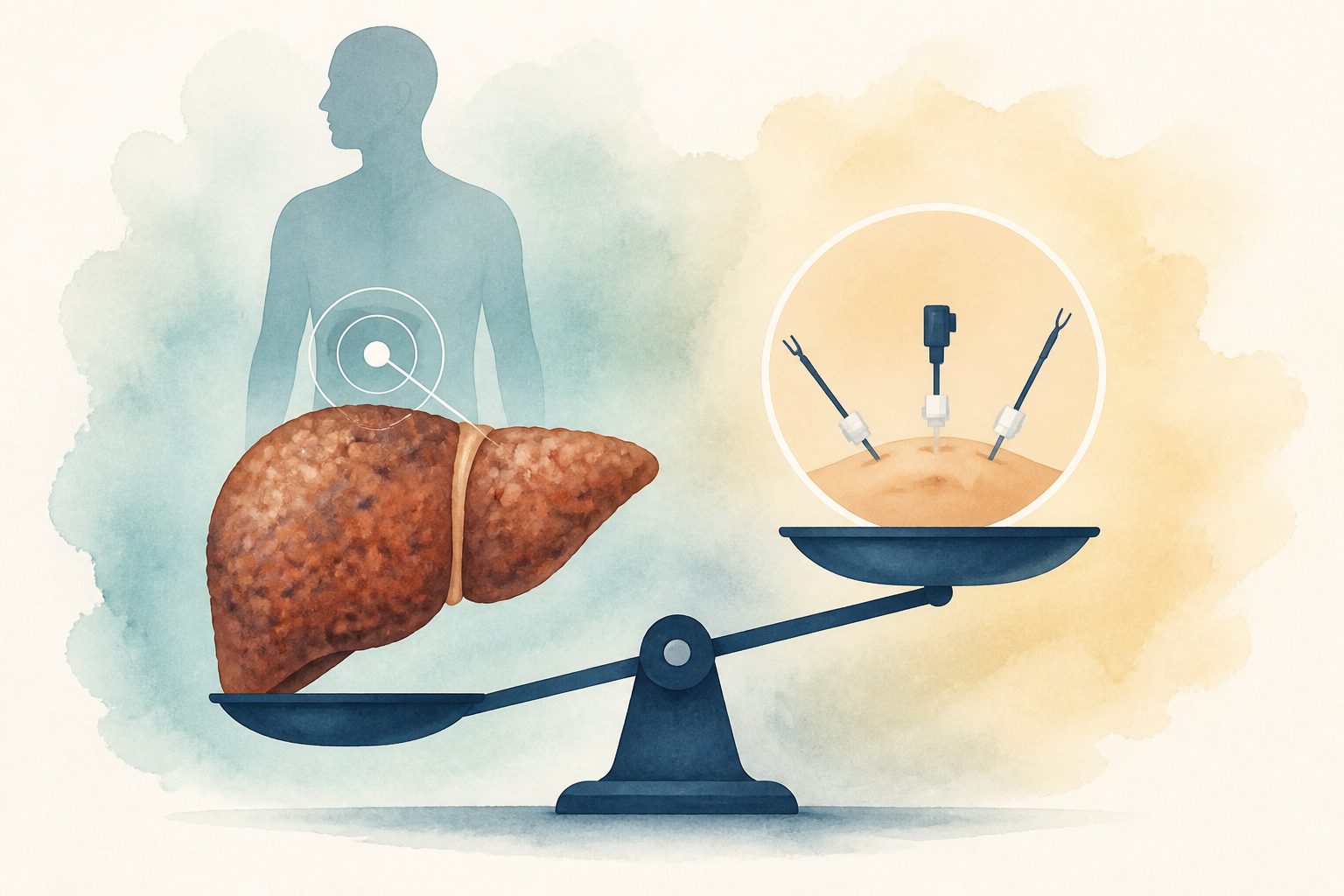
Editorial illustration — not from the study.
Researchers combined results from 32 studies comparing patients with and without cirrhosis who underwent minimally invasive liver resection. Most patients with cirrhosis were carefully selected people with Child-Pugh A disease and were treated at high-volume centers.
The analysis found associations between cirrhosis and higher rates of transfusion during surgery, conversion to open surgery, and complications and death within 90 days. Outcomes measured at 30 days were similar between groups. The findings do not establish that cirrhosis itself caused the differences, because the included studies had important risks of bias.
The question reviewed
The researchers reviewed studies identified through searches of PubMed, Embase, CINAHL, Scopus, and Web of Science through September 17, 2025. The review included 32 human studies involving 12,892 patients undergoing minimally invasive liver resection: 5,658 had cirrhosis and 7,234 did not. The main outcomes were blood transfusion during surgery, conversion from minimally invasive surgery to open abdominal surgery, complications, and death at 30 and 90 days. The analysis also examined differences between people with Child-Pugh A and Child-Pugh B cirrhosis and the role of portal hypertension.
Key conclusions
Compared with patients without cirrhosis, patients with cirrhosis had higher odds of receiving a transfusion during surgery (odds ratio 1.55), being converted to open surgery (1.24), having a complication within 90 days (1.38), and dying within 90 days (1.82). The reported confidence intervals were 1.17–2.05, 1.05–1.47, 1.04–1.83, and 1.24–2.67, respectively. Thirty-day complications and deaths were similar between groups. Among patients with cirrhosis, Child-Pugh B disease was associated with more transfusions than Child-Pugh A disease (1.48), and portal hypertension was associated with more conversions to open surgery (1.66). These are associations from combined studies, not proof that cirrhosis or these other conditions caused the outcomes.
Who this may apply to
These findings may apply most closely to adults with cirrhosis who undergo minimally invasive liver resection in experienced, high-volume centers, particularly those with Child-Pugh A disease. They may not apply to people with more advanced cirrhosis, different medical conditions, different types of liver surgery, or treatment in other healthcare settings. The review does not provide individualized predictions, and its reported associations should not be treated as proof of cause or as applicable to every patient.
The significance
The findings indicate that liver surgeons and patients in settings similar to those studied may face different short-term outcome patterns when cirrhosis is present. They are most relevant to carefully selected patients, particularly those with Child-Pugh A cirrhosis treated at high-volume centers. Because the evidence came from studies with serious risk of bias, the size and reliability of the reported differences remain uncertain.
Limitations & evidence assessment
The authors reported serious risk of bias across the included studies, limiting certainty about the associations. The review combined studies that were not described in the abstract as randomized trials, so differences between patient groups or treatment settings may have influenced the results. The abstract does not provide enough information to assess the individual studies' sample sizes, follow-up beyond 90 days, or how consistently outcomes were measured. The evidence also largely concerned carefully selected patients, predominantly those with Child-Pugh A cirrhosis treated at high-volume centers, so it may not represent people with more advanced disease or care in lower-volume settings.
Why this evidence level: This was a systematic review and meta-analysis combining 32 human studies and 12,892 patients. However, the authors reported serious risk of bias across the included studies, which lowers confidence in the strength of the associations.
Evidence levels are editorial estimates derived from study metadata — they are not clinical appraisals.
// Source
Annals of Hepato-Biliary-Pancreatic Surgery · 2026 · DOI: 10.14701/ahbps.26-117
This systematic review examined randomized human trials of concurrent chemotherapy and radiation for locally advanced head and neck, cervical, esophageal, and non-small-cell lung cancers. Across the included trials, combined treatment was reported to provide better overall survival than radiation alone, but it also caused more severe short-term side effects. The review did not provide enough information in its abstract to show how many trials or patients were included.
Researchers pooled results from seven human studies comparing multiple-staged with single-stage removal and reconstruction of congenital melanocytic nevi, sometimes called congenital moles. Staged surgery was associated with fewer major wound complications and recurrences, as well as slightly shorter and narrower scars, but the studies did not find a clear difference in cosmetic or overall patient satisfaction.
A cluster-randomized human study in 210 adults with recently detected stage 1 hypertension in Uzbekistan compared salt-sensitivity testing followed by assigned medication choices with conventional management. After 12 weeks, more participants in the testing-guided group reached the study's blood pressure target, although the study was small, short, and conducted in only three primary care centers.