Review compares epigenetic drugs with chemotherapy in relapsed T-cell lymphoma
The pooled studies found similar response rates, while some longer-term outcomes favored regimens containing epigenetic drugs.
Moderate evidenceReviewInterpret with caution
Medical disclaimer: This article summarizes research findings and is for informational purposes only. It is not medical advice.
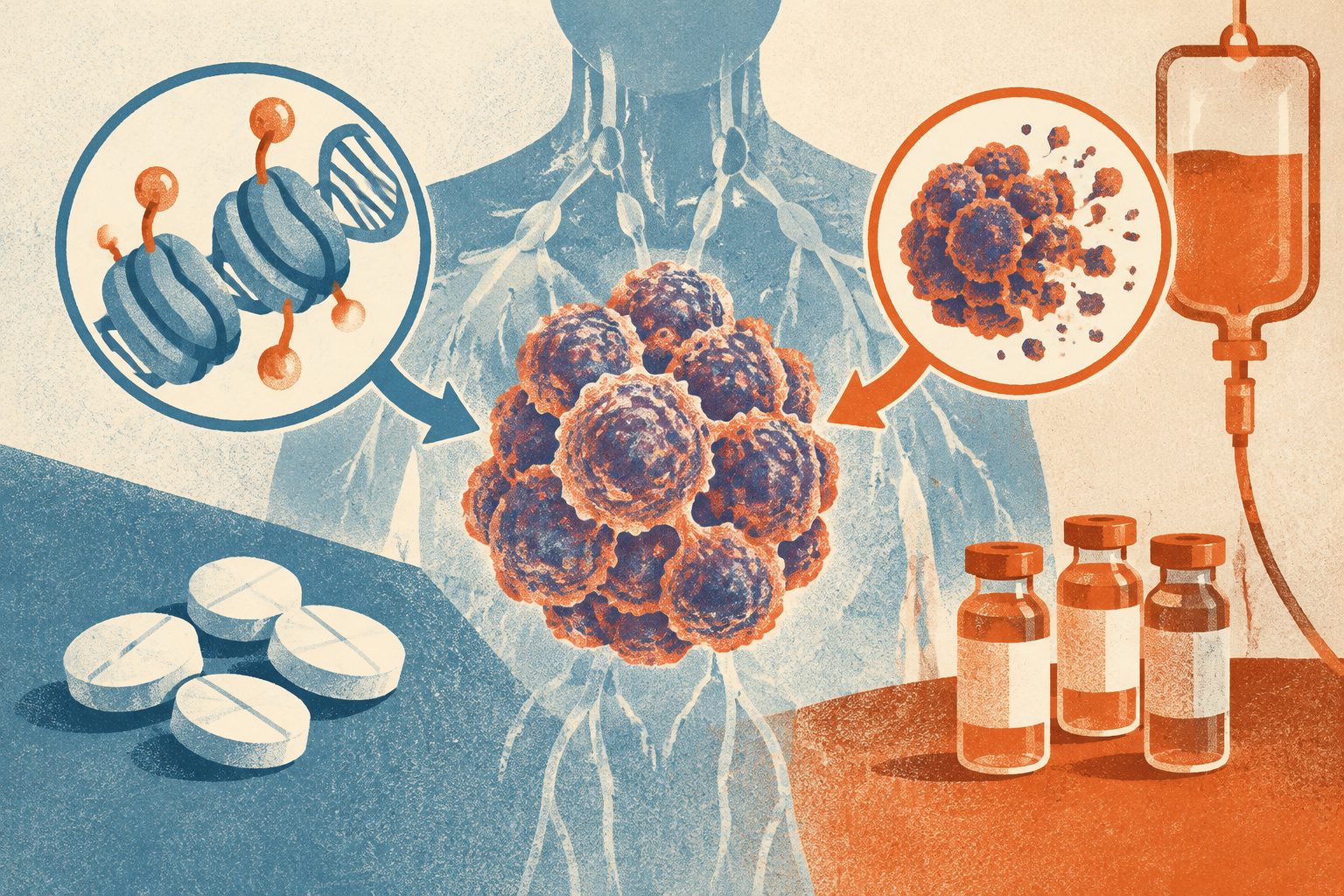
Editorial illustration — not from the study.
Researchers combined results from studies of people whose peripheral T-cell lymphoma had returned or had not responded to earlier treatment. They compared regimens containing at least one epigenetic drug with conventional chemotherapy that did not contain these drugs.
The pooled overall response rates were similar: 46% with epigenetic-containing regimens and 47% with conventional chemotherapy. At one year, progression-free survival was 28% versus 20%, and overall survival was 57% versus 41%, respectively. These differences may reflect the treatments, differences among the study populations, or both.
What the review covered
The researchers searched MEDLINE, Embase, and the Cochrane Library through May 2025. They included 38 prospective or retrospective human studies, covering 24 cohorts treated with epigenetic-containing regimens and 16 cohorts treated with conventional chemotherapy, for a total of 2,170 patients with relapsed or refractory peripheral T-cell lymphoma. The epigenetic regimens included at least one HDAC, DNMT or hypomethylating, or EZH1/2 inhibitor, used alone or in combination. The researchers pooled single-arm response and survival estimates and used subgroup analyses and meta-regression to examine whether differences in patient and disease characteristics affected the results.
Key conclusions
The pooled overall response rate was 46% with epigenetic-containing regimens, with a 95% confidence interval of 40% to 52%, compared with 47% with conventional chemotherapy, with a 95% confidence interval of 41% to 54%. This difference was not statistically significant.
The one-year progression-free survival rate was 28% with epigenetic-containing regimens versus 20% with conventional chemotherapy. The one-year overall survival rate was 57% versus 41%, respectively. Meta-regression found that use of an epigenetic-containing regimen was associated with better one-year progression-free survival after adjustment for the proportion of T-follicular helper-type disease, advanced-stage disease, and the number of previous treatment lines, but it was not associated with a higher response rate. These results describe associations across studies and do not establish that the epigenetic regimens caused the survival differences.
Where this may apply
These findings may be relevant to populations similar to the adults included in the underlying studies: people with relapsed or refractory peripheral T-cell lymphoma treated in comparable clinical settings. They do not necessarily apply to people with newly diagnosed lymphoma, other lymphoma types, children, or patients whose characteristics and prior treatments differ substantially from those cohorts. Because the evidence was not from randomized direct comparisons and the abstract does not provide detailed subgroup information, the results should not be interpreted as showing that one regimen will have the same outcomes for every patient.
What this could mean
For people with relapsed or treatment-resistant peripheral T-cell lymphoma, the analysis adds a broad comparison of two treatment approaches in an area where the abstract says there is no uniform salvage standard. The similar response rates alongside differences in one-year survival measures suggest that response rate alone may not capture all clinically relevant outcomes. However, the findings are not a direct randomized comparison, so they do not establish which approach is more effective for an individual patient.
Limitations & evidence assessment
The main limitation is the study design: the analysis pooled separate prospective and retrospective cohorts, including single-arm studies, rather than results from randomized head-to-head trials. Patients, disease subtypes, prior treatments, disease severity, follow-up, and specific drug combinations may have differed between cohorts, which can create confounding. Meta-regression can adjust for some reported differences but cannot remove all bias. The abstract does not provide enough information to judge study quality, heterogeneity, or possible publication bias in detail. It also does not report treatment-related harms, so the comparison does not describe safety.
Why this evidence level: This meta-analysis combined results from 38 human studies involving 2,170 people, but the included evidence came from separate prospective or retrospective cohorts rather than randomized head-to-head trials. The pooled findings therefore provide a useful comparison but may be affected by differences between studies and patients.
Evidence levels are editorial estimates derived from study metadata — they are not clinical appraisals.
// Source
Cancer Research and Treatment · 2026 · DOI: 10.4143/crt.2026.0505
This systematic review examined randomized human trials of concurrent chemotherapy and radiation for locally advanced head and neck, cervical, esophageal, and non-small-cell lung cancers. Across the included trials, combined treatment was reported to provide better overall survival than radiation alone, but it also caused more severe short-term side effects. The review did not provide enough information in its abstract to show how many trials or patients were included.
Researchers pooled results from seven human studies comparing multiple-staged with single-stage removal and reconstruction of congenital melanocytic nevi, sometimes called congenital moles. Staged surgery was associated with fewer major wound complications and recurrences, as well as slightly shorter and narrower scars, but the studies did not find a clear difference in cosmetic or overall patient satisfaction.
A cluster-randomized human study in 210 adults with recently detected stage 1 hypertension in Uzbekistan compared salt-sensitivity testing followed by assigned medication choices with conventional management. After 12 weeks, more participants in the testing-guided group reached the study's blood pressure target, although the study was small, short, and conducted in only three primary care centers.