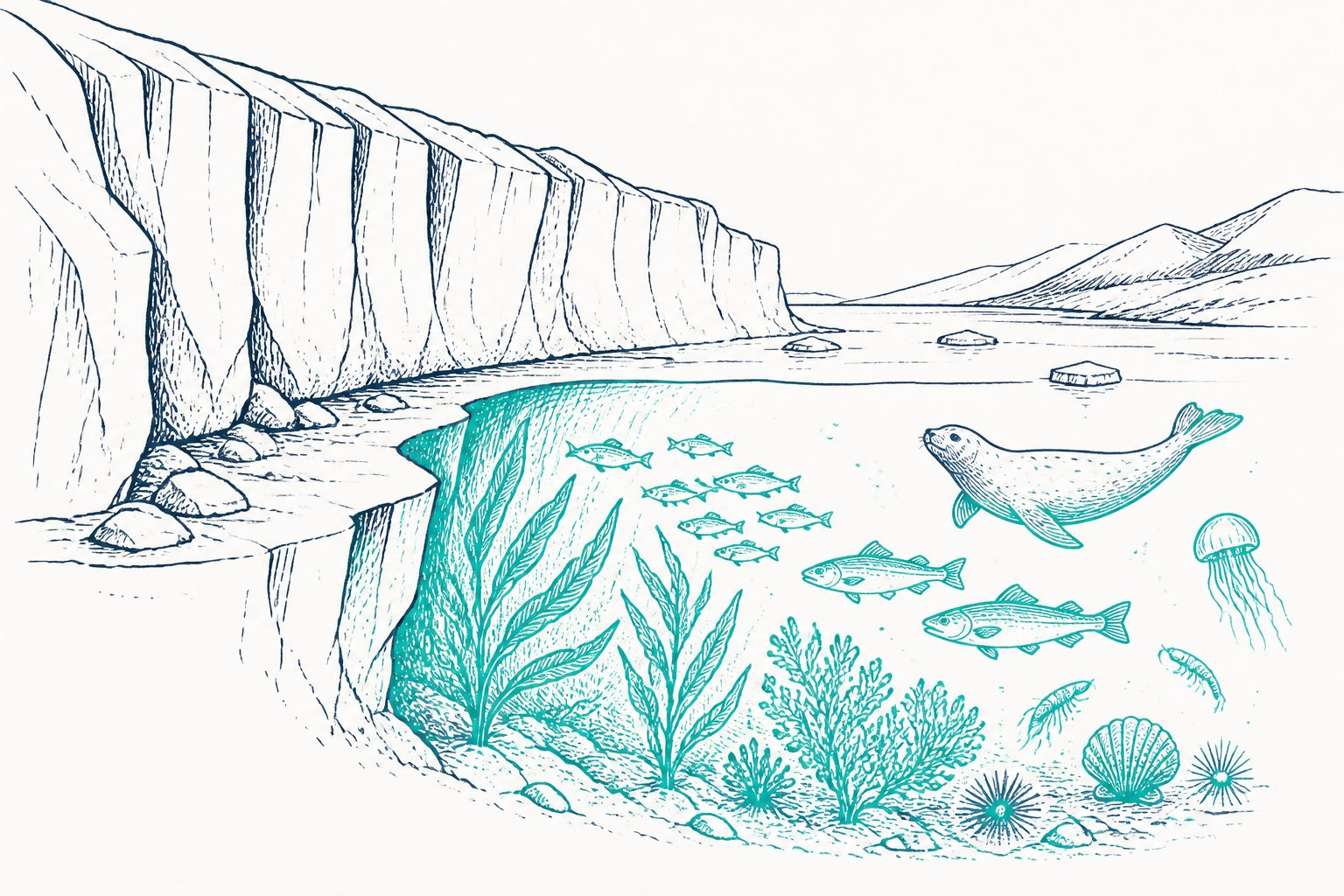
A remotely operated vehicle recorded zooplankton, fish and other organisms at the glacier’s underwater edge in May and August.
Researchers used a remotely operated underwater vehicle to observe the ocean boundary of Naajat Sermiat, a marine-terminating glacier in South Greenland. The footage showed large quantities of zooplankton, fish and other organisms at the glacier terminus in both May and August, along with glacier morphology and the discharge of meltwater and suspended material.
Aerial measurements tracked turbid plumes within meters of the glacier, while boat-based observations followed how those plumes changed down the fjord. The findings identify the glacier boundary as a dynamic water-and-sediment interface and an ecological hotspot.
Life at the glacier edge
The researchers directly observed glacier shape, meltwater discharge and suspended material at Naajat Sermiat’s ocean boundary using a remotely operated underwater vehicle. They found large quantities of zooplankton, fish and other organisms there in both May and August. The organisms seemed to be responding directly to material from the glacier, rather than to deeper nutrient-rich waters carried upward into the area, as previously assumed. Aerial measurements showed the structure of turbid plumes close to the glacier terminus, and boat observations showed how the plumes developed farther down the fjord.