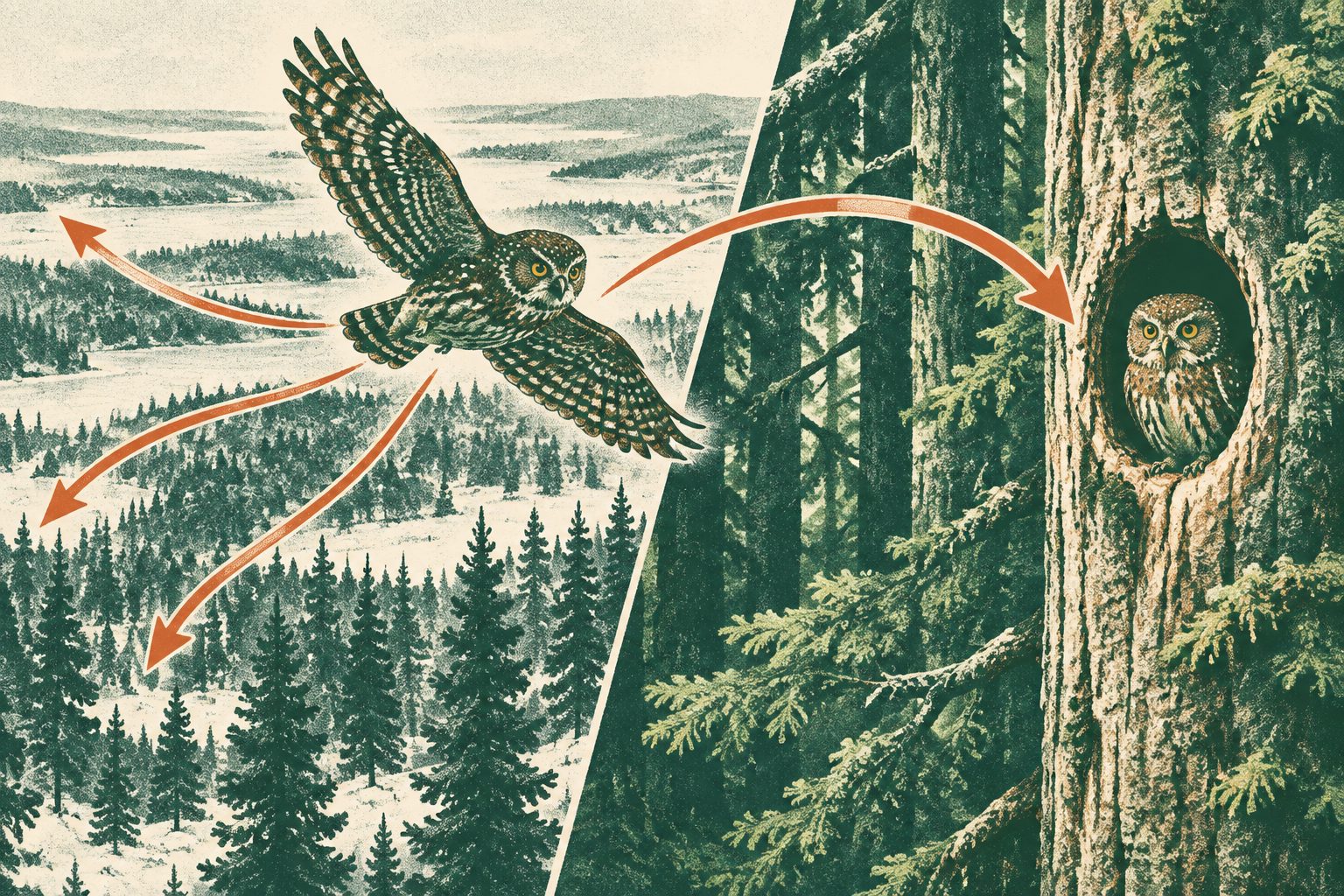
Owls in Finland used larger ranges and stayed active longer than Alpine birds, while both populations avoided open land and recent clear-cuts.
Researchers compared breeding male Eurasian Pygmy Owls in south-west Finland and the Western Italian Alps from 2021 to 2024. GPS tags on 26 birds produced 6,076 locations, which were used to study home ranges, hunting habitat and daily activity.
The owls were active during the day, with activity peaks around dawn and dusk. Boreal owls had home ranges about twice as large as those of Alpine owls and moved about one-third farther each day, while longer daylight and twilight were associated with longer activity periods. Across both regions, however, the birds showed a consistent dependence on continuous, mature forest.
How the owls used the landscape
The study found that Eurasian Pygmy Owls were clear forest specialists in both landscapes. Their home ranges were dominated by continuous forest, and the birds consistently avoided open habitats and recent clear-cuts.
Their movement and daily schedules differed between regions. Owls in boreal south-west Finland had home ranges about twice as large as those of owls in the Western Italian Alps, and their daily movement distances were about one-third greater. Activity was diurnal in both populations, with peaks at dawn and dusk, but Finnish owls had longer activity periods associated with extended daylight and twilight.
Evidence and caveats
This was a comparative field study of 26 breeding males—13 in south-west Finland and 13 in the Western Italian Alps—tracked with GPS between 2021 and 2024. The researchers analysed 6,076 locations alongside habitat and activity patterns using statistical models.
The study compares two populations in different regions rather than experimentally changing their habitats or daylight conditions. Its results show population-level differences associated with contrasting landscapes and photoperiods, but the design cannot by itself isolate the effect of each factor or establish that one directly caused the other. The sample also consisted only of breeding males in these two regions.