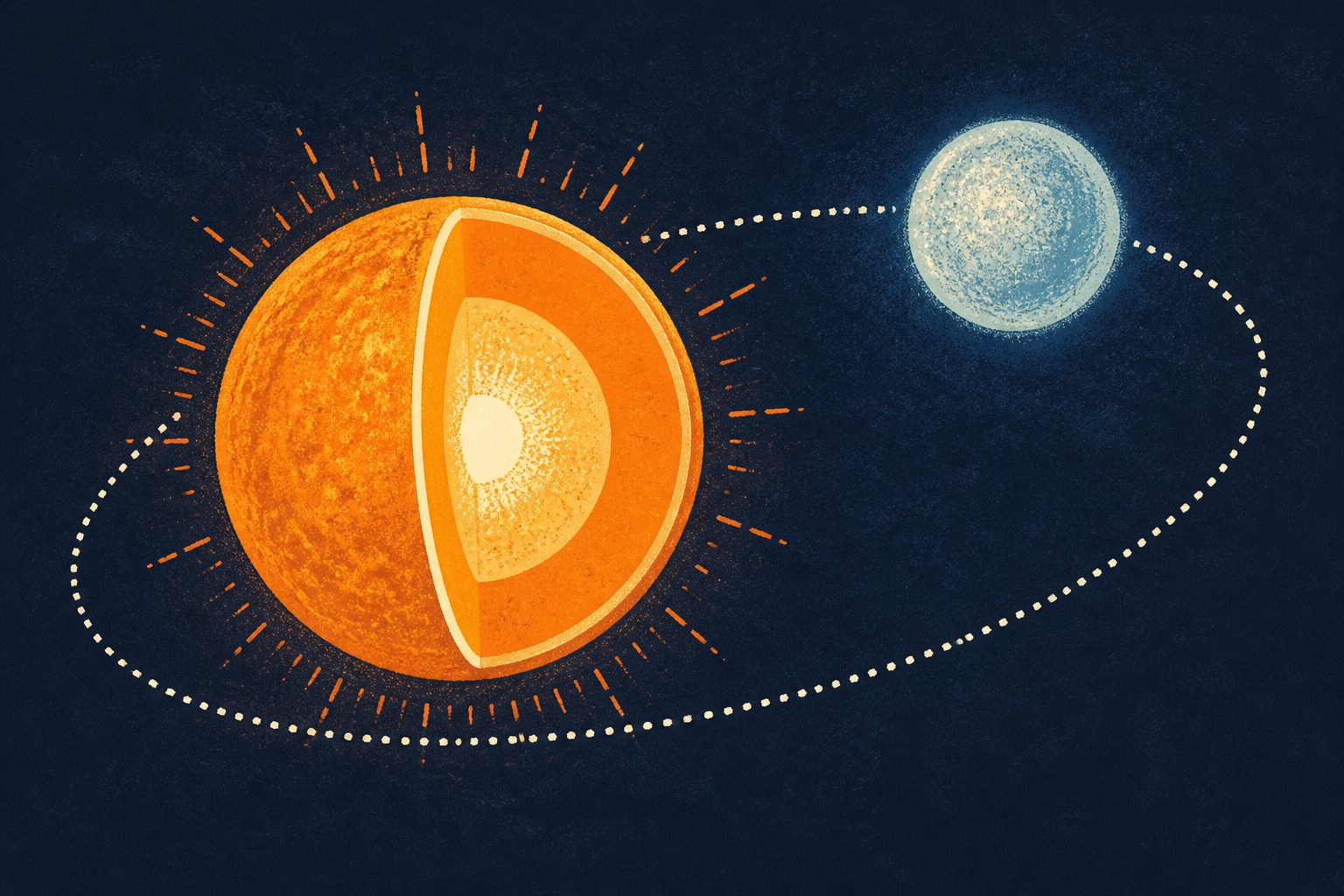
When one star passes in front of another, their combined signals help researchers measure stellar properties and test how stars evolve.
Long-duration, high-precision observations from space telescopes have greatly increased the number of known pulsating stars in eclipsing binary systems. Because eclipses reveal how the stars move and compare in size, and pulsations provide information about their interiors, researchers can combine the two types of evidence to study stars in greater detail.
The review describes how this approach can constrain processes including rotation, mixing, tides and mass transfer. Studying binary systems before and after interactions may also help test how binaries evolve, including the possible role of mergers.
What the stars reveal
The review finds that pulsating stars in eclipsing binaries offer two complementary sources of information. Eclipses and repeated spectroscopic observations can provide model-independent dynamical masses and radii, while the stars’ pulsations can constrain conditions inside them, including rotation and mixing.
The authors also describe how these systems can be used to test the effects of tides on pulsations, stellar structure and orbital motion. Asteroseismology—the study of internal stellar structure through vibrations—can further help constrain binary evolution involving tides, mass transfer and mergers.
Evidence and caveats
This is a review article that synthesizes results from space-based light curves and multiepoch spectroscopy rather than reporting one new experiment or a single sample. The abstract does not give the review’s full set of studies or quantify the precision of the constraints.
Pulsating binaries are difficult to interpret because the relevant techniques and physical processes vary with the systems’ orbital and physical properties. Tides can affect the pulsations, stellar structure and orbit at the same time, so separating these effects remains a central challenge.
// Source
Annual Review of Astronomy and Astrophysics · 2026 · DOI: 10.1146/annurev-astro-120425-015551
Authors: J. Southworth, D. M. Bowman
Institutions: Newcastle University, Keele University, Institute of Astronomy, Newcastle College