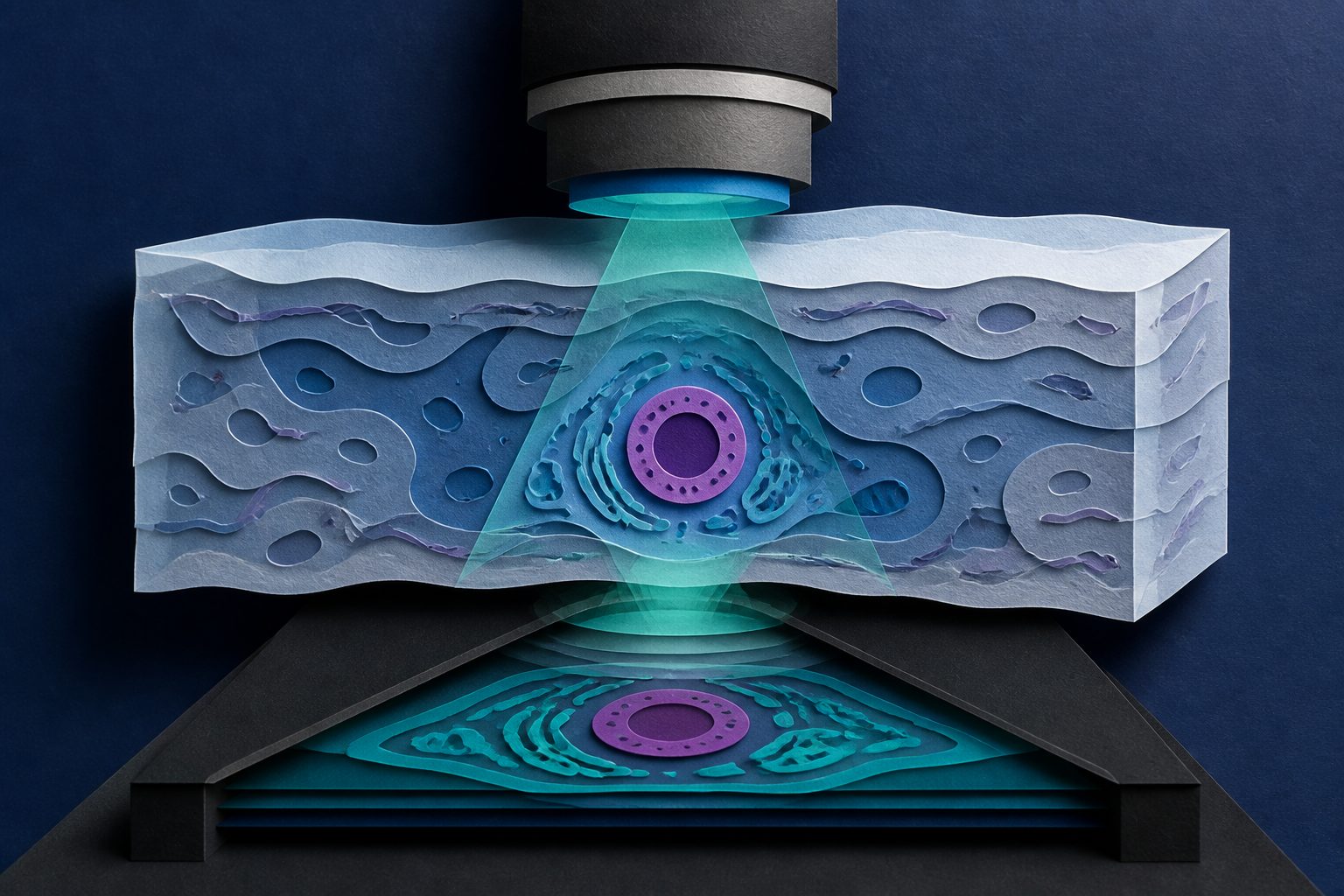
Light scattering can scramble information in thick biological samples, making it difficult to see structures deep inside them. The researchers tested multi-slice beam propagation, a physics-based computational method that reconstructs a sample’s three-dimensional refractive index—the way its material changes the path of light.
They found that using an amplitude-only measure in the reconstruction calculation, together with measurements taken from different angles and at different focus settings, enabled fully volumetric, label-free imaging with subcellular resolution across multiple-scattering samples. The work was demonstrated using both model samples and biological samples.