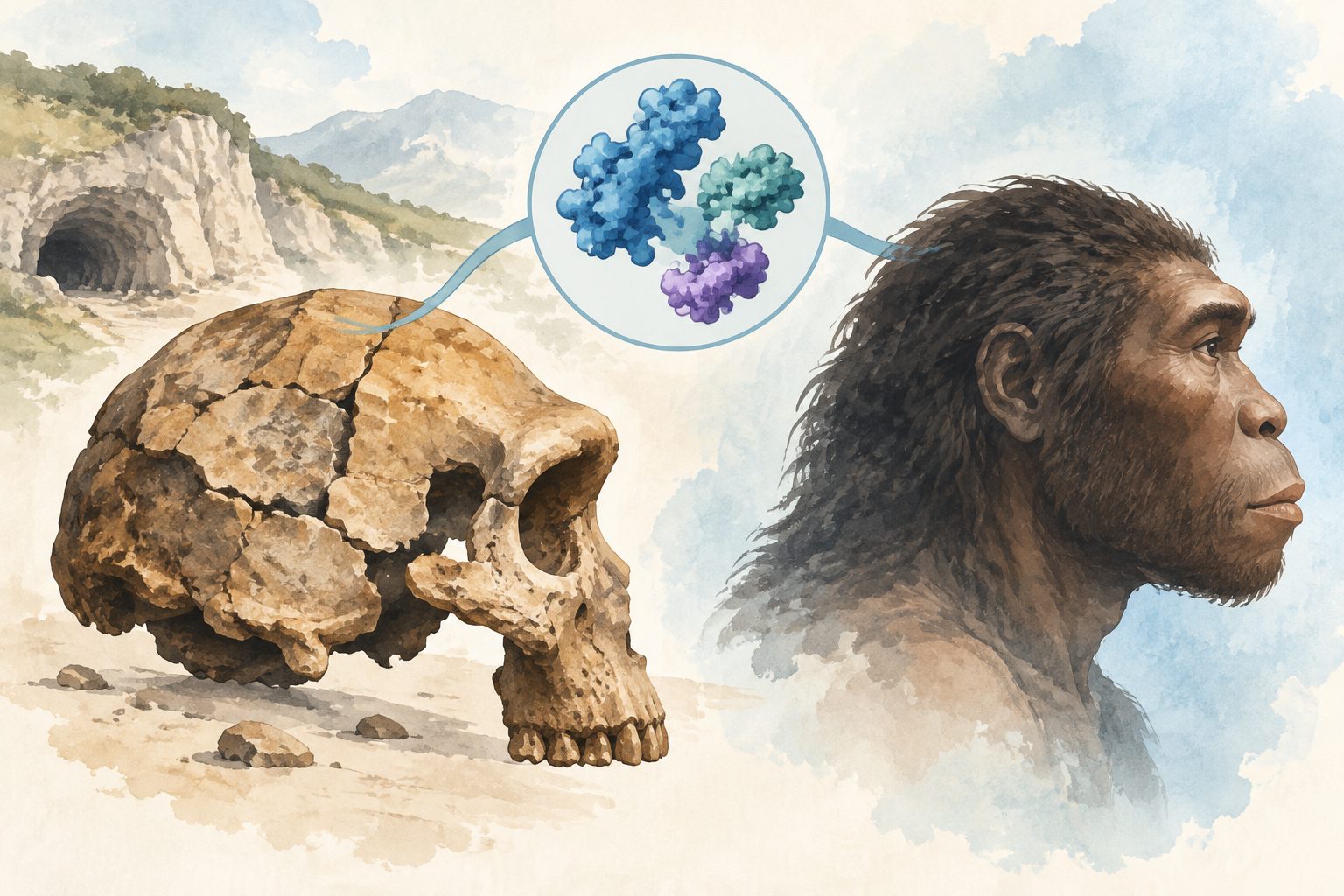
Proteins and shared skull features place Xujiayao and several other East Asian fossils within the Denisovan lineage.
Researchers examined Xujiayao fossils, which date to about 199,000 to 138,000 years ago, using palaeoproteomics and comparisons of physical features. Proteomic analysis of two specimens identified 18 proteins, including a Denisovan-specific change in the COL1A2 protein that strongly supported their affiliation with the Denisovan lineage.
The researchers also identified shared features among fossils from Xujiayao, Harbin, Jinniushan, Dali and Hualongdong. They describe Denisovans as having a low skull profile with nearly parallel side walls, a large brow ridge, a flat cheek-and-upper-jaw region and a relatively weak projection of the face.
Denisovan protein and skull clues
Proteomic analysis of two Xujiayao specimens identified 18 proteins that originated in the hominins rather than from later contamination, according to the abstract. Both specimens showed the Denisovan-specific COL1A2-996 R>K mutation, which strongly supported their assignment to the Denisovan lineage.
Morphological comparisons linked Xujiayao and Harbin fossils with other late Middle Pleistocene archaic Homo from East Asia, including Jinniushan, Dali and Hualongdong. The shared Denisovan pattern included a low cranial profile with near-parallel lateral walls, a massive supraorbital torus, a flat zygomaxillary region and weak prognathism. The fossils also combined traits seen in Homo erectus, modern humans and late Neanderthals.
// Source
Nature · 2026 · DOI: 10.1038/s41586-026-11132-z
Authors: Song Xing, Zhongyou Wu, Qingfeng Shao, Junyi Ge, E. Andrew Bennett, Huiyun Rao, Sungui Lin, Yuhao Zhao, Feng Liu, Yichen Liu, Kai Zhou, Xiaotian Feng, Qigao Jiangzuo, Qiaomei Fu
Institutions: Chinese Academy of Sciences, Peking University, University of Chinese Academy of Sciences, Nanjing Normal University, Institute of Vertebrate Paleontology and Paleoanthropology, Centro Nacional de Investigación sobre la Evolución Humana