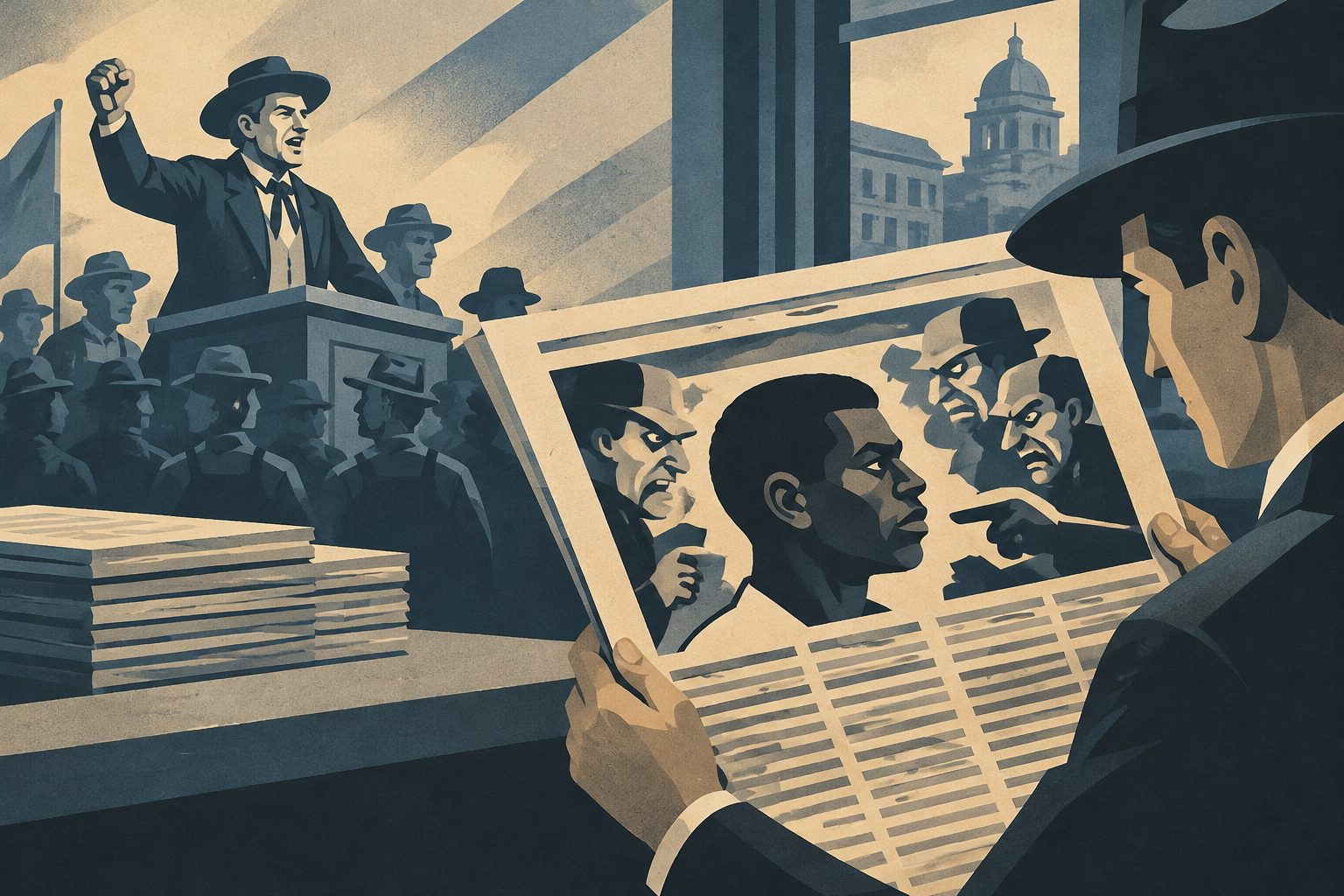
A study of 19th-century newspapers finds the increase was concentrated in counties where Democrats faced a stronger Populist challenge.
The study examines Southern newspapers around the 1892 presidential election, when the Populist Party attracted support from poor farmers and challenged Democratic dominance. The researchers measured anti-Black propaganda in newspaper text and compared changes over time between counties with and without signs of a serious Populist threat.
After October 1892, anti-Black propaganda increased most in Democratic-affiliated newspapers in threatened counties. The pattern was not found in independent or other-party newspapers, and the authors say it was absent outside the South, where they did not expect the same political incentive.
Newspapers changed after 1892
Counties were classified as facing a Populist threat when the Populists gained votes and Democrats lost votes relative to the 1888 presidential election. After October 1892, newspapers in those counties published about 0.37 more pages of anti-Black propaganda per month than newspapers in counties without the same threat—about a 20% increase over the sample average, or roughly 52 additional pages per newspaper over the study period.
The increase was driven by Democratic-affiliated newspapers. They produced about 0.4 additional pages of anti-Black propaganda per month after October 1892 compared with papers in counties not exposed to the Populist threat. The researchers found no comparable effect in independent newspapers or those affiliated with other parties. Additional analyses were consistent with Democrats benefiting from this propaganda in subsequent elections.
Evidence and remaining questions
The researchers used text data from a large historical newspaper collection and difference-in-differences comparisons, including comparisons across newspaper affiliations, counties and the South. Newspaper and month fixed effects accounted for newspapers’ time-invariant racial bias and content shared across papers in a given month. The results remained robust when the researchers excluded papers whose political affiliation was unknown and had been treated as Democratic in the main analysis.
The study cannot definitively rule out demand for anti-Black content among readers as an explanation for part of the pattern. Political affiliation was unavailable for about 32% of the newspapers; about 49% were identified as Democratic-affiliated and almost 18% as affiliated with Republicans, Populists, independent or no party. The authors therefore describe the evidence as showing that the stories were likely, but not definitively proven to be entirely, propaganda supplied by partisan newspapers.