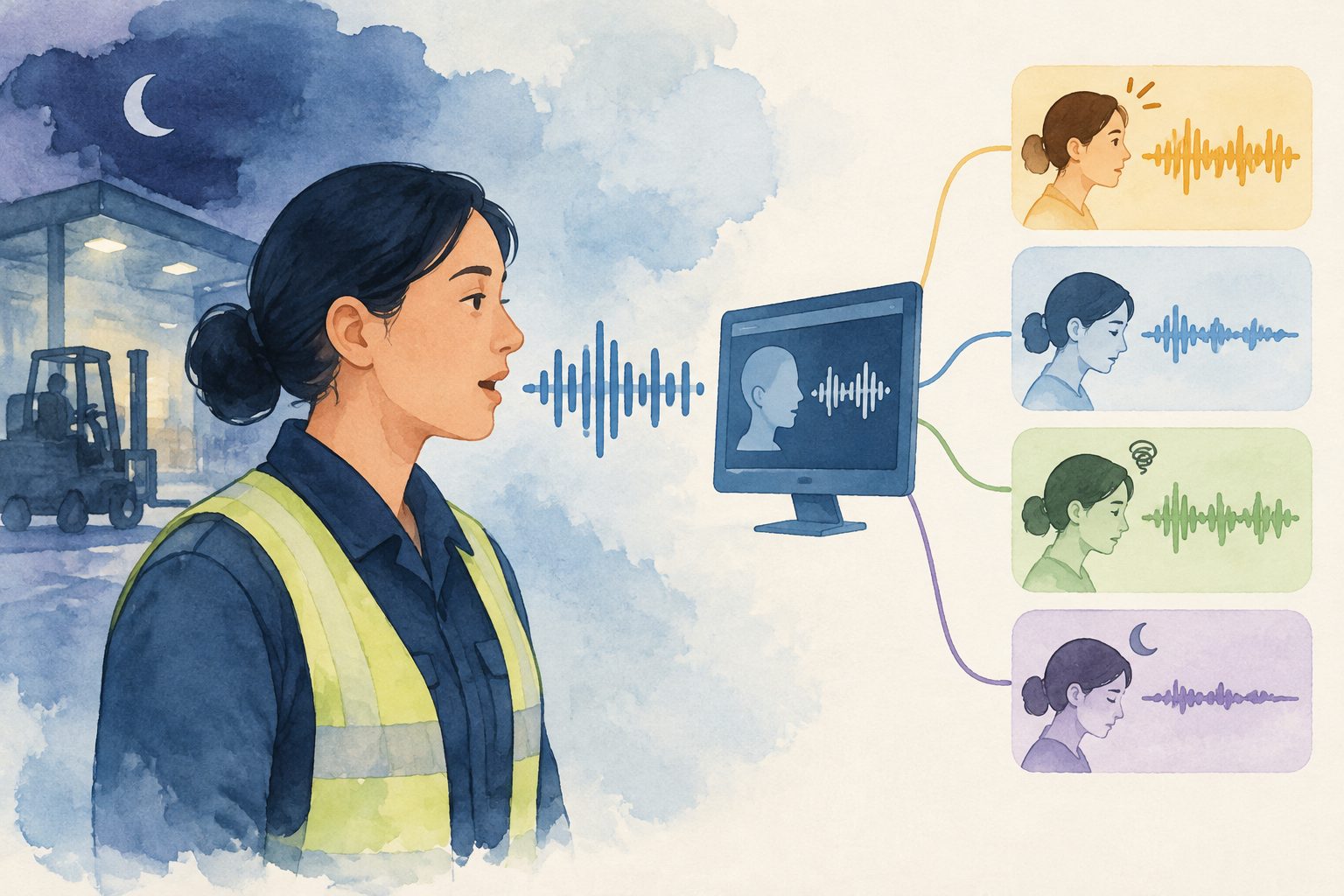
A two-week study suggests brief recordings could help measure both sleepiness and longer-lasting exhaustion.
Participants provided speech samples and fatigue reports twice a day for two weeks while going about their usual lives. Researchers analyzed nonverbal aspects of speech, such as features of how people spoke, and tested predictions on data the models had not seen before.
Across the full group, speech predicted current sleep deprivation and self-reported sleepiness with good performance. Predictions of more subjective fatigue measures, including physical and mental exhaustion, improved when the models used information specific to each participant.
What the speech predicted
The study included 1,197 people from six countries, with measurements taken twice daily for two weeks. In the group-level analysis, speech features predicted time since sleep and current sleepiness with performance described by the researchers as good and close to or above existing leading results.
Predictions were less accurate for physical exhaustion, mental exhaustion, lack of energy and lack of motivation when people were analyzed together. Models that accounted for each person’s own patterns showed robust performance increases and could detect these more subjective forms of fatigue. Using speech from several activities at each measurement time generally performed slightly better than using one activity alone; the single-activity models performed about 10% lower.
Why repeated tracking matters
Shift workers can experience fatigue that changes over short periods and may also develop into more persistent physical or mental exhaustion. Brief speech samples could offer a low-burden way to monitor several dimensions of fatigue repeatedly, without relying solely on longer questionnaires or specialized equipment.
The researchers say regular, real-time monitoring could eventually help identify people at heightened risk of fatigue-related health problems early enough to consider interventions. This study provides preliminary support for that possibility, but it does not test whether speech monitoring improves health or changes outcomes.
Evidence and caveats
This was an intensive longitudinal prediction study, not an intervention trial. Participants provided repeated speech samples and self-reported fatigue measures, and the models were evaluated on held-out data. The sample included people from six countries; 83% reported being shift workers, and 43% of those shift workers worked schedules that included night shifts.
The study did not establish which specific vocal qualities drove the predictions. The speech representations were difficult to interpret, and the models may partly have learned speaker identity rather than fatigue. More subjective fatigue measures were harder to predict in group-level analyses and showed less variation during the two-week study, so longer studies may be needed to assess slower-moving forms of fatigue. The findings are therefore preliminary and do not show that the approach will work equally well for all workers or settings.