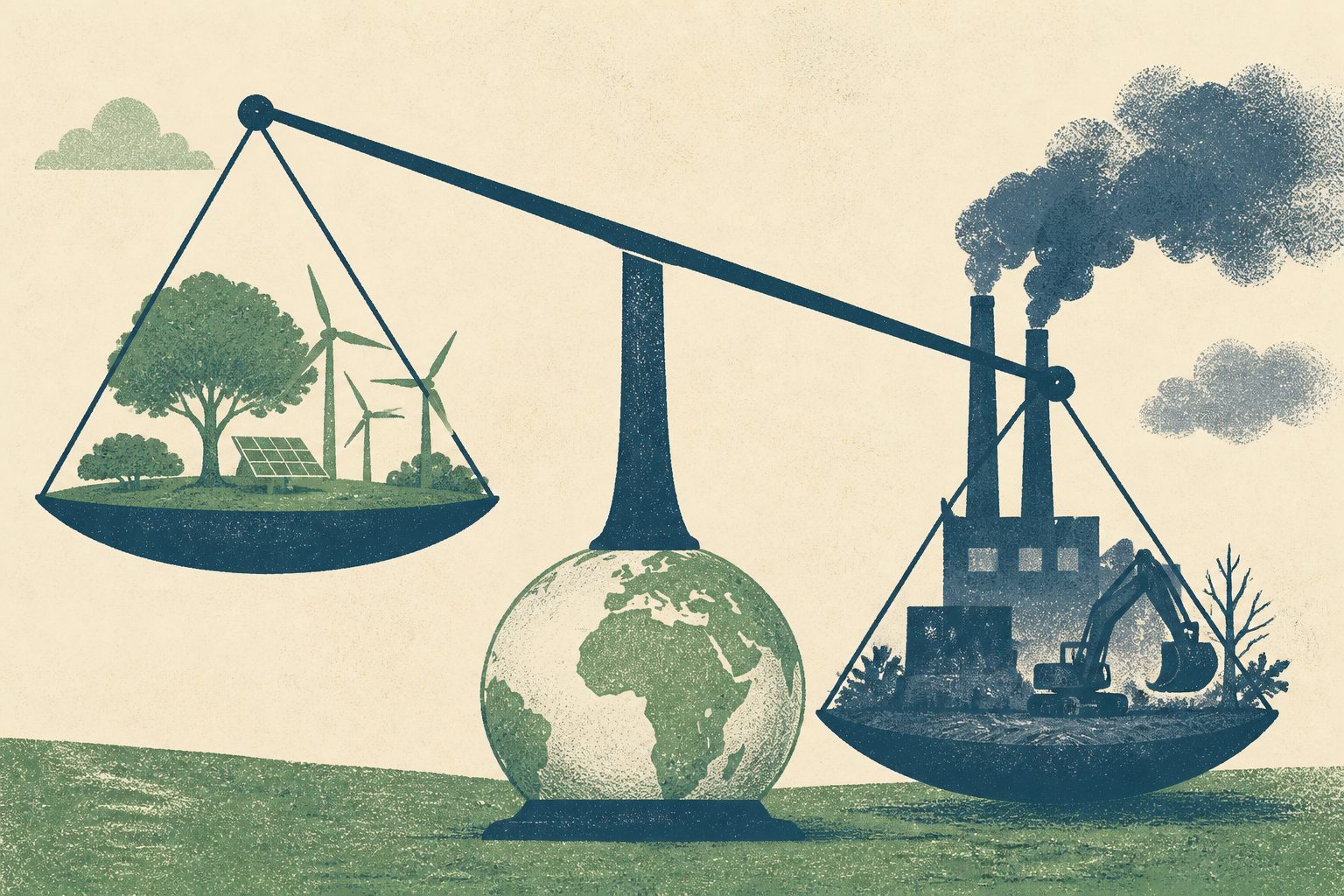
From 2000 to 2019, most land and people saw at least one setback, while only a small share improved across climate, air, development, and ecosystems.
Researchers looked at high-resolution data to track four parts of sustainable development—climate mitigation, air pollution control, socioeconomic activity and infrastructure, and ecosystem vitality—from 2000 to 2019.
They found deterioration in at least one dimension across 95.0% of land, affecting 94.8% of people, while only 5.0% of land—covering 5.2% of people—improved in all four dimensions.
Mixed progress across goals
The study reports widespread mixed outcomes rather than broad, simultaneous progress. Deterioration in at least one of the four dimensions occurred across 95.0% of land (94.8% of people), while improvement across all four occurred on 5.0% of land (5.2% of people). It also finds pronounced inequality between country income groups: 72.4% of people in high-income countries lived in improving areas, compared with 24.7% in low-income countries and 11.6% in lower-middle-income countries. Changes in carbon emissions, fine particle air pollution, nighttime light intensity, and vegetation greenness often moved in different directions, indicating tradeoffs among goals.
// Source
Communications Sustainability · 2026 · DOI: 10.1038/s44458-026-00124-9
Authors: Yangyang Guo, Wenhua Yu, Rongbin Xu, Zhihu Xu, Tingting Ye, Michael Tong, Sotiris Vardoulakis, Yuming Guo, Xuemei Bai
Institutions: Monash University, Australian National University, Chongqing University, Chongqing Emergency Medical Center, University of Canberra