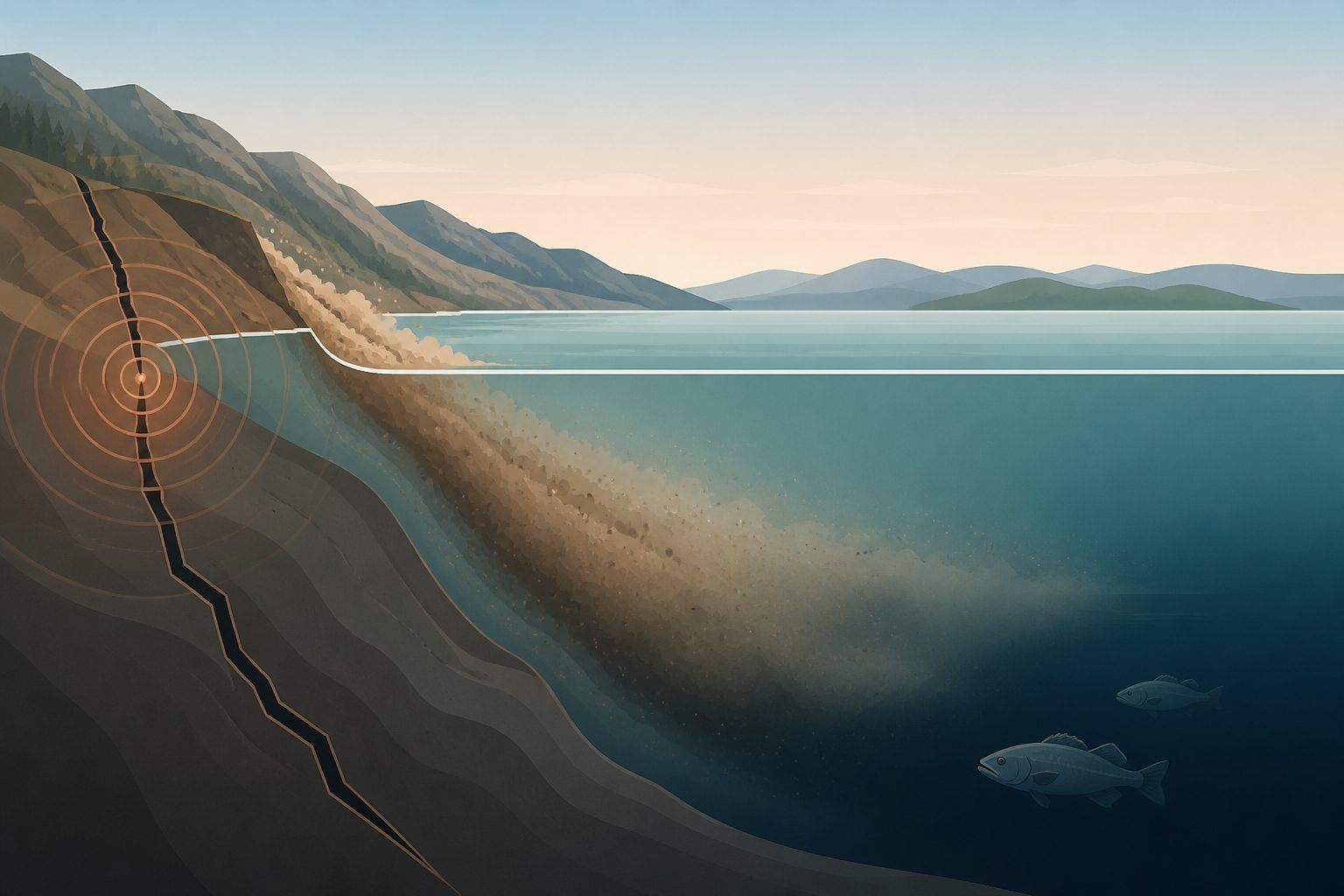
Measurements in the Toyama Deep-Sea Channel found that sediment flows after the earthquake were followed by higher nutrients and prolonged low-oxygen conditions.
Researchers used water measurements and instruments moored on the seafloor to examine conditions in Toyama Bay’s Toyama Deep-Sea Channel before and after the January 1, 2024 Noto Peninsula Earthquake. They found signs that large sediment flows carried organic-rich material from shallow areas into the deep sea, followed by oxygen depletion and higher nutrient concentrations.
Two smaller sediment flows were recorded on March 30–31 and May 17–18. Low-oxygen conditions lasted at least 152 days after the earthquake, while oxygen and water-cloudiness levels returned to pre-earthquake conditions by June 2025 as these smaller events became less frequent.
Sediment flows changed water conditions
After the earthquake, oxygen levels in the Toyama Deep-Sea Channel temporarily fell, and low-oxygen conditions persisted for at least 152 days. Nutrient concentrations increased at the same time, consistent with the decomposition of organic matter carried into the channel.
Water also became temporarily more turbid, indicating that sediment was transported or stirred up. Instruments on the channel floor recorded two post-earthquake sediment-flow events, on March 30–31 and May 17–18. These flows had strong, downslope currents concentrated near the bottom, exceeding 16 centimeters per second, along with temporary increases in temperature and turbidity. They were weaker and smaller than the large flow associated with the main earthquake, but comparisons with earlier conditions suggest that smaller flows became more common afterward. Oxygen and turbidity returned to pre-earthquake conditions in June 2025 as the smaller flows became less frequent.
Evidence and limits
The study is based on hydrographic and mooring observations collected before and after the January 1, 2024 earthquake in the Toyama Deep-Sea Channel. The observations support a link between the earthquake, sediment flows, oxygen depletion and nutrient increases, but the abstract does not provide the size of the affected area or the exact changes in oxygen and nutrient concentrations. The two later sediment-flow events also coincided with meteorological disturbances, although comparisons with pre-earthquake conditions suggest such events became more likely after the earthquake. Biological effects were not reported.
// Source
Journal of Oceanography · 2026 · DOI: 10.1007/s10872-026-00805-y
Institutions: Kyushu University, University of Toyama