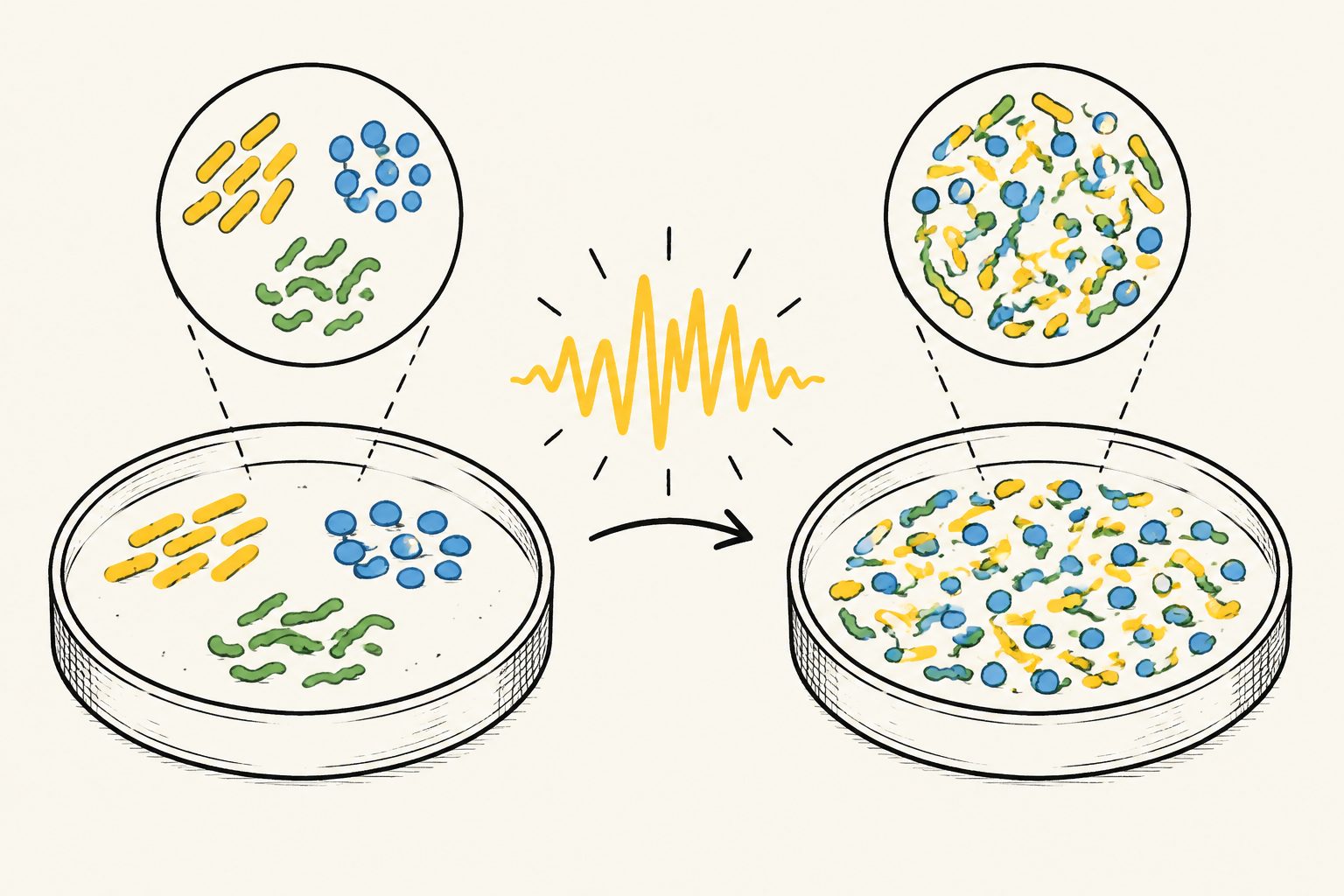
A study finds that higher-order interactions among three or more species can be difficult to distinguish from measurement noise.
The study applies mathematical tools from genetic fitness landscapes to microbial community-function landscapes, where each community is represented by the species it contains and its measured function. The researchers examined how uncertainty grows as interactions involve more species and how much each interaction order contributes to overall functional variation.
They analyzed a fully sampled landscape built from all combinations of 10 bacterial strains and used generalized Lotka–Volterra simulations to test whether noise could produce misleading higher-order patterns. The results indicate that higher-order effects are harder to detect both because their estimates combine many measurements and because their contributions are diluted across the landscape.
What the measurements could show
The researchers found two limits on detecting interactions involving three or more species. First, estimating a local interaction of order k requires combining measurements from 2^k community configurations, so experimental uncertainty grows rapidly with interaction order. Second, higher-order effects make smaller contributions to total functional variation because the landscape’s combinatorial structure spreads their influence across many possible interactions.
In the fully sampled landscape of all combinations of 10 bacterial strains, only first-order effects—those involving individual species—and second-order effects—those involving pairs of species—could be distinguished from experimental noise. Generalized Lotka–Volterra simulations showed that noise alone can produce the appearance of higher-order structure even when direct mechanistic interactions are pairwise and indirect interactions are weak.
Evidence and caveats
The study combines a mathematical analysis of noisy community-function landscapes, measurements from a fully sampled landscape of 10 bacterial strains, and generalized Lotka–Volterra simulations. The analysis accounts for stochastic variation and batch effects and also examines departures from idealized noise assumptions.
The results set limits on what can be inferred from finite, noisy data; they do not show that higher-order interactions are absent in nature. The experimental landscape involved one 10-strain system, and the broader claims concern structural limits that the researchers argue apply across high-dimensional ecological and genetic landscapes. The simulations also illustrate what noise can produce under specified model conditions rather than directly measuring every possible microbial interaction.