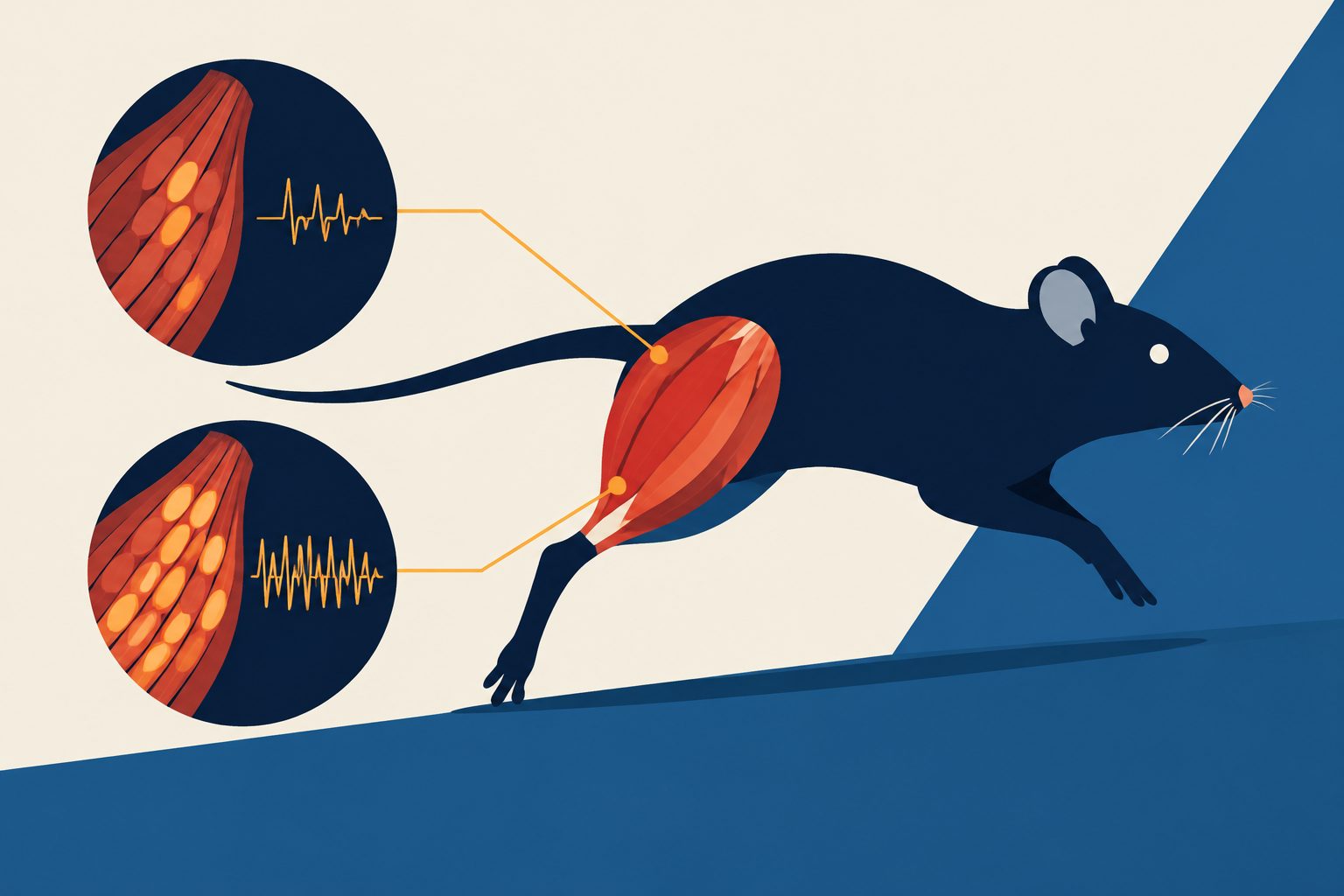
Recordings from two elbow muscles showed that faster walking involved bringing more motor units into action, while also increasing their firing rates.
Researchers combined detailed measurements of mouse walking with recordings from individual motor units in two parts of the triceps brachii, a muscle group involved in elbow and shoulder movement. The recordings showed distinct patterns of activity in the two muscle parts and considerable variation from one motor unit to another.
As walking speed increased, both the likelihood that a motor unit would be recruited and its firing rate increased. Recruitment changed proportionally more than firing rate, and the recruitment of individual units occurred alongside changes in the movement of the limbs.
How mice control speed
The researchers found three main patterns. First, the lateral and long heads of the triceps brachii had significantly different motor-unit activity, suggesting they are controlled differently despite being closely located. Second, individual motor units were recruited probabilistically: a given unit was active during only a subset of strides. This means that repeatable overall muscle signals can be produced by changing subsets of active units from stride to stride. Third, faster walking increased both motor-unit recruitment and firing rate, but recruitment increased more than firing rate. The recruitment of individual units also accompanied changes in limb movement.
Evidence and caveats
The study combined quantitative analysis of mouse locomotion with recordings from individual motor units in the lateral and long heads of the triceps brachii. This provides more detail than bulk electromyography, which measures the combined electrical activity of many muscle fibers. The abstract does not report the number of animals or motor units recorded. The experiments focused on mouse walking and two parts of one muscle group, so the findings may not apply directly to other muscles, species or forms of movement. The recordings show systematic relationships between motor-unit activity, walking speed and limb movement, but the abstract does not establish that recruitment changes alone cause the kinematic changes.