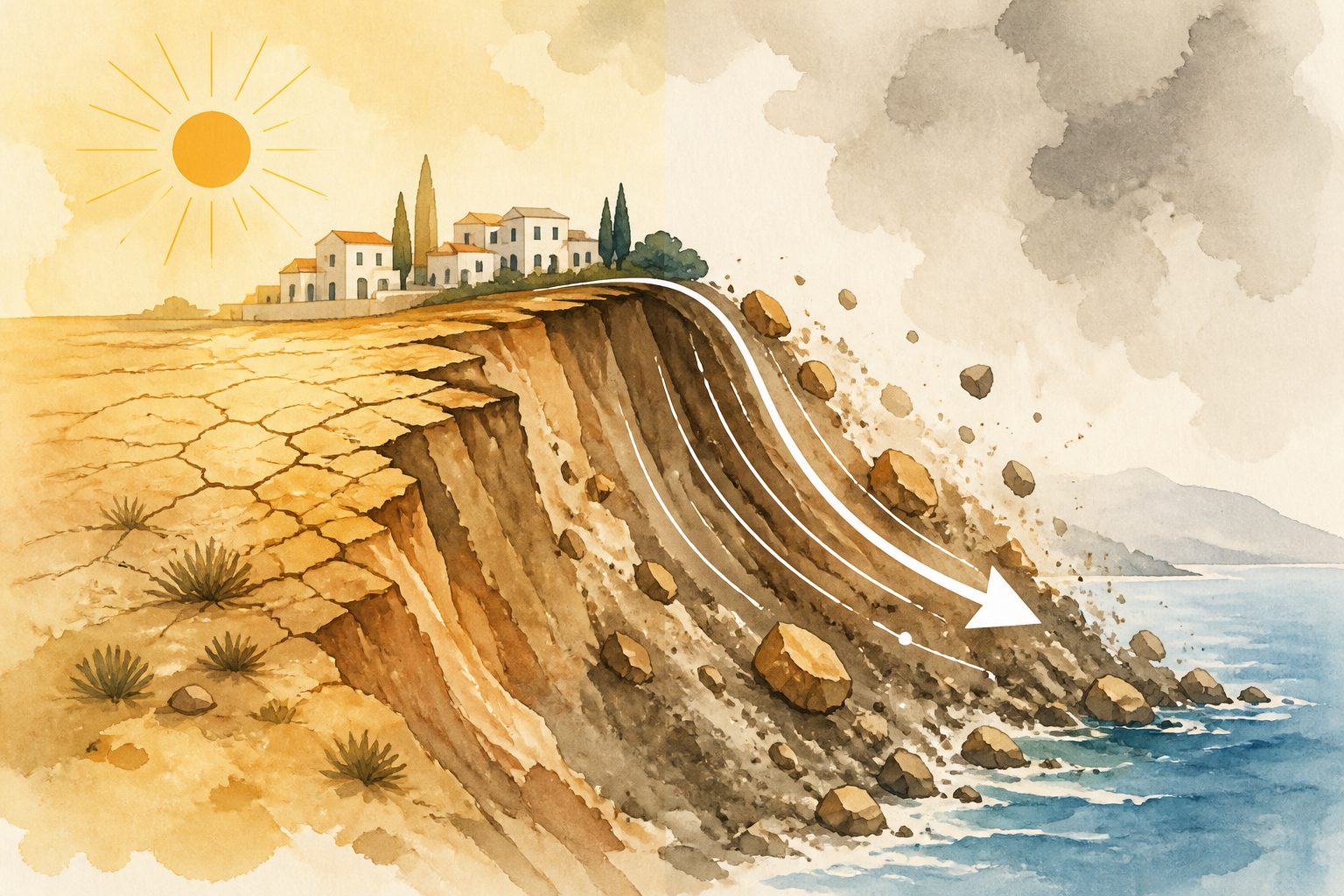
Modeling in southern Italy suggests that intense rain and earlier wet conditions could outweigh a broader drying trend.
A study of the Partenio Mountains in southern Italy projects more rainfall-triggered landslides through 2070, even though soils are generally expected to become drier. The researchers used regional climate projections, corrected against observations from 2006–2023, and simulations of soil water and slope stability across an area of about 170 square kilometers.
The projected increase differed between the two emissions scenarios. Under the higher-emissions scenario, landslides were mainly associated with more intense rain that triggers failures; under the moderate-emissions scenario, they reflected both wetter soil beforehand and intense rainfall arriving early in a storm.
Projected landslide changes
The researchers studied a roughly 170-square-kilometer area in the Partenio Mountains in southern Italy, using regional rainfall projections for 2006–2070 under moderate and high emissions scenarios. They corrected the projections using observations from 2006–2023 and compared them with a synthetic dataset designed to reproduce current rainfall conditions.
The simulations projected generally drier soil conditions but greater variation in rainfall among three subregions. Despite the drying, they found a significant rise in projected landslide occurrence. The increase was faster under the moderate-emissions scenario than under the high-emissions scenario. In the high-emissions scenario, landslides were mainly linked to more intense triggering rain. In the moderate-emissions scenario, they resulted from a combination of wetter soil before the event and intense rainfall arriving early in the storm.