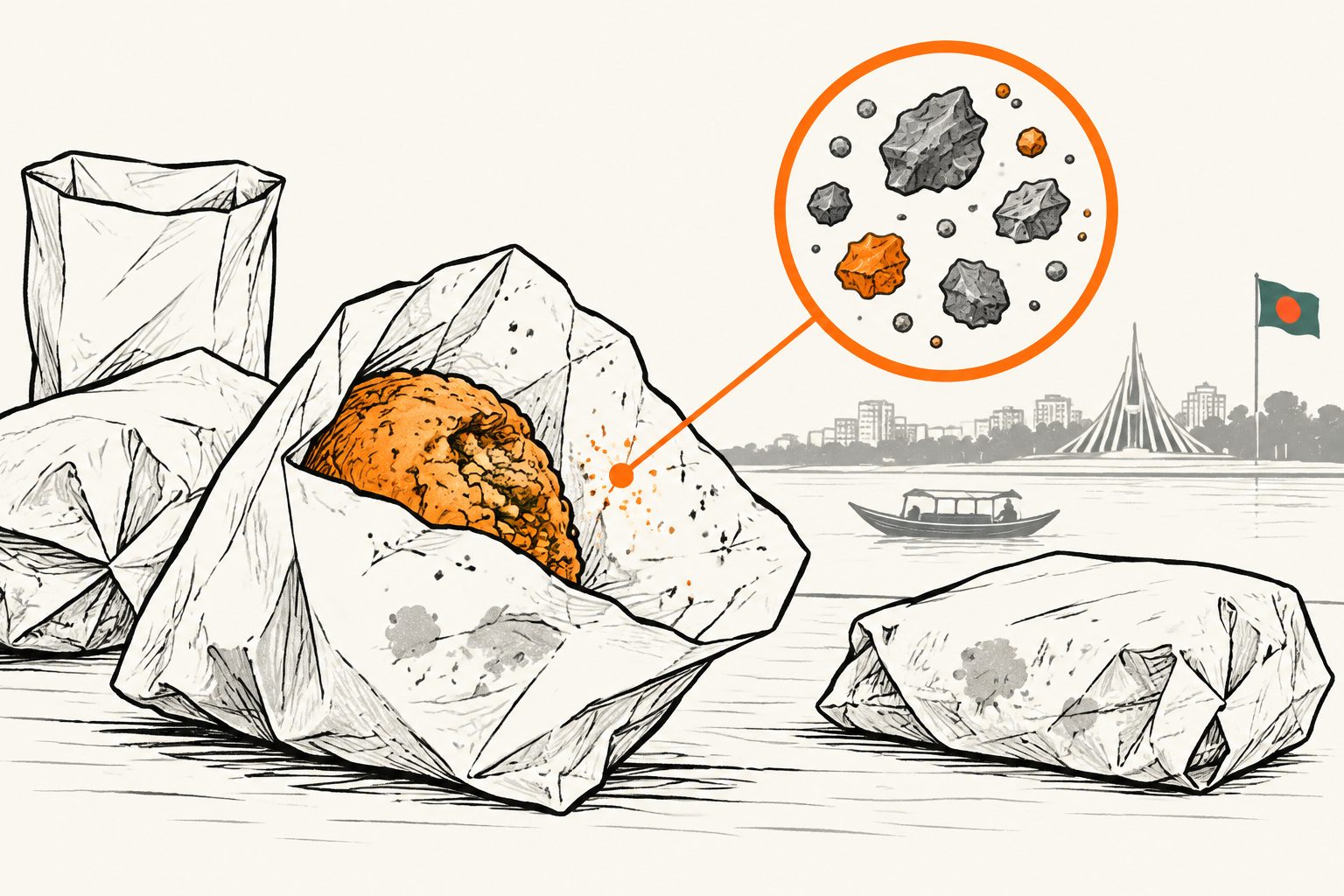
A study of 38 papers used to wrap food found several elements above international safety limits and identified higher estimated risks for children.
The study tested 38 paper samples, including different printed areas of newspapers, magazines and book papers, for seven trace elements. Copper and manganese were the most abundant, while arsenic, lead, cadmium and chromium frequently exceeded international safety limits by factors of 2 to 100.
The researchers linked different papers and printed areas with different element patterns. Their health-risk assessment estimated risks above the safe threshold for children across all paper types, and cancer-risk estimates for four metals exceeded the stated acceptable level. The authors say Bangladesh has no national standards for trace-element content in paper used to contact food.
What the papers contained
The researchers analyzed seven elements—arsenic, lead, cadmium, chromium, nickel, copper and manganese—in 38 paper samples commonly used as food wrappers in Dhaka. Copper reached up to 61.9 parts per million and manganese up to 31.7 parts per million. Arsenic, lead, cadmium and chromium frequently exceeded international safety limits by 2 to 100 times.
The results varied by material and printing. Bold newspaper print showed a pattern associated with arsenic and lead, newspaper photo areas with copper, and magazines with nickel. The estimated Hazard Index, a measure in which values above 1 indicate a potential non-cancer health concern, exceeded 1 for children across all paper types; the value was 3.962 for bold newspaper print and 1.774 for magazines. Estimated cancer risks for arsenic, lead, cadmium and chromium exceeded the stated acceptable level of 1 × 10⁻⁶, with children’s estimates about 2.3 times those for adults.
Why food wrapping matters
The findings point to a potential food-safety concern where printed or recycled paper is used directly to wrap food. They also identify a regulatory gap: according to the study, Bangladesh lacks national standards for trace-element content in food-contact paper.
The researchers recommend measuring whether these elements migrate from paper into food, requiring certification for food-contact materials and educating vendors. They also recommend further research before considering bans on non-food-grade papers for direct food wrapping.
Evidence and open questions
This was a laboratory analysis of 38 paper samples combined with health-risk calculations. It measured the elements in the papers, but did not measure migration—the amount that transfers into food—or the chemical forms, known as species, in which the elements were present.
Because those data were missing, the cancer-risk estimates carry considerable uncertainty. The study therefore indicates potential risks from the tested materials rather than directly measuring people’s exposure or showing that eating food wrapped in them causes illness.
// Source
Food Safety and Risk · 2026 · DOI: 10.1186/s40550-026-00169-7
Authors: Fahmida Alam Bintu, Sabiha Zaman Tithi, Md. Tahsinur Rahman, Pinaki Chowdhury, Badhan Saha, Fakharuddin Ahmed Chowdhury, Md Yasir Arafat, Mohammad Moniruzzaman, Ohidul Alam, Lokman Hossain
Institutions: Kunming University of Science and Technology, Chinese University of Hong Kong, University of Dhaka, Noakhali Science and Technology University, Bangladesh Council of Scientific and Industrial Research