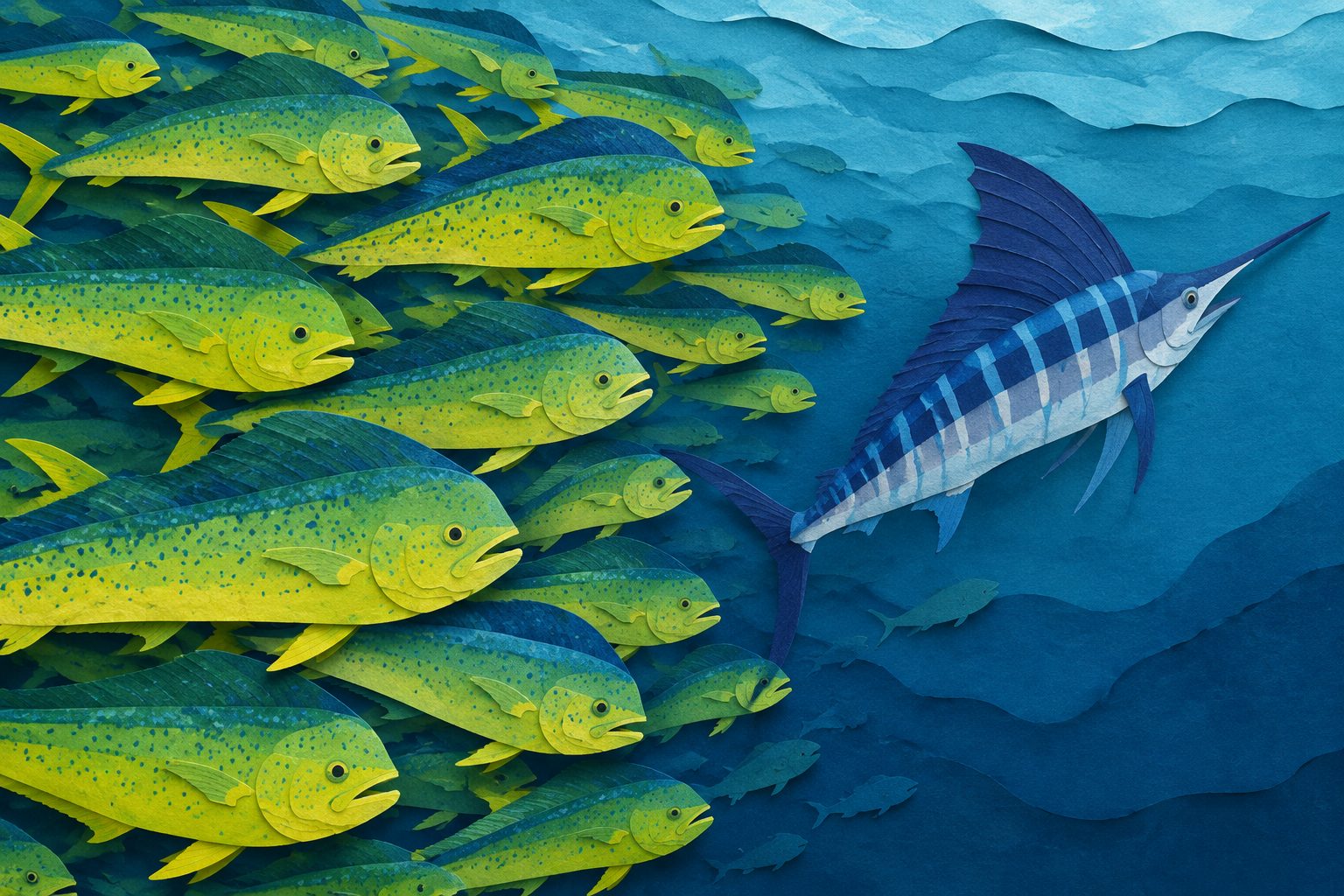
Aerial observations suggest that large groups of the faster, more efficient hunters can disrupt marlin attacks at prey schools.
Researchers used aerial video to study striped marlin and mahi-mahi feeding at prey schools. They estimated the fishes’ abundance, attack and capture rates, and positions in the water as the predators competed for prey.
Mahi-mahi caught prey more efficiently than marlin and occupied the space closest to the prey school. Marlin attack rates did not change when mahi-mahi were present, but their net capture rates increased, apparently because they caught more individual fish separated from the school. When mahi-mahi were more abundant, however, their abundance was negatively related to marlin abundance, and they may have interfered with marlin hunts enough to cause the marlin to leave.
How the predators interacted
Mahi-mahi had higher capture efficiency than striped marlin, and the presence of marlin did not change mahi-mahi predatory behaviour. The presence of mahi-mahi did not change the marlin’s attack rate on the prey school, but it was associated with a higher net capture rate, probably because marlin shifted toward catching individual fish isolated from the school. Smaller numbers of mahi-mahi may benefit marlin, while larger groups may occupy the best hunting space, interfere with marlin attacks and cause the marlin to abandon the hunt. Estimated mahi-mahi abundance also had a negative relationship with marlin abundance.
Evidence and caveats
The study used aerial video to estimate predator abundance, attacks, captures and positions while the fishes fed at prey schools. The reported relationships show how the predators behaved during these feeding events, but the abstract does not establish a controlled cause-and-effect test. The explanation that large mahi-mahi groups caused marlin to abandon hunts is presented as a likely interpretation, and the abstract does not give sample sizes, locations or effect sizes.
// Source
Philosophical Transactions of the Royal Society B Biological Sciences · 2026 · DOI: 10.1098/rstb.2025.0196
Authors: Matthew J. Hansen, Palina Bartashevich, Pia Bideau, Fritz A. Francisco, David James, Max Licht, Félicie Dhellemmes, Alicia Burns, Hector Villalobos-Ortiz, Sofia Ortega‐García, Felipe Galván‐Magaña, Rogelio González‐Armas, Fernando R. Elorriaga-Verplanken, Jens Krause
Institutions: Boston University, Humboldt-Universität zu Berlin, Leibniz Institute of Freshwater Ecology and Inland Fisheries, Max Planck Institute for Human Development, University of Massachusetts Boston, Institut polytechnique de Grenoble