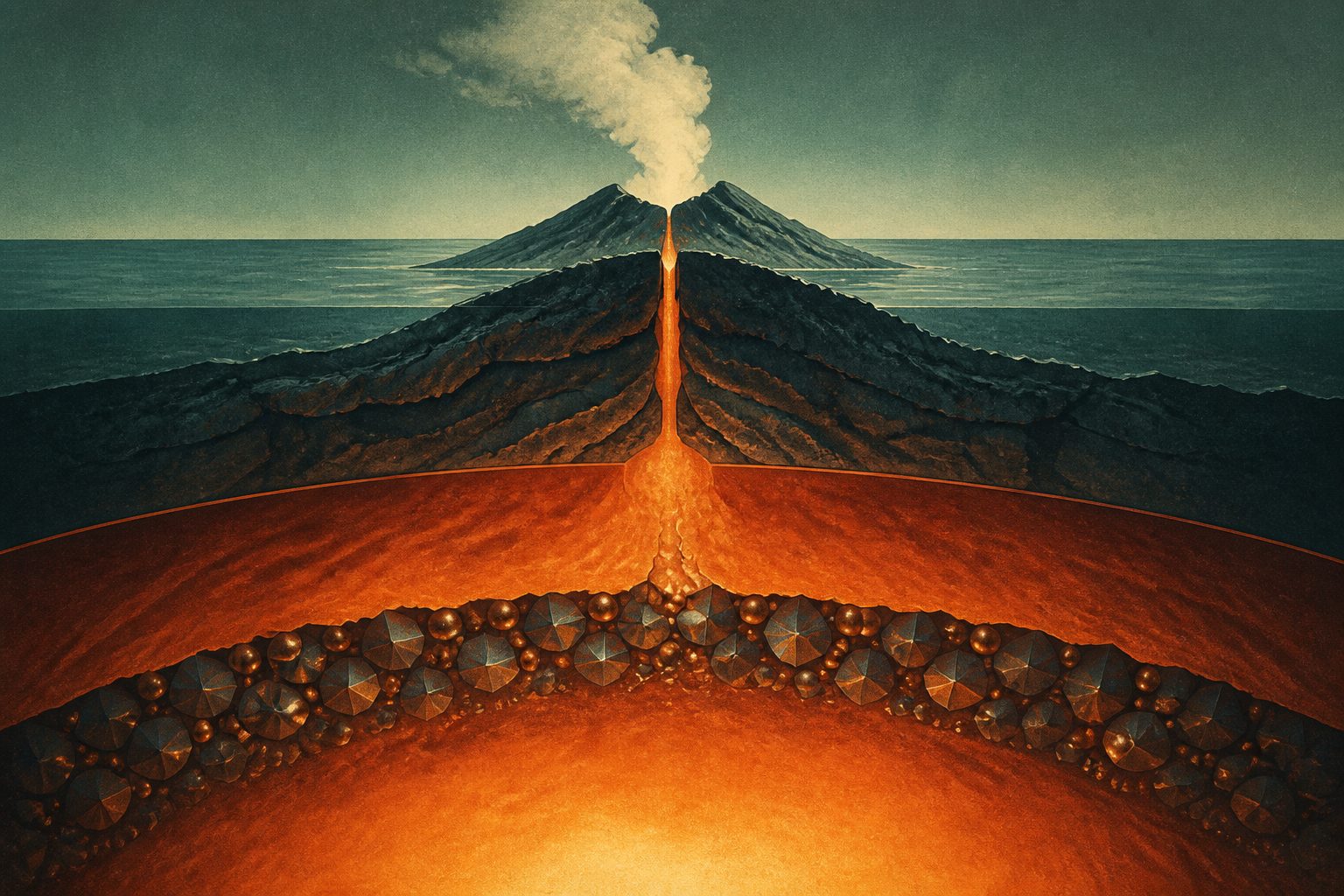
High-pressure measurements, calculations and simulations point to dense deep-Earth material as a possible source of heavy iron in ocean-island basalts.
A study suggests that iron-rich regions at the boundary between Earth’s core and mantle could hold unusually high levels of heavy iron isotopes. These regions, known as ultralow-velocity zones, contain minerals whose iron–oxygen bonds are stronger than those in metallic iron alloys and some major mantle minerals.
Calculations and high-pressure measurements indicate that these zones could become enriched in heavy iron by 0.07 to 0.17 parts per thousand under conditions near the core–mantle boundary. Geodynamic simulations suggest that dense material from the zones can be drawn into rising mantle plumes, potentially linking deep Earth processes with the iron isotope signatures of ocean-island basalts.
Heavy iron in deep zones
The researchers studied two minerals proposed to occur in iron-rich ultralow-velocity zones: ferropericlase and pyrite-type FeO2Hx, where x is 0 to 1. High-pressure nuclear resonant inelastic X-ray scattering and first-principles calculations indicated that these minerals have stiffer iron–oxygen bonds than metallic iron alloys and iron-bearing bridgmanite. That bonding favors the concentration of heavier iron isotopes.
Mass-balance modelling estimated heavy iron isotope enrichments of +0.07 to +0.17‰ at 2,500–3,500 K and 135 GPa. The estimated value depended on the minerals present and on local equilibration. Geodynamic simulations supported the possibility that dense material from ultralow-velocity zones can be entrained in rising mantle plumes.
// Source
Communications Earth & Environment · 2026 · DOI: 10.1038/s43247-026-03888-z
Authors: Chaojia Lv, Wenzhong Wang, Tianyang Wang, Mingming Li, Haotian Chen, Wendy L. Mao, Ho‐kwang Mao, Yongjun Tian, Jin Liu
Institutions: Peking University, Stanford University, Arizona State University, University of Science and Technology of China, Planetary Science Institute, Center for High Pressure Science & Technology Advanced Research, Yanshan University, Center for High Pressure Science and Technology Advanced Research