Researchers used molecular dynamics simulations driven by an artificial-intelligence force field to study how protons move through CsH2PO4 and CsHSO4. The simulations indicate that long-range transport is not caused by proton hopping or group rotation alone: limited rotation of a phosphate or sulfate group works together with substantial reorientation of the O–H bond.
Materials & Energy2 weeks ago
In solid acids, rotating groups help protons make longer jumps
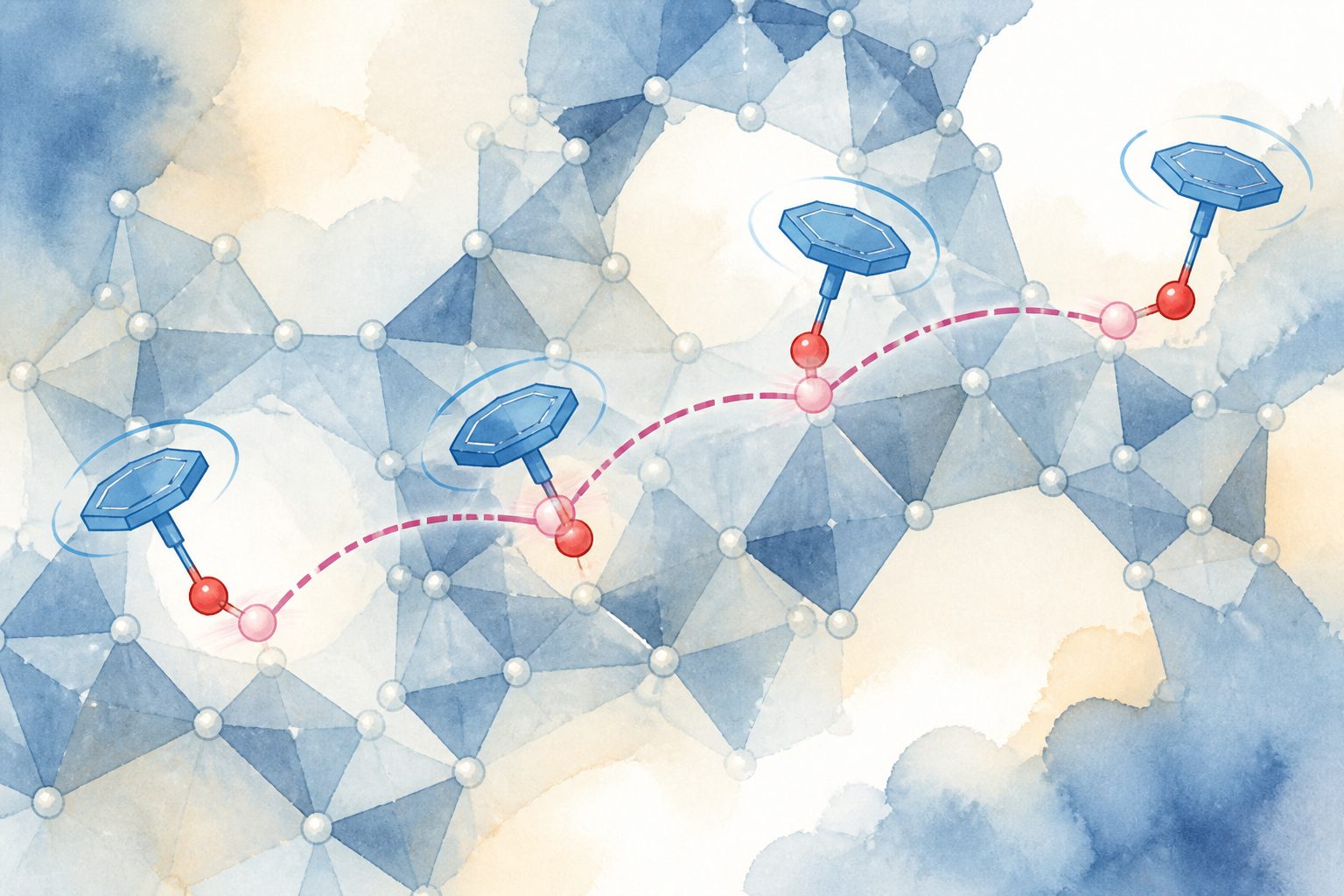
Simulations show that proton transport depends on a small rotation of phosphate or sulfate groups followed by a larger turn of the proton’s bond to oxygen.
How protons make longer jumps
The simulations reveal a sequence in which a rotating negatively charged group first carries a proton, followed by O–H bond reorientation that extends the proton’s displacement. Together, these motions produce long-range proton jumps, refining the usual picture of proton hopping.
The two materials behave differently despite their similar structures. CsH2PO4 shows two rotation rates with different activation energies, while CsHSO4 shows one rate and faster productive motion of its sulfate groups. The higher proton concentration in CsH2PO4 is associated with more frustrated and slower phosphate rotation than sulfate rotation in CsHSO4. In CsH2PO4, the researchers also find a link between oxygen sharing and proton transport, which they associate with the extra proton on each phosphate group.
Why the motion matters
The findings provide a framework for understanding how group rotation, proton coordination and proton hopping combine to produce fast conduction in solid acid electrolytes. They also suggest that adjusting proton concentration could help speed group rotation and increase conductivity, a consideration relevant to designing materials for proton-conducting technologies.
Evidence and limitations
The study is based on nanosecond-scale molecular dynamics simulations using equivariant neural-network force fields, rather than direct measurements of proton motion in the materials. The abstract does not report experimental confirmation, conductivity values or tests of whether changing proton concentration improves a material in practice. The conclusions therefore describe the mechanisms represented by the simulations and may require further experimental validation.
// Source
Journal of the American Chemical Society · 2026 · DOI: 10.1021/jacs.5c21965
Authors: Menghang Wang, Jingxuan Ding, Grace Xiong, Ni Zhan, Cameron J. Owen, Albert Musaelian, Yu Xie, Nicola Molinari, Ryan Prescott Adams, Boris Kozinsky, Sossina Mariam Haile
Institutions: Northwestern University, Harvard University, Northwestern University, Princeton University, Robert Bosch (United States), Robert Bosch (Slovenia)