A nickel–molybdenum oxide catalyst reached high current in alkaline water electrolysis and stayed stable in the reported long-duration test.
The team used oleylamine molecules on nickel molybdate nanowires to partially convert nickel ions into confined metallic nickel domains. This produced coherent, closely spaced nickel–nickel molybdate interfaces while preserving the oxide structure.
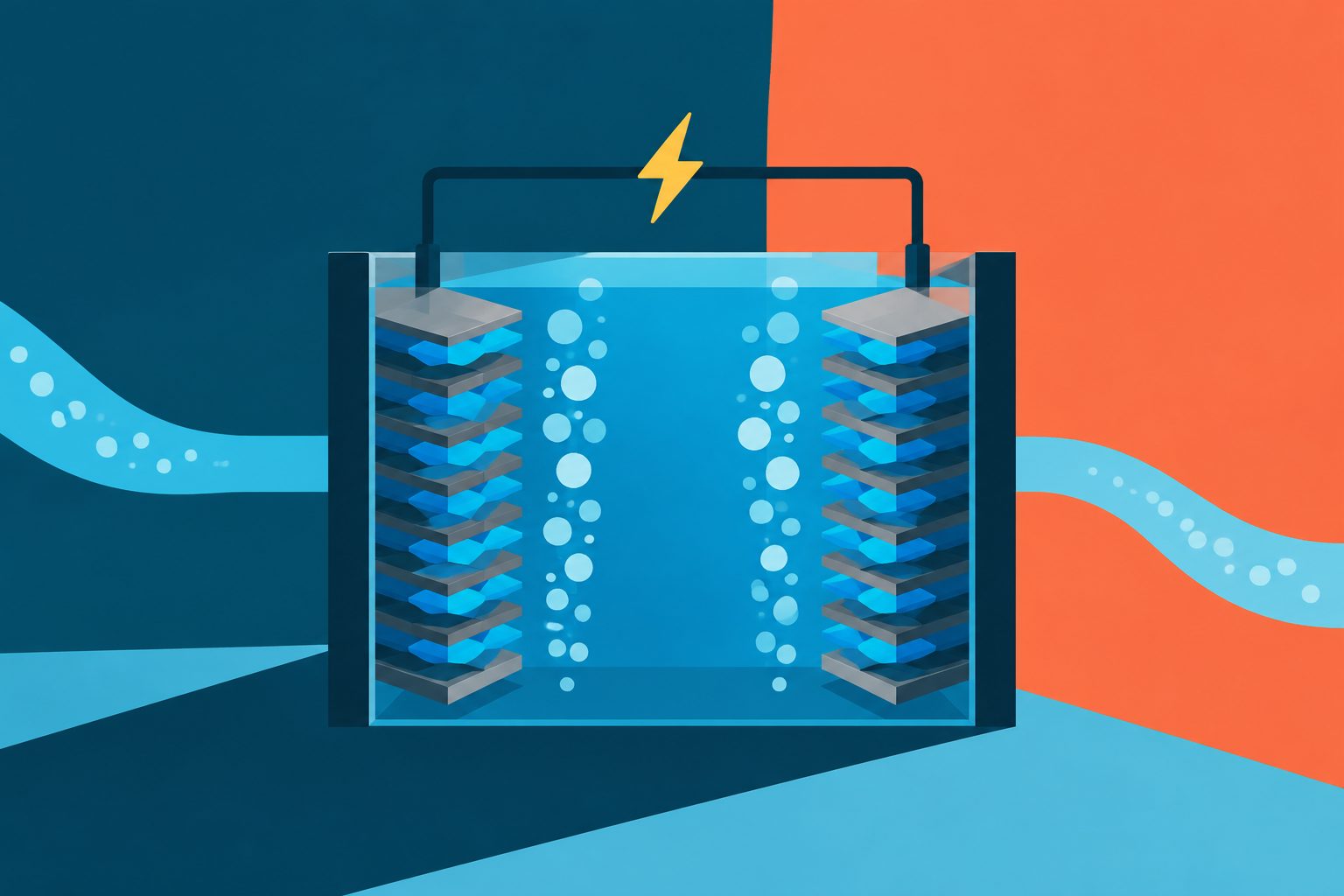
Experiments and calculations indicated that these interfaces changed the local electronic structure and may help bind and activate molecules involved in hydrogen production. In alkaline solution, the catalyst needed 14.4 ± 2.9 millivolts of extra voltage to reach 10 milliamps per square centimetre. In a membrane water electrolyzer, it reached 2 amps per square centimetre at 1.62 volts and 80°C, with stable operation reported for more than 2,200 hours.
What the nickel structure did
Oleylamine acted as a mild reducing agent, selectively turning some nickel ions in nickel molybdate sub-nanowires into metallic nickel. Spatial confinement limited long-range atomic movement, helping create alternating, sub-nanometer nickel and nickel molybdate domains.
The resulting interfaces were associated with changes in nickel’s local electronic structure. Theoretical calculations found that the nickel d-band center shifted by about 0.14 electronvolts toward the Fermi level compared with a conventional nanometer-scale nickel–nickel molybdate structure. The researchers say this change, along with the high density of interfaces, may affect the adsorption and activation of hydrogen-evolution intermediates.
The catalyst required an overpotential of 14.4 ± 2.9 millivolts to reach 10 milliamps per square centimetre in 1 M potassium hydroxide. It delivered 2 amps per square centimetre at 1.62 volts in an anion-exchange membrane water electrolyzer at 80°C. Stable operation lasted more than 2,200 hours under the reported conditions; the abstract identifies the long-duration test as being conducted at 25°C. The catalyst showed higher activity than the platinum-on-carbon and conventional heterostructure benchmarks used in the study.
Why the interfaces matter
The work offers a way to place metal and oxide phases in very close, repeated contact rather than leaving much of the interface isolated or buried. According to the experiments and calculations, this dense arrangement can alter the local electronic environment at the catalyst surface and is associated with strong hydrogen-evolution performance.
The long-duration electrolyzer test also shows that the material was not only tested at low current in alkaline solution. It sustained a high current density for more than 2,200 hours under the researchers’ reported conditions. The approach was also extended to several other transition-metal systems, although the study describes the nickel–nickel molybdate catalyst in greatest detail.
Evidence and caveats
The evidence combines material characterization, electrochemical measurements, electrolyzer testing and density functional theory calculations. The calculations support a proposed explanation for how the sub-nanometer interfaces change electronic structure, while the electrochemical and electrolyzer experiments directly measure catalyst activity and stability.
The explanation that the interfaces facilitate hydrogen-intermediate adsorption and activation is supported by the analyses but is not presented as a direct observation of every reaction step. The performance results come from the specific alkaline-solution and membrane-electrolyzer conditions reported in the study, so they do not by themselves establish how the catalyst would perform under other conditions or in commercial systems. The excerpts also do not provide details on stability beyond the reported test or on the performance of each additional transition-metal system.
// Source
Nature Communications · 2026 · DOI: 10.1038/s41467-026-78575-w
Authors: Yuan Huang, Zhenyu Ren, Yaru Gao, Haoyang Li, Hai Yan Xiao, Qingda Liu, Xun Wang
Institutions: Tsinghua University