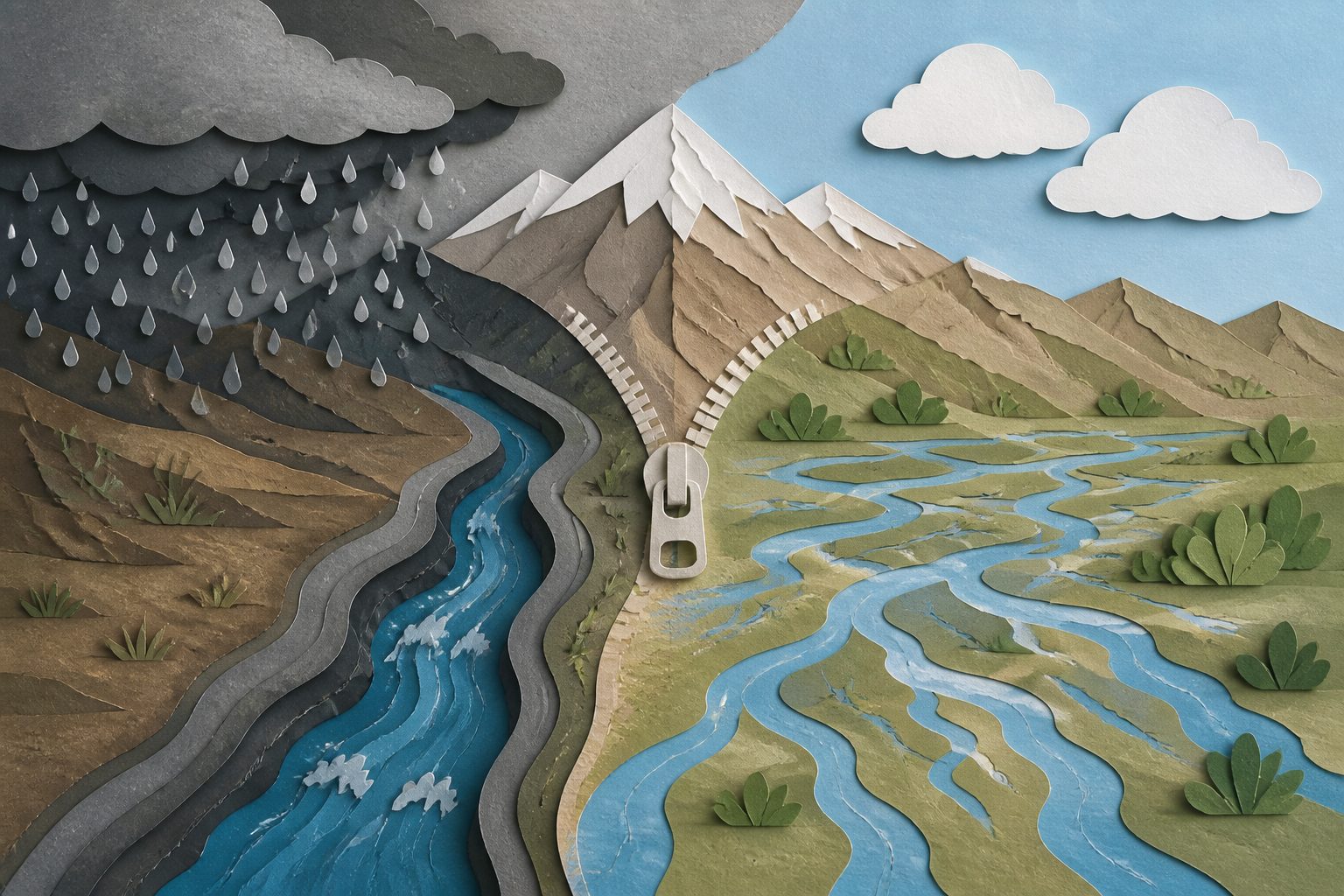
A 53-year analysis suggests snow accumulation and melting can separate the timing of streamflow from rainfall.
Researchers analyzed monthly precipitation and streamflow records from the snow-influenced Khiav Chai watershed between 1970 and 2022. They used trend tests, a change-point test and circular statistics to compare changes in the amount and timing of precipitation and river flow.
The study found that the watershed’s streamflow regime shifted before the detected change in precipitation. Although the average timing of precipitation and streamflow remained relatively close, their seasonal patterns moved in opposite directions: precipitation became less concentrated, while streamflow became more concentrated during parts of the hydrological year.
How rain and river flow changed
Annual precipitation showed an upward trend, with an Innovative Trend Analysis slope of 0.022, while streamflow showed a downward trend, with a slope of -0.00093. The Pettitt test identified a statistically significant change in streamflow in 1984 and one in precipitation in 1995, an 11-year difference.
The average timing of precipitation was 5.09 months, compared with 4.45 months for streamflow. Precipitation seasonality declined (τ = -0.23, p = 0.01), indicating that rainfall became more evenly distributed across the year. Streamflow seasonality increased (τ = 0.34, p < 0.001), meaning a larger share of flow occurred during particular periods. Streamflow also showed stronger seasonal clustering than precipitation, a pattern the researchers associate with snow accumulation and melting.
Evidence and caveats
The study is a statistical analysis of nearly continuous monthly precipitation and streamflow records covering 53 years. The discharge data came from one gauging station, while precipitation was measured at a single station; fewer than 1% of the records had gaps that were filled by linear interpolation.
The circular-statistics approach identifies seasonal patterns but does not determine the separate effects of snowmelt, rainfall intensity, groundwater recharge or land-use change. The analysis also did not model nonlinear rainfall-runoff processes. Because it was conducted at the watershed outlet, it could not assess how elevation, slope or other landscape features affect seasonality across different parts of the watershed. The authors recommend process-based models and monitoring across sub-basins to investigate these mechanisms.