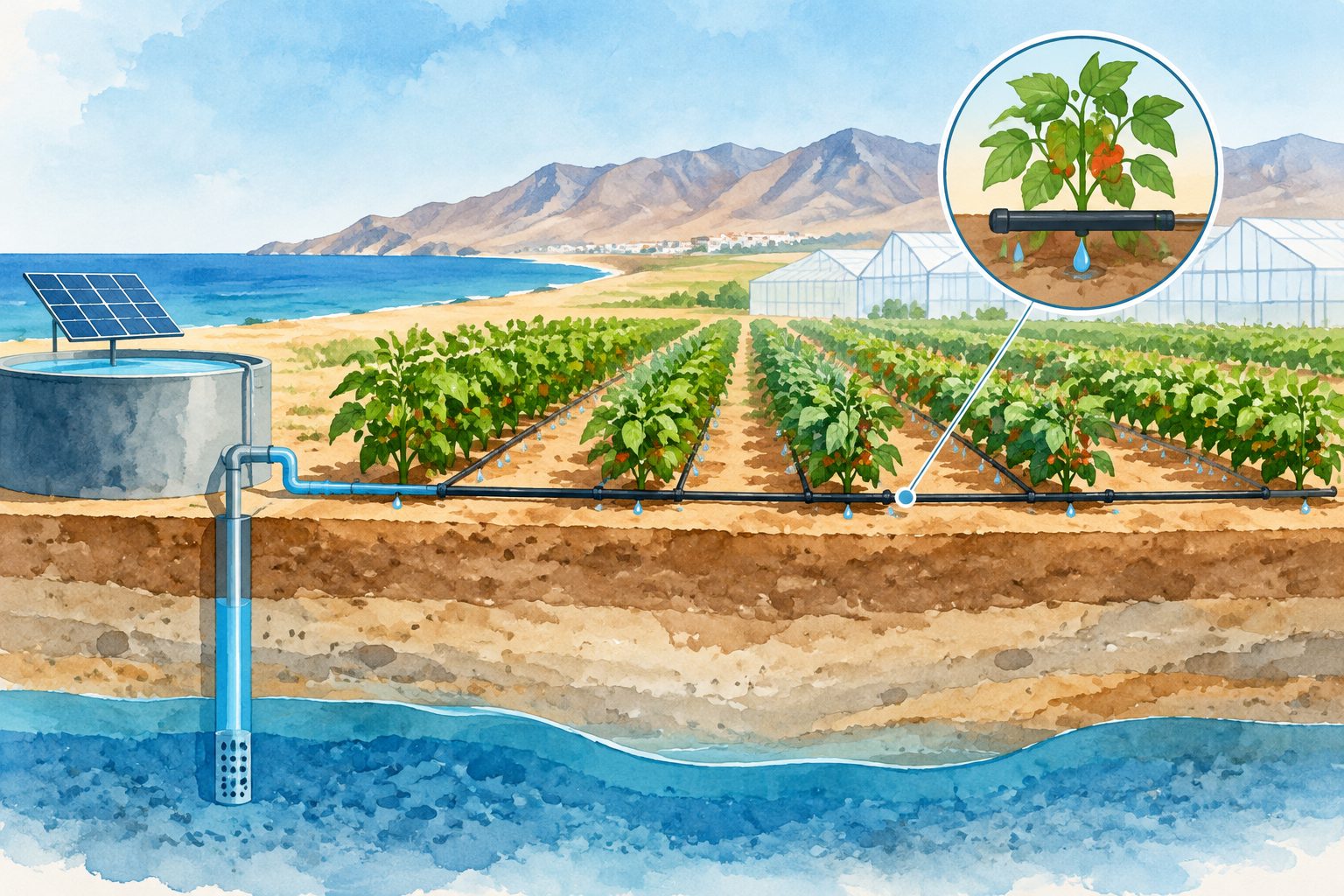
The Campo de Dalías case shows that better irrigation can intensify farming when groundwater withdrawals are not effectively controlled.
Campo de Dalías, in southeastern Spain, became a major greenhouse-farming region after groundwater was discovered in the 1940s. The study traces how pumping led to overuse and degradation of the aquifer, followed by more efficient irrigation practices and the use of desalinated water today.
The researchers examined whether improved efficiency made farming productive enough to absorb the higher cost of desalinated water, and whether adopting those practices earlier could have prevented the loss of groundwater. They conclude that efficiency alone was not enough: without rules keeping withdrawals below natural recharge, it may have delayed depletion rather than avoided it.
Why efficiency was not enough
The case shows why improving water efficiency is not, by itself, a guarantee that pressure on scarce water resources will fall. In Almeria, efficiency helped sustain intensive greenhouse agriculture, while groundwater pumping remained insufficiently controlled. The study points to the need for water policies that combine efficient farming with limits on withdrawals and broader, participatory management of water resources.
// Source
npj Sustainable Agriculture · 2026 · DOI: 10.1038/s44264-026-00196-z
Authors: Wan Izar Haizan Wan Rosely, Nick Voulvoulis
Institutions: Imperial College London