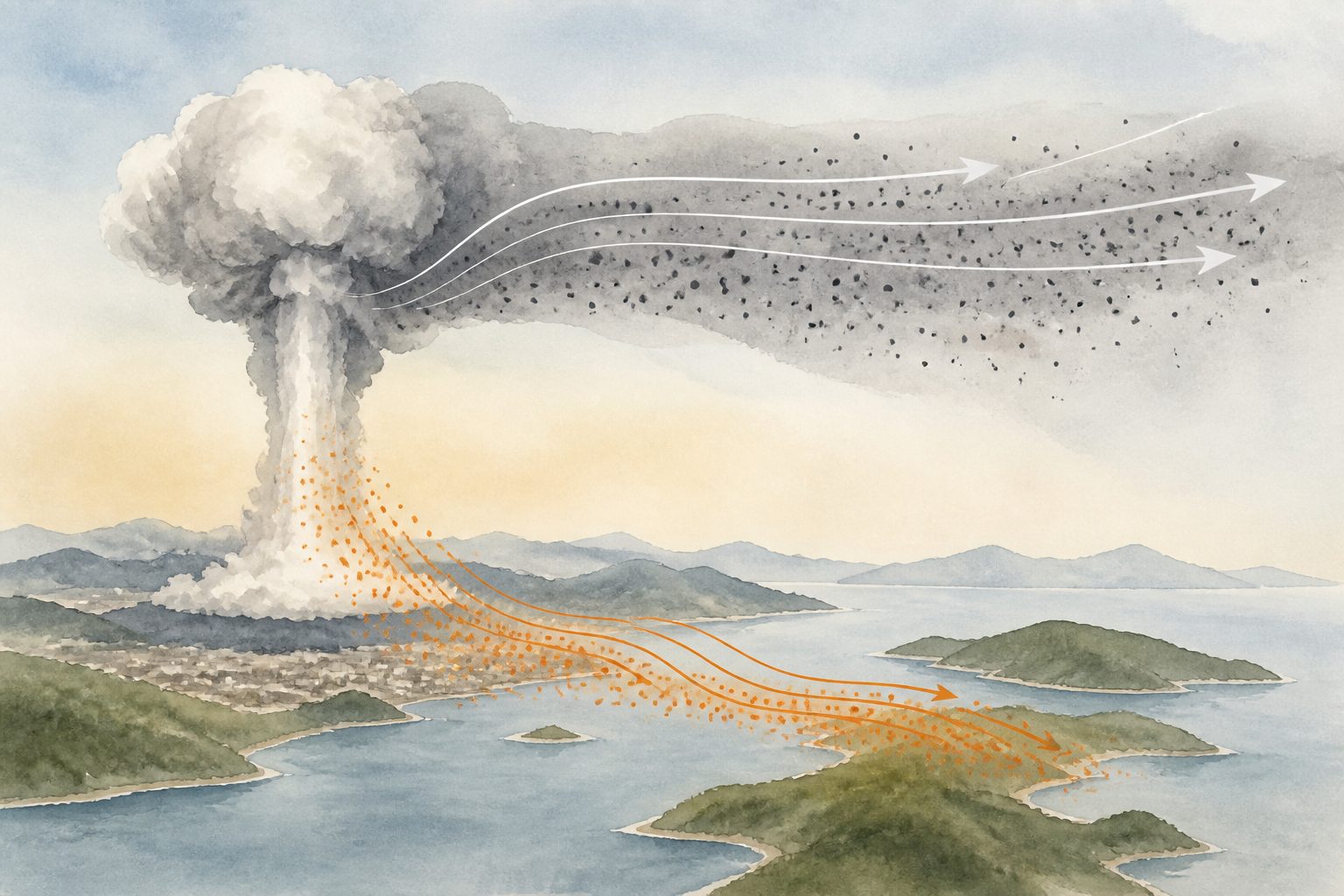
The model found that ground dust rose through the cloud’s center, while bomb-derived radioactive material gathered around its spreading head.
Researchers modeled the blast wave, fireball and later mushroom-cloud rise in three stages. They tracked ground-derived dust and bomb-derived radioactive material separately as they moved through the simulated airflow.
The simulation reproduced the hot fireball’s upward rise, the cloud head’s horizontal spread and a rotating ring structure. The two materials followed different routes: dust was drawn mainly into the central updraft, while radioactive material was preferentially carried into the ring around the cloud head. The results are intended to provide starting conditions for later simulations of radioactive “black rain.”
How the materials moved
The calculations showed that the reflected shock wave deformed the fireball and created a strong upward flow along the cloud’s central axis. As the mushroom cloud rose, its hot core continued upward, its head spread sideways and a vortex ring developed around the head.
Ground-derived dust—used in the model to represent non-radioactive smoke and dust from fires and disturbed surfaces—was entrained mainly through the central updraft. Bomb-derived radioactive material, assumed to represent plutonium released from the bomb, was preferentially incorporated into the vortex-ring region around the cloud head.
The study also found that the simulated cloud rise depended on numerical resolution and the background atmospheric profile. Coarse grids blurred the interaction between the reflected shock and fireball and underestimated the later cloud-top height. A dry adiabatic atmosphere agreed better with historical nuclear-test data than the International Standard Atmosphere used in another comparison.
// Source
Progress in Earth and Planetary Science · 2026 · DOI: 10.1186/s40645-026-00841-8
Authors: Kenta Nakajima, Akiko Matsuo
Institutions: Keio University