Structural and mutational evidence shows how a cyanobacterial protein system may have been adapted to move proteins into chloroplasts.
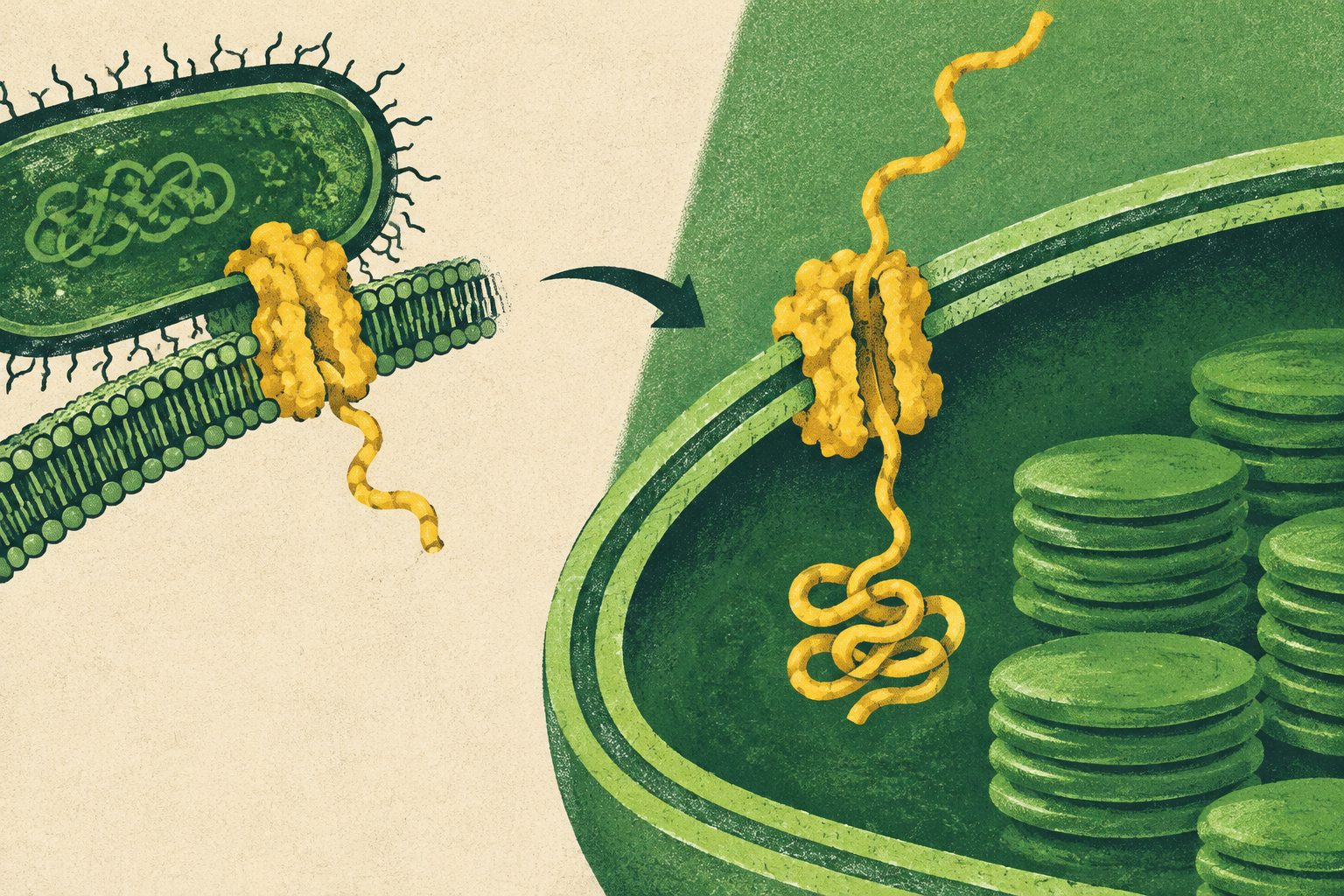
Researchers used cryo-electron microscopy and mutational analysis to study a cyanobacterial Omp85 protein, which helps assemble proteins in the bacterial outer membrane. They found a barrel-shaped structure with a lid and three supporting domains involved in assembling other membrane proteins.
The structure resembled the assembly intermediate formed by Omp85 and its substrate. Experiments showed that the membrane-spanning part of Toc90, a chloroplast protein, can act as an Omp85 substrate in bacteria. The researchers propose that Toc75 evolved a positively charged region that locks Toc90 in place, turning the former export-system arrangement into a stable channel for chloroplast protein import.
How the channel formed
The cyanobacterial Omp85 protein forms a lidded barrel made of 16 beta strands and has three POTRA domains, which help assemble outer-membrane proteins. Structural comparisons showed that the Toc75–Toc90M complex resembles an Omp85–substrate assembly intermediate. Toc90M, the membrane-spanning part of Toc90, could serve as a substrate for bacterial Omp85. Unlike typical Omp85 systems, which release their substrates after assembly, Toc75 has a basic patch in its barrel that anchors Toc90M as a stable lateral pore. The researchers conclude that this arrangement could provide the route through which precursor proteins enter chloroplasts.
Evidence and limits
The study combines cryo-electron microscopy, structural comparisons and mutational analysis, along with an experiment showing that Toc90M can serve as a bacterial Omp85 substrate. Together, these results support a model for how the import channel evolved and functions. The abstract does not provide the full experimental details, such as the number of structures or the scope of testing in living chloroplasts, so the findings should be understood primarily as structural and mechanistic evidence for this evolutionary model.
// Source
Nature Communications · 2026 · DOI: 10.1038/s41467-026-78967-y
Authors: Yu-Sian Wu, Yih-Lin Chen, Yuan‐Chih Chang, Chiung‐Chih Chu, Chia-Yun Chang, Koichiro Awai, Hsou‐min Li
Institutions: Institute of Biological Chemistry, Academia Sinica, Shizuoka University, Academia Sinica, Institute of Molecular Biology, Academia Sinica