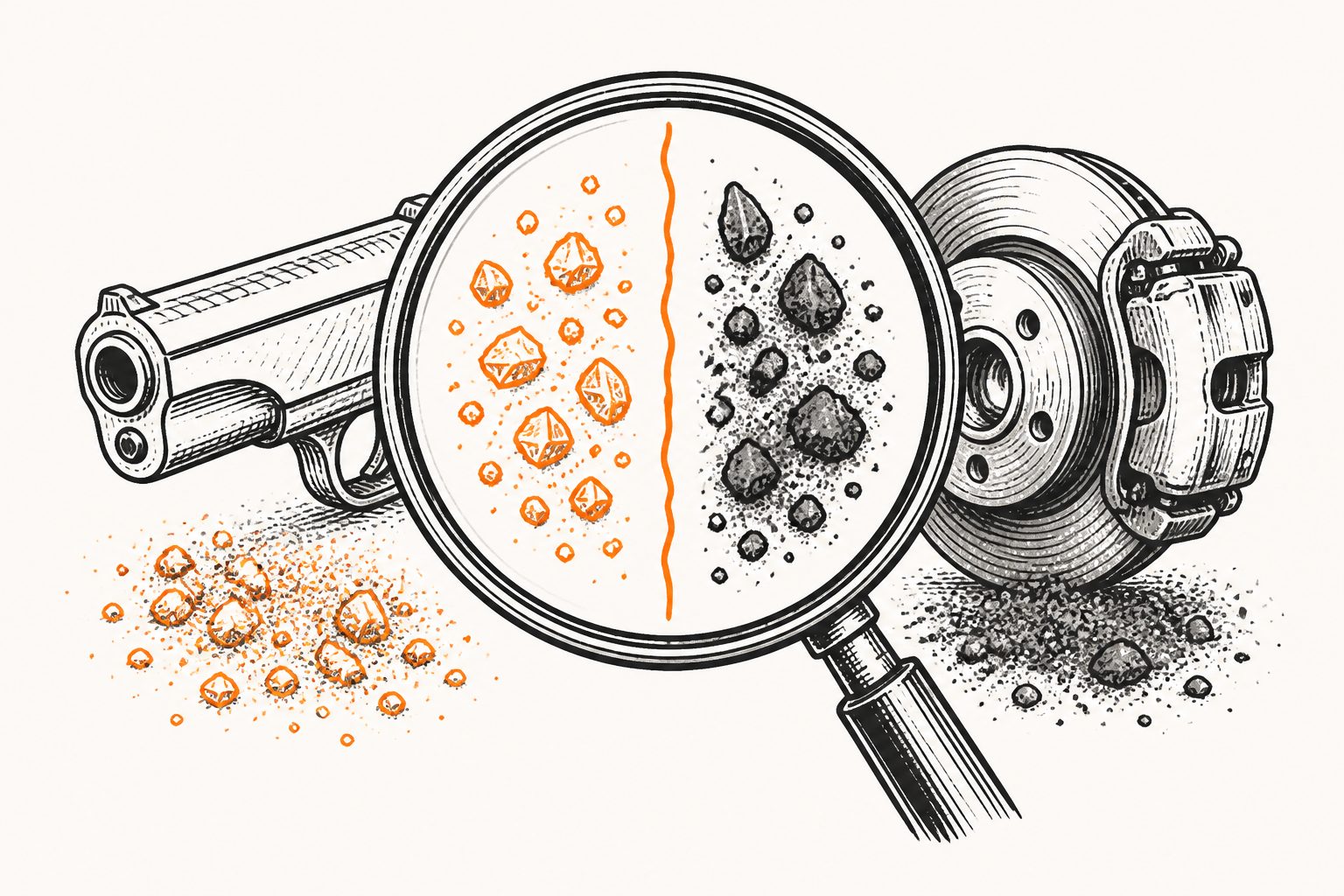
A preliminary study found that Raman spectroscopy could help distinguish particles from shooting from similar dust produced by brake work.
Researchers compared particles collected from 10 people after shooting and from 10 mechanics after work involving disc brakes. They analyzed the samples with Raman spectroscopy, as well as scanning electron microscopy and elemental analysis, to examine their chemical and physical features.
The Raman measurements showed consistent differences between the groups. A spectral band shifted to lower frequencies in brake-pad dust and to higher frequencies in gunshot-residue samples, while an intensity ratio was lower for all gunshot-residue samples than for the brake-pad samples.
Different particle fingerprints
Raman spectra distinguished the gunshot-residue samples from brake-pad dust in both qualitative and quantitative ways. The center frequency of the G-band was lower in brake-pad dust and higher in gunshot residue. Researchers also calculated the intensity ratio between bands near 1,350 and 1,585 cm−1; this ratio was lower for every gunshot-residue sample than for the brake-pad samples.
The study analyzed 20 samples: 10 collected from people after they each fired three shots, and 10 collected from mechanics after work on brake pads or while changing a wheel. The researchers also used scanning electron microscopy to examine particle shape and energy-dispersive X-ray analysis to measure elemental composition. They reported that elemental compositions can overlap between brake dust and gunshot residue, so morphology and chemical structure are important for distinguishing them.
A second check for residue
Particles from brake work can resemble gunshot residue in standard elemental analysis, creating a risk of false-positive interpretations. Raman spectroscopy is non-destructive, so using it alongside established microscopy and elemental analysis could provide additional information while preserving samples for further testing.
The researchers present Raman spectroscopy as a complementary or preliminary screening method, not a replacement for the established approach. Its potential value is in helping investigators distinguish gunshot residue from similar particles produced by an occupational or environmental source.
Evidence and caveats
This was a preliminary study based on 20 samples: 10 from shooters using three pistol types and one stated primer type, and 10 from mechanics at different workshops. The results support a distinction between the sampled gunshot residue and brake-pad dust, but they do not establish how well the method would perform with a broader range of ammunition, firearms, industrial sources or operating conditions.
The researchers say future work should test more samples and conditions and assess the method with advanced statistical analysis. The study does not propose replacing scanning electron microscopy with elemental analysis; instead, it supports investigating Raman spectroscopy as a non-destructive complement.
// Source
WSEAS TRANSACTIONS ON ENVIRONMENT AND DEVELOPMENT · 2026 · DOI: 10.37394/232015.2026.22.82
Authors: Acri Giuseppe, Romeo Marco, Marino Matteo, Ruello Elisa, Hartwig Valentina, Rosanna Abbruzzo, Scoglio Alberto, Testagrossa Barbara
Institutions: Czech Academy of Sciences, Institute of Physiology, University of Catania, Istituto Nazionale di Fisica Nucleare, Galileo Galilei Institute for Theoretical Physics, University of Messina, Istituto di Fisiologia Clinica, Istituto delle Scienze Neurologiche di Bologna