In a 75-day greenhouse trial, the combined treatment increased cucumber yield by 18% compared with untreated plants.
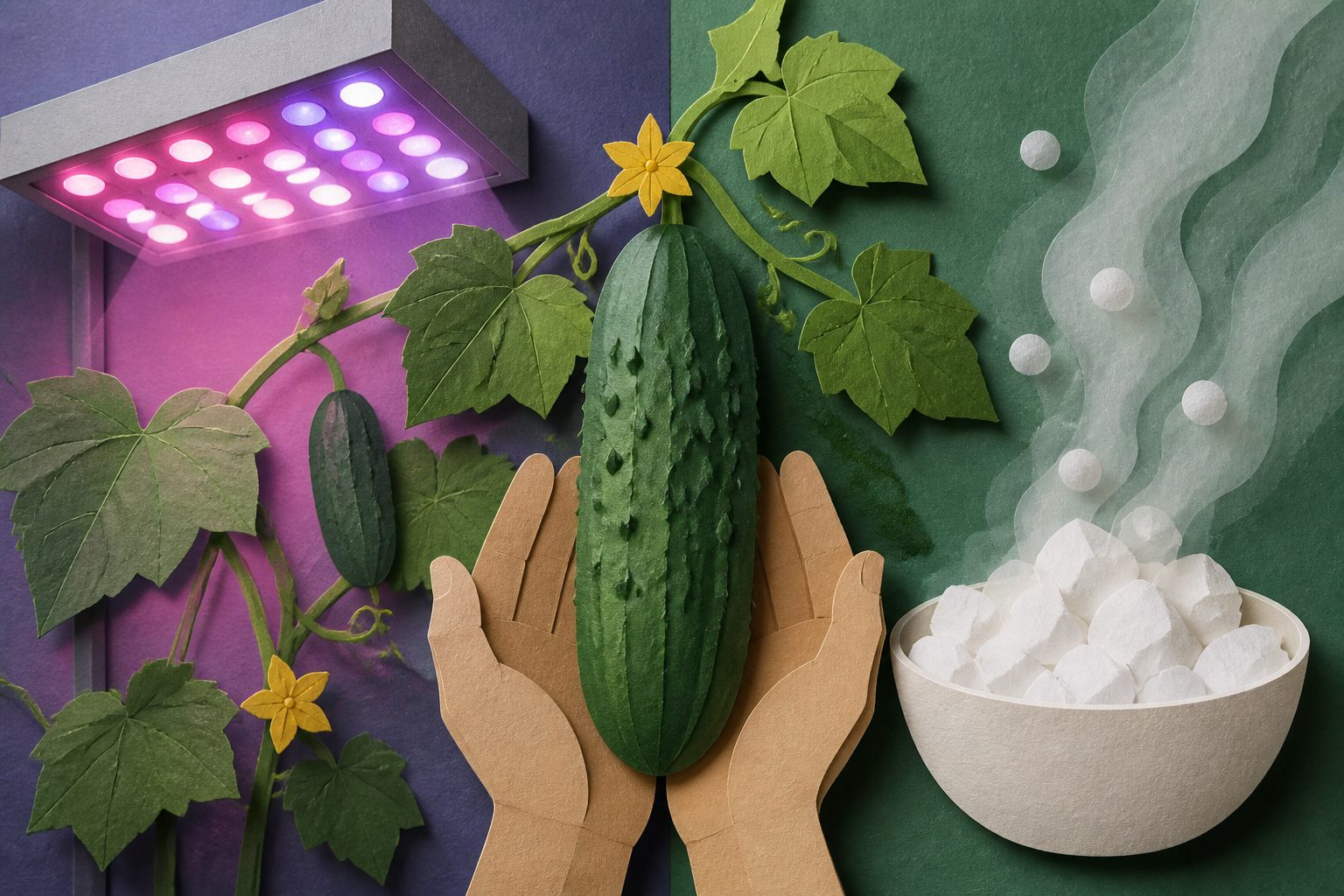
Researchers tested the combined treatment in a plastic greenhouse in Korea over 75 days. LEDs were used for four hours after sunrise, while solid carbon dioxide generators raised carbon dioxide levels compared with the control area.
The treated cucumbers grew taller, developed more leaves and nodes, and had higher SPAD readings, a measure related to leaf greenness. They also produced more female flowers and fruit with greater width and fresh and dry weight. The combined treatment increased yield by 18% and generated an additional 4,796,415 Korean won per 10 a, with the income ratio 21% higher than in the control.
What the treatment changed
The combined supplemental lighting and solid carbon dioxide treatment increased plant height, leaf and node numbers, and SPAD values compared with the control. It also produced more female flowers, wider fruit, and greater fresh and dry fruit weights.
The solid carbon dioxide generators raised carbon dioxide concentrations by an average of 217 ± 67 micromoles per mole compared with the control. Yield was 18% higher with the combined treatment, and the economic analysis found an additional net income of 4,796,415 Korean won per 10 a, with the income ratio increasing by 21%.
Why the result matters
Winter greenhouse cucumbers face low available light and low carbon dioxide concentrations. The results indicate that addressing both conditions at the same time can improve fruit characteristics and yield while increasing calculated farm income, including after the added treatment costs.
The study also points to solid carbon dioxide generators as a lower-cost alternative to conventional liquid carbon dioxide systems, according to the researchers’ conclusion.
Evidence and limits
This was a 75-day experiment in one tunnel-shaped plastic greenhouse in Changnyeong, Korea. The greenhouse had a control section and a section receiving both treatments; growth and fruit-quality measurements used 10 biological replicates per treatment.
Because lighting and carbon dioxide were applied together, the study could not determine how much each treatment contributed independently or whether they interacted. The researchers say factorial studies across multiple commercial greenhouses are needed to confirm the results under broader production conditions.
// Source
Horticultural Science and Technology · 2026 · DOI: 10.7235/hort.20260025
Authors: Jeong Kil Koo, Yu Jin, Eun Won Park, So Yeong Hwang, Ji Hye Yun, Hyeong Eun Choi, Seung Jae Hwang
Institutions: Gyeongsang National University